

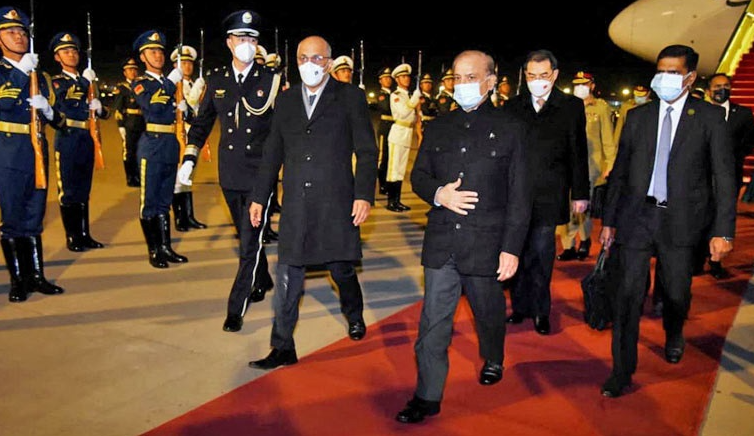
As Prime Minister Shehbaz Sharif arrived in Beijing for high-level meetings with Xi Jinping and Premier Li Qiang, the visit carried significance far beyond routine diplomacy. Officially framed around trade, investment, industrial cooperation, and the next phase of the China-Pakistan Economic Corridor, the four-day engagement reflects a much broader geopolitical reality taking shape across Asia.
The symbolism of the visit is difficult to ignore. Pakistan and China are marking 75 years of diplomatic relations at a moment when the global order is undergoing visible fragmentation. Beijing is simultaneously managing strategic tensions with Washington, deepening coordination with Moscow, navigating instability in West Asia, and consolidating influence across Eurasia through economic corridors, industrial supply chains, and technological partnerships. Within that landscape, Pakistan is increasingly positioning itself not merely as a recipient of Chinese investment, but as an integrated partner in China’s wider regional architecture.
The first leg of Shehbaz Sharif’s visit in Hangzhou demonstrated how the relationship is evolving beyond roads, ports, and energy projects. The Pakistan-China Business-to-Business Investment Conference focused heavily on battery storage systems, solar technologies, IT, artificial intelligence, charging infrastructure, pharmaceuticals, and industrial cooperation. Agreements and memorandums exceeding $7 billion were announced, while separate deals worth $1.22 billion were signed between companies from both countries.
The sectors highlighted during the conference reveal Beijing’s changing priorities. Earlier phases of CPEC were largely infrastructure-driven, built around highways, power plants, and logistics corridors. CPEC Phase II is increasingly centered on industrial integration, technology transfer, renewable energy, agriculture modernisation, and digital connectivity. Pakistan’s leadership is attempting to present the country as a production and manufacturing destination at a time when rising labour costs inside China are pushing Chinese industries to search for external manufacturing bases.
Shehbaz Sharif repeatedly emphasized four sectors during his engagements with Chinese companies and officials: agriculture, information technology, special economic zones, and mines and minerals. His argument was straightforward. Pakistan possesses land, labour, untapped mineral reserves, and geographic connectivity, while China brings industrial capacity, capital, technology, and market access.
Agriculture emerged as one of the most strategic pillars of the discussions. Pakistan’s leadership argued that despite China importing roughly $100 billion worth of agricultural products annually, Pakistan’s share remains marginal. Islamabad now wants to reposition itself as a long-term agricultural supplier to the Chinese market through mechanisation, high-yield seeds, advanced farming practices, and agro-industrial value chains. The goal announced during the conference was ambitious: increasing agricultural exports to China by nearly $10 billion within the next five to seven years.
Special Economic Zones were another major focus. The Pakistani delegation highlighted Karachi’s 6,000-acre export zone and offered Chinese investors long-term leases and investment incentives. The message directed toward Chinese manufacturers was deliberate. As industrial wages rise inside China, Pakistan wants to attract labour-intensive manufacturing industries relocating abroad. Textile production, leather processing, light engineering, and electronics assembly are all being positioned as future pillars of bilateral industrial cooperation.
The visit also revealed how deeply Chinese corporate actors are now embedded in Pakistan’s economic planning. Meetings with executives from CATL, StarCharge, and pharmaceutical firms focused heavily on energy storage systems, electric vehicle infrastructure, renewable energy, and healthcare manufacturing. Meanwhile, discussions at Alibaba Group expanded into export integration, fintech, AI, digital commerce, healthcare, and human capital development.
Alibaba chairman Joe Tsai reportedly outlined plans to integrate Pakistani exporters and small businesses into wider Chinese digital commerce ecosystems. This matters strategically because the future of influence is no longer built solely through military alliances or traditional infrastructure projects. It increasingly revolves around who controls digital platforms, payment systems, logistics chains, data ecosystems, and industrial standards.
Equally important was Shehbaz Sharif’s repeated rejection of dependency politics. During the conference, he openly stated that Pakistan sought “expertise, experience, investments — not loans, not aid, not handouts.” That line was likely directed as much toward domestic audiences as international ones. Pakistan’s leadership understands the criticism surrounding debt vulnerabilities and wants to recast CPEC as a platform for industrialisation rather than merely infrastructure borrowing.
At the political level, the simultaneous meetings held by Deputy Prime Minister Ishaq Dar and Planning Minister Ahsan Iqbal with Chinese Communist Party officials reinforced another reality: China increasingly values political continuity and institutional relationships inside Pakistan. The Pakistan-China Political Parties Forum and the CPEC Joint Consultation Mechanism were designed not only to deepen state-to-state relations but also to embed long-term political coordination across party structures.
The timing of the visit also intersects with wider regional instability. Pakistani officials confirmed that the ongoing US-Iran conflict and regional de-escalation efforts would feature prominently during discussions in Beijing. Pakistan and China have recently coordinated diplomatic positions on West Asia, including consultations linked to ceasefire mechanisms and regional stability efforts.
For India, the visit will be watched with considerable attention. New Delhi has long viewed CPEC as strategically problematic because parts of the corridor pass through territory India claims in Kashmir. Beyond that dispute, however, India is now observing the gradual transformation of Pakistan-China ties from a traditional security partnership into a deeper techno-industrial alignment.
Indian strategists will likely focus on several aspects of the visit. First is the growing integration of Chinese industrial ecosystems with Pakistani infrastructure and logistics networks. Second is the expansion of cooperation into AI, renewable energy, battery technologies, fintech, and digital commerce. Third is the possibility that Pakistan could increasingly emerge as a western extension of China’s broader Eurasian manufacturing and connectivity ambitions.
At the same time, India itself remains deeply engaged with the United States, Europe, Japan, and the Quad framework. This creates an increasingly visible strategic divergence in Asia. While India is moving deeper into Western-aligned technological and security architectures, Pakistan is consolidating its place within China-centered economic and geopolitical networks. The result is not merely bilateral rivalry. It is the gradual emergence of parallel strategic ecosystems across Asia.
That divergence will shape future competition across ports, trade routes, industrial supply chains, semiconductor networks, digital infrastructure, and energy corridors. It also explains why Beijing continues investing political capital in stabilising Pakistan internally and regionally. China does not simply view Pakistan as a neighbouring partner anymore. It increasingly sees Pakistan as a critical node in its wider western strategic architecture linking Xinjiang to the Arabian Sea, the Middle East, Africa, and beyond.
For Beijing, a stable and economically functional Pakistan serves multiple objectives simultaneously. It secures western access routes, protects Belt and Road investments, creates manufacturing spillover opportunities, stabilises regional security environments, and counters competing influence networks supported by the United States and India.
Whether Pakistan can fully capitalise on these opportunities remains uncertain. Security concerns, governance challenges, political instability, debt management, and institutional weaknesses continue to raise questions about long-term execution capacity. Announcing billions in agreements is easier than translating them into functioning industries, export growth, technological upgrading, and sustainable employment.
Yet the direction is unmistakable. This visit demonstrates that the Pakistan-China partnership is entering a far more sophisticated phase. It is no longer limited to highways, defence ties, or diplomatic rhetoric. It is steadily evolving into a multidimensional economic, technological, and strategic alignment designed to endure within an increasingly fractured global order.
For India, the challenge is not merely military or geopolitical. It is structural. While New Delhi pursues its own rise through Western partnerships and Indo-Pacific frameworks, Beijing is quietly building parallel economic and political architectures around its closest regional partners. Pakistan’s expanding integration into that ecosystem signals that the next phase of Asian competition may be shaped less by borders alone and more by who controls the industrial, technological, and logistical arteries of the emerging Eurasian order.