

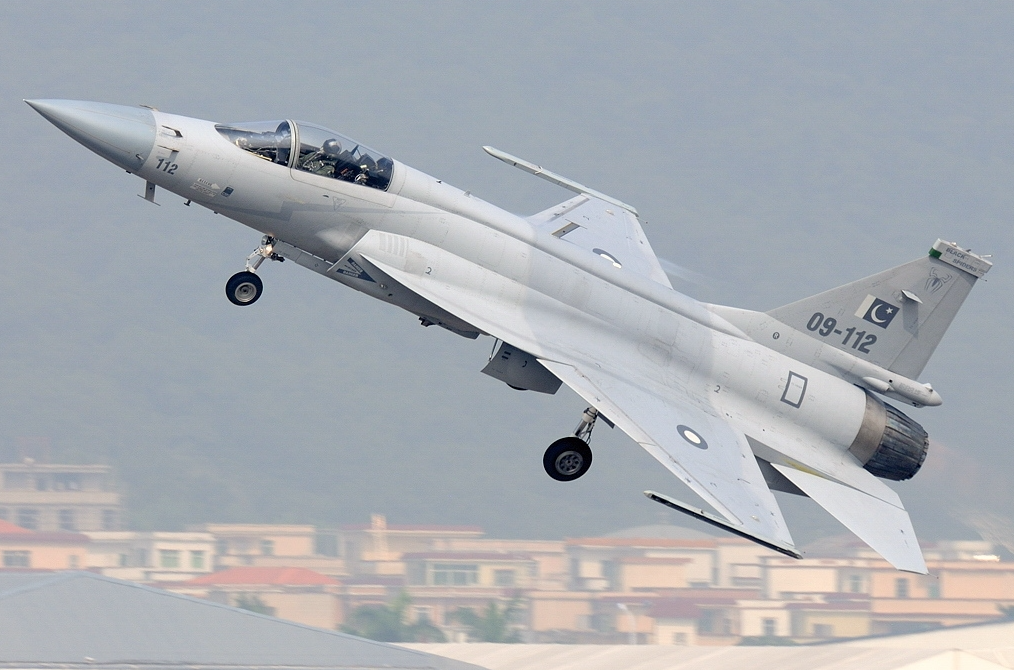
Bangladesh’s possible acquisition of the JF-17 Thunder Block III fighter jet from the China-Pakistan defence partnership could introduce a new layer of strategic tension in South Asia, particularly along India’s sensitive eastern frontier. Reports that Pakistan has already transferred a fully operational simulator of the aircraft to Bangladesh strongly suggest that Dhaka is seriously considering the platform as part of its future air force modernisation plans. The JF-17, jointly developed by Pakistan Aeronautical Complex and China’s Chengdu Aircraft Corporation, represents a major leap from Bangladesh’s ageing fleet of Russian-made MiG-29s and older Chinese-origin F-7 fighter jets. Equipped with modern avionics, beyond-visual-range missile capability, and multi-role combat functions, the aircraft would significantly improve Bangladesh’s deterrence and operational flexibility.
The development comes at a politically delicate moment in India-Bangladesh relations. Ties between New Delhi and Dhaka have remained strained since the fall of Sheikh Hasina’s government in 2024 and India’s refusal to extradite the former prime minister after she sought refuge across the border. Although Bangladesh and Pakistan were once bitter adversaries following the 1971 war that created Bangladesh, relations between Dhaka and Islamabad have gradually improved under the new political leadership in Bangladesh. Defence cooperation between the two countries now appears to be moving beyond symbolic engagement toward practical military coordination, and the reported simulator transfer is likely the clearest sign yet of this shift.
For India, the strategic concern extends beyond the aircraft itself. The larger issue is the geopolitical alignment surrounding the platform. The JF-17 is not merely a fighter jet but a visible symbol of growing China-Pakistan defence cooperation entering India’s eastern security environment. This becomes especially sensitive near the Siliguri Corridor, often referred to as the “Chicken’s Neck”, the narrow strip of land connecting mainland India to its northeastern states. India has already reinforced the region through the deployment of S-400 air defence systems, Rafale fighter squadrons, and new military garrisons designed to strengthen surveillance and rapid-response capabilities. Any enhancement in Bangladesh’s air combat capability naturally reduces India’s strategic comfort margin around this vulnerable corridor.
At the same time, the potential acquisition should not automatically be interpreted as preparation for direct military confrontation. Bangladesh’s air force modernisation is part of a broader effort to replace obsolete systems and maintain regional deterrence credibility. Even with the JF-17 Block III, Bangladesh would remain far behind India in terms of overall air power, force projection, and operational depth. However, modern fighter aircraft can still complicate military planning during crises, increase uncertainty during border tensions, and create new operational calculations for neighbouring states. The greater danger lies not in deliberate war, but in the gradual accumulation of mistrust, military signalling, aggressive rhetoric, and reactive deployments that can increase the risk of miscalculation during periods of political instability.
Despite these tensions, the long-term trajectory of India-Bangladesh relations may still stabilise if both sides choose strategic pragmatism over confrontation. Bangladesh appears increasingly interested in balancing relations with India, China, and Pakistan simultaneously rather than remaining dependent on any single regional power. India, meanwhile, understands the importance of maintaining stable ties with Dhaka for connectivity, trade, and security in the northeast. The challenge for both countries will be managing rising strategic suspicion without allowing defence developments to dominate the entire relationship. In an increasingly multipolar South Asia, military procurement decisions are no longer viewed as isolated defence matters. They are interpreted through the wider lens of shifting alliances, regional influence, and long-term geopolitical positioning.