

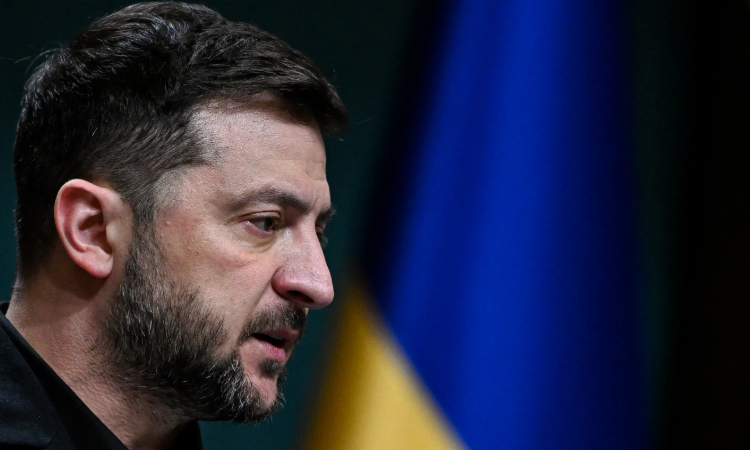
Volodymyr Zelensky’s latest demand for full European Union membership is not simply about economics, visas, trade access, or symbolic European identity. It is fundamentally about power, legitimacy, and survival in a rapidly transforming European order. By publicly rejecting Friedrich Merz’s proposal for a special “associate membership” arrangement, Zelensky has once again forced Europe to confront a difficult strategic question it has tried to postpone since the beginning of the war. Is Ukraine truly part of Europe’s future political architecture, or merely a geopolitical buffer zone being sustained until the conflict stabilises?
The timing of Zelensky’s intervention is deliberate. Ukraine has recently regained political momentum after a series of battlefield and diplomatic developments that strengthened Kyiv’s negotiating position with Western capitals. Simultaneously, the political landscape inside Europe itself has shifted. The electoral defeat of Viktor Orbán removed one of the strongest institutional obstacles to Ukraine’s accession path. Hungary had repeatedly slowed sanctions, military coordination, and accession discussions. With Budapest temporarily less obstructive, Kyiv sees a narrow strategic window to push for irreversible integration before European fatigue deepens again.
Zelensky’s rejection of “half membership” reveals a deeper fear inside Kyiv. Europe may ultimately seek a permanent grey-zone arrangement for Ukraine. Under Merz’s proposal, Ukraine would participate in European institutions, attend summits, appoint commissioners, and gain symbolic representation, but remain excluded from actual decision-making authority. From Berlin’s perspective, this was a pragmatic compromise designed to accelerate integration while bypassing political paralysis inside the bloc. For Ukraine, however, such an arrangement risks institutionalising second-class status indefinitely.
His message to Brussels was carefully constructed. “We are defending Europe fully, not partially,” Zelensky wrote. The argument is straightforward. If Ukrainian soldiers are dying for what Europe calls the defence of democratic order, then Ukraine cannot be permanently treated as an external security protector without equal political rights. In Kyiv’s strategic narrative, partial membership without voting rights transforms Ukraine into a military frontier for Europe rather than an equal European state.
Yet Europe’s hesitation is not irrational. Full Ukrainian accession would fundamentally reshape the European Union economically, politically, institutionally, and strategically. Ukraine is geographically massive, agriculturally powerful, heavily militarised by necessity, and financially dependent on Western assistance after years of war. Integrating such a state into the EU would alter subsidy structures, labour markets, agricultural competition, migration patterns, defence priorities, and voting balances inside European institutions.
This is why Berlin’s proposal emerged in the first place. Germany increasingly recognises that Ukraine cannot remain permanently outside Europe’s institutional framework, particularly while Russia continues challenging the post Cold War security order. But European capitals also understand that immediate full membership carries enormous risks. Associate membership was designed as a geopolitical bridge. Enough integration to lock Ukraine into Europe strategically, without immediately forcing the EU to absorb the full economic and political consequences of enlargement.
Merz’s simultaneous proposal to extend Article 42.7 style security guarantees to Ukraine further reveals Europe’s evolving mindset. The European Union is slowly drifting from being primarily an economic union toward becoming a geopolitical security actor. The war has accelerated this transformation dramatically. Defence spending has risen across Europe, industrial military production is expanding, and discussions once considered politically impossible are now becoming mainstream. Ukraine sits at the centre of this transition.
However, the credibility problem remains unresolved. NATO’s Article 5 works largely because it is backed by overwhelming American military power. The EU’s mutual defence clause lacks comparable military capability and command structures. Zelensky understands this perfectly. Kyiv’s long-term security calculations still ultimately revolve around hard military guarantees rather than political declarations alone. This explains why Ukraine continues pushing simultaneously for EU accession, deeper NATO integration, and bilateral military agreements with major Western powers.
The broader geopolitical environment also complicates the debate. Donald Trump’s return to the White House has unsettled many European capitals. Questions surrounding long-term American commitments to European security are no longer hypothetical discussions inside policy circles. Trump’s increasingly transactional rhetoric on alliances, defence costs, and global burden-sharing has accelerated European strategic anxiety. In this environment, some European leaders now see Ukrainian integration not merely as solidarity with Kyiv, but as part of a larger effort to build a more autonomous European geopolitical structure capable of surviving fluctuations in Washington.
This partially explains the renewed discussion surrounding the E3 format involving Britain, France, and Germany. Zelensky appears increasingly interested in working through flexible power centres rather than relying exclusively on slow-moving EU consensus mechanisms. London, despite Brexit, remains one of Ukraine’s strongest military backers. Paris seeks greater European strategic autonomy. Berlin, under Merz, appears more willing to take geopolitical risks than previous German leadership. Kyiv sees potential in consolidating these relationships into a parallel European security core.
Ironically, Britain’s own internal debate about returning closer to Europe adds another layer of political symbolism to this moment. Keir Starmer’s call to place Britain back at the “heart” of Europe, combined with growing voices inside Labour openly discussing eventual EU re-entry, reflects how the Ukraine war has quietly reshaped European political psychology. Brexit once symbolised fragmentation. Today, security instability is pushing parts of Europe back toward strategic consolidation.
Still, the central contradiction remains unresolved. Europe wants Ukraine close enough to defend the continent, but many European governments remain uncertain whether they are prepared to fully absorb Ukraine politically and economically. Kyiv understands that delayed accession risks creating permanent limbo. Brussels fears accelerated accession could destabilise internal European balances.
The danger for Europe is that prolonged ambiguity may eventually satisfy nobody. A permanently semi-integrated Ukraine could become frustrated with conditional promises, while European societies grow exhausted by open-ended commitments. Russia, meanwhile, would continue exploiting uncertainty wherever possible.
Zelensky’s demand therefore forces Europe into a historic decision it has tried to avoid since 2022. Either Ukraine is genuinely part of the future European project, with full political equality and long-term integration, or Europe must admit that its vision for Ukraine remains fundamentally strategic rather than fully civilisational. The era where Brussels could indefinitely balance between symbolism and commitment is gradually ending.