

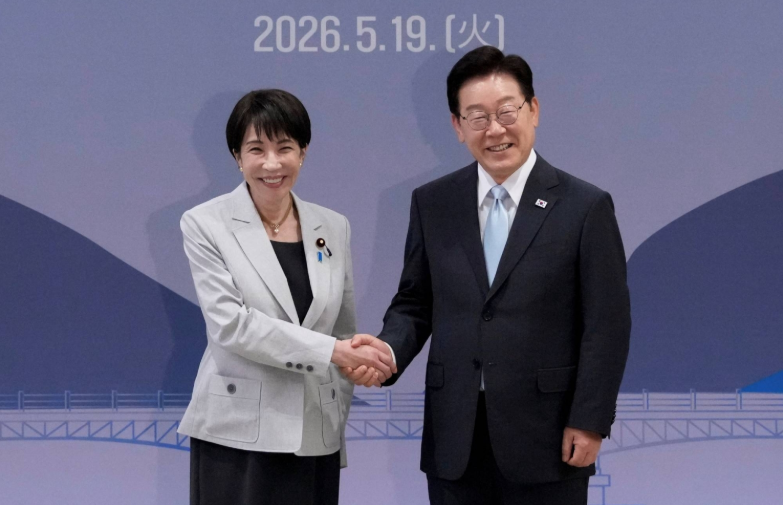
As war in West Asia continues to disrupt global energy flows and uncertainty surrounding the Strait of Hormuz shakes Asian economies, a quiet but strategically significant transformation is taking place in Northeast Asia. Sanae Takaichi and Lee Jae Myung are no longer treating Japan-South Korea cooperation merely as a diplomatic repair project rooted in historical reconciliation. It is now evolving into something far more consequential: a regional survival framework shaped by energy insecurity, supply chain vulnerability and doubts about the long-term reliability of the global order itself.
Their latest summit in Andong, the hometown of the South Korean president, may eventually be remembered as one of the most important strategic meetings in East Asia since the beginning of the Hormuz crisis. Publicly, the two leaders framed their agreement around crude oil supplies, LNG cooperation, stockpiling mechanisms and energy resilience. But beneath the technical language lies a larger geopolitical reality. Asia’s industrial powers are beginning to realise that the age of guaranteed global energy stability may be ending.
The timing of the summit was not accidental. The effective closure and disruption of the Strait of Hormuz during the US-Israel confrontation with Iran exposed one of Asia’s greatest structural weaknesses: extreme dependence on imported energy moving through narrow maritime chokepoints. Nearly 93 percent of Japan’s crude oil imports pass through Hormuz, while South Korea remains among the most energy-vulnerable industrial economies in the world.
For decades, both Tokyo and Seoul relied heavily on the assumption that the United States Navy would permanently secure global maritime trade routes. That assumption is now quietly being reassessed across Asia.
What makes the Japan-South Korea initiative important is that it goes beyond emergency energy coordination. It signals the emergence of a new Asian doctrine centred around strategic resilience. The proposed crude oil swaps, LNG coordination, shared petroleum reserves and the Japan-led POWERR Asia framework represent early attempts to create regional shock absorbers against future geopolitical disruptions.
Japan’s approach has become especially proactive under Takaichi. Tokyo now increasingly sees energy security as inseparable from national security, economic resilience and geopolitical autonomy. The launch of POWERR Asia and the expansion of the Asia Zero Emission Community into AZEC 2.0 reflect Japan’s broader ambition to position itself as the architect of a new Indo-Pacific energy order capable of surviving prolonged disruptions in maritime trade.
South Korea’s calculations are slightly different but equally urgent. The Hormuz crisis exposed severe weaknesses in Seoul’s energy self-development capacity compared with Japan and China. Recent Korean assessments showed Japan’s overseas energy acquisition and strategic reserve system significantly outperforming Seoul’s preparedness. This partly explains why President Lee moved quickly to deepen coordination with Tokyo despite the deep political sensitivities that still surround the bilateral relationship.
The symbolism of the summit also mattered. The leaders intentionally emphasised “shuttle diplomacy” and “future-oriented relations” while holding meetings in each other’s hometowns. This was carefully designed political theatre aimed at normalising strategic trust between two countries historically divided by colonial memory, wartime trauma and nationalist politics.
For years, historical disputes repeatedly derailed cooperation between Japan and South Korea. Issues surrounding wartime labour, territorial disputes and historical interpretation frequently paralysed diplomatic progress. Yet the geopolitical environment is now forcing both countries into a new level of realism.
The convergence is being accelerated by three simultaneous pressures.
First, the growing instability in global energy markets.
Second, the rise of China and uncertainty surrounding future regional balances of power.
Third, growing concern about the transactional nature of American strategic commitments under Donald Trump.
Trump’s remarks following his China visit sent shockwaves through strategic circles across Asia. His public questioning of whether the United States should “travel 9,500 miles” to defend Taiwan raised broader doubts about Washington’s willingness to absorb long-term military costs for its allies. His description of Taiwan arms packages as a “negotiating chip” with Beijing only deepened those anxieties.
For Tokyo and Seoul, the implications are profound. Both remain heavily dependent on the American security umbrella, yet both increasingly understand that they may need stronger regional coordination to hedge against unpredictability in Washington itself.
That is why the summit also focused heavily on security cooperation, deterrence capabilities and maintaining trilateral coordination with the United States. While neither Japan nor South Korea seeks strategic separation from Washington, both are quietly building greater regional resilience in case American priorities shift.
China’s shadow looms over all of this even when Beijing is not directly mentioned. Takaichi avoided explicitly naming China during the summit, but references to “regional stability,” “supply chain resilience” and Indo-Pacific deterrence were clearly aimed at the broader strategic environment shaped by Chinese expansion and maritime competition.
At the same time, President Lee carefully balanced the conversation by stressing the importance of maintaining dialogue among South Korea, Japan and China. This balancing act reflects Seoul’s complicated geopolitical position. South Korea seeks deeper cooperation with Japan and the United States while avoiding complete strategic confrontation with Beijing, its largest trading partner.
North Korea remains another underlying factor driving cooperation. The continued advancement of Pyongyang’s missile and nuclear programmes has reinforced the logic of tighter trilateral security coordination among Seoul, Tokyo and Washington. Yet unlike previous periods where North Korea dominated regional diplomacy, energy vulnerability is now becoming equally central to East Asian strategic thinking.
The wider regional implications are enormous.
If Japan and South Korea successfully institutionalise joint energy reserves, coordinated LNG mechanisms and broader Indo-Pacific supply chain frameworks, other Asian countries may eventually align around similar models. Southeast Asian economies suffering from the Hormuz disruption are already searching for regional resilience strategies as fuel shortages and price shocks ripple through manufacturing networks.
This could gradually produce a new architecture of Asian minilateralism built not purely around military alliances, but around energy security, logistics, maritime protection and industrial resilience.
In many ways, this is the real lesson of the Hormuz crisis. The modern global economy is far more fragile than political leaders previously admitted. A single maritime chokepoint can disrupt industries ranging from semiconductors and petrochemicals to medical manufacturing and aviation fuel.
Japan and South Korea appear to understand this earlier than most.
Their latest summit was not simply about oil reserves or LNG swaps. It was about adapting to a world where globalisation no longer guarantees stability, American power no longer automatically guarantees predictability and economic survival increasingly depends on regional resilience.
The future of Asia may not be decided only by aircraft carriers, missiles or military alliances. It may also be decided by who controls energy storage, supply chain redundancy, maritime logistics and strategic coordination during prolonged global crises.
Tokyo and Seoul have now started preparing for that reality.