

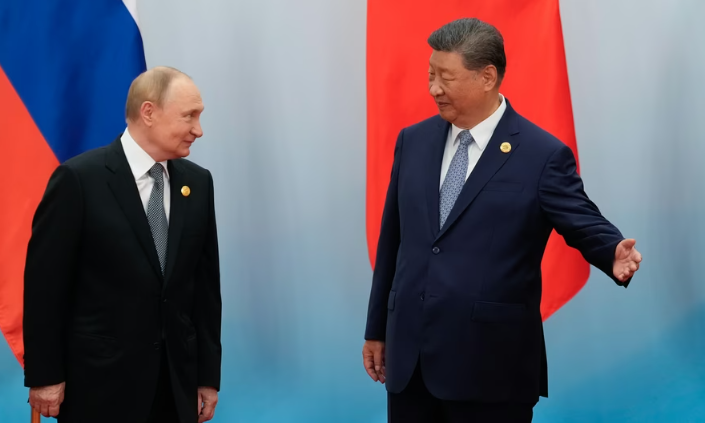
Just days after Donald Trump concluded his carefully watched visit to Beijing, Russian President Vladimir Putin is now heading to China for what appears to be a far more strategic and substantive summit. The timing is impossible to ignore. Within the span of a single week, Xi Jinping will have hosted the leaders of both the United States and Russia, positioning Beijing at the centre of nearly every major geopolitical crisis shaping the current international order.
While Trump’s visit was filled with symbolism, ceremony and carefully choreographed diplomacy, Putin’s trip is expected to focus on strategic alignment, energy security, regional instability and the long-term restructuring of Eurasian power politics.
The Kremlin confirmed that Putin will visit China from May 19 to 20 at Xi Jinping’s invitation. Both sides stated that the summit would focus on strengthening the “comprehensive strategic partnership” between Moscow and Beijing while addressing major international and regional issues. A joint declaration is expected at the end of the talks, alongside multiple agreements on trade, infrastructure, supply chains and energy cooperation.
This will not be another ceremonial handshake summit.
The meeting comes at a moment when the global system is undergoing simultaneous shocks. The Ukraine war continues without a political settlement. The US-Israel war involving Iran has destabilised global energy markets. The Strait of Hormuz remains partially disrupted. Oil prices continue fluctuating under geopolitical pressure. NATO and Russia remain locked in prolonged confrontation. Meanwhile, Washington and Beijing are attempting to establish what China now calls a framework of “strategic stability” after Trump’s visit.
Inside that environment, Putin’s arrival in Beijing carries deeper significance than optics alone.
China is increasingly trying to position itself as the only major power capable of simultaneously engaging Washington, Moscow, Tehran, the Gulf states and the Global South without fully collapsing relations with any side. Hosting Trump and Putin within days allows Beijing to project precisely that image: a power able to maintain dialogue across rival blocs while the rest of the world drifts deeper into fragmentation.
For Moscow, the visit serves equally important purposes.
Western sanctions imposed after the Ukraine war pushed Russia deeper toward China economically, financially and strategically. Over the past three years, Beijing has effectively become Moscow’s largest economic stabiliser. China emerged as the largest buyer of Russian oil and gas while simultaneously expanding exports of electronics, machinery, vehicles and industrial components into Russia.
Bilateral trade reached approximately $228 billion last year, with Russia posting a major trade surplus largely driven by energy exports. Since the start of the Ukraine conflict, the Sino-Russian economic corridor has transformed from a secondary relationship into one of the central pillars sustaining Russia’s wartime economy.
Energy remains at the core of this partnership.
The proposed Power of Siberia 2 pipeline continues to dominate discussions between both governments. The project would transport up to 50 billion cubic metres of Russian gas annually from the Yamal Peninsula through Mongolia into northern China. Preparatory commercial agreements are reportedly nearing completion, while Gazprom and Chinese state energy companies continue finalising logistical and pricing arrangements.
If completed, the pipeline would dramatically deepen Eurasian energy integration while reducing Russia’s dependence on European markets permanently.
At the same time, the Iran crisis has unexpectedly strengthened Moscow’s short-term strategic value.
The disruption around the Strait of Hormuz and instability in Middle Eastern energy flows have once again elevated the importance of Russian hydrocarbons for global markets. Rising oil prices are providing Moscow temporary financial breathing space despite sanctions pressure. China understands this reality clearly. Beijing needs stable long-term energy access as it manages slowing domestic growth, industrial competition with the United States and broader supply chain insecurity.
This is why Putin’s summit in Beijing is likely to focus heavily on energy security, transport corridors and supply chain resilience.
The symbolism of timing also matters.
Trump arrived in Beijing attempting to stabilise relations with China after years of tariff wars, semiconductor restrictions and growing tensions around Taiwan. During that visit, Xi Jinping reportedly warned Trump directly that mishandling Taiwan could lead to confrontation between both powers. Trump later hinted he may reconsider parts of planned US arms sales to Taipei after hearing Xi’s objections.
Now, immediately after that fragile reset attempt, Putin arrives to reinforce a relationship that is already institutionally mature and strategically consolidated.
Unlike the constantly fluctuating relationship between Washington and Beijing, Sino-Russian ties now operate with long-term continuity. Regular leadership summits, energy agreements, defence coordination, regional diplomacy and economic integration have created a system that no longer depends on short-term political moods.
This is one reason why Beijing appears increasingly confident in balancing both sides simultaneously.
China does not view stabilising ties with Washington and deepening cooperation with Moscow as contradictory goals. Beijing sees both as necessary components of preserving strategic room for manoeuvre while avoiding direct containment by any single bloc.
The broader geopolitical implication is becoming clearer.
A multipolar order is no longer a theoretical discussion. It is actively taking shape through overlapping strategic arrangements, flexible partnerships and issue-based alignments. China is speaking with Washington about strategic stability while simultaneously consolidating Eurasian integration with Moscow. Russia continues confronting NATO while strengthening economic dependence on Asia. The Gulf states increasingly hedge between America, China and Russia simultaneously. Even Europe is struggling internally over how to navigate the emerging balance.
Meanwhile, Trump’s remarks aboard Air Force One after leaving Beijing revealed another important development. He confirmed discussing a potential three-way nuclear framework involving the United States, China and Russia.
That conversation alone reflects the scale of global transition currently underway.
For decades, strategic nuclear architecture was overwhelmingly dominated by Washington and Moscow. China remained secondary in that equation. Today, Beijing is no longer being treated as a peripheral actor. It is increasingly recognised as a central pillar in any future strategic balance involving military deterrence, technological competition, global trade and energy stability.
Ukraine was also reportedly discussed during Trump’s talks with Xi, linking nuclear stability with broader security concerns. China continues presenting itself as formally neutral in the conflict while refusing to condemn Russia’s invasion directly. Beijing also rejects Western accusations that it is materially sustaining Moscow’s military operations, instead accusing the United States and Europe of prolonging the war through continuous arms shipments to Kyiv.
Yet beneath the diplomatic language, the strategic reality remains visible.
China does not want Russia defeated.
A weakened or destabilised Russia would increase Western pressure on China itself, disrupt Eurasian stability and potentially collapse one of Beijing’s most important geopolitical buffers against American influence. Maintaining Russian state stability therefore remains firmly within China’s strategic interest.
That does not mean Beijing wants endless war. China’s larger objective is controlled stability: avoiding systemic collapse while gradually reshaping the international order into something less dominated by Washington.
This is why the sequence of events matters so much.
Trump arrived in Beijing seeking stabilisation with China. Days later, Putin arrives to reinforce a partnership already built on long-term strategic convergence. One relationship is still negotiating its future framework. The other already operates with strategic clarity.
And Beijing sits at the centre of both.