

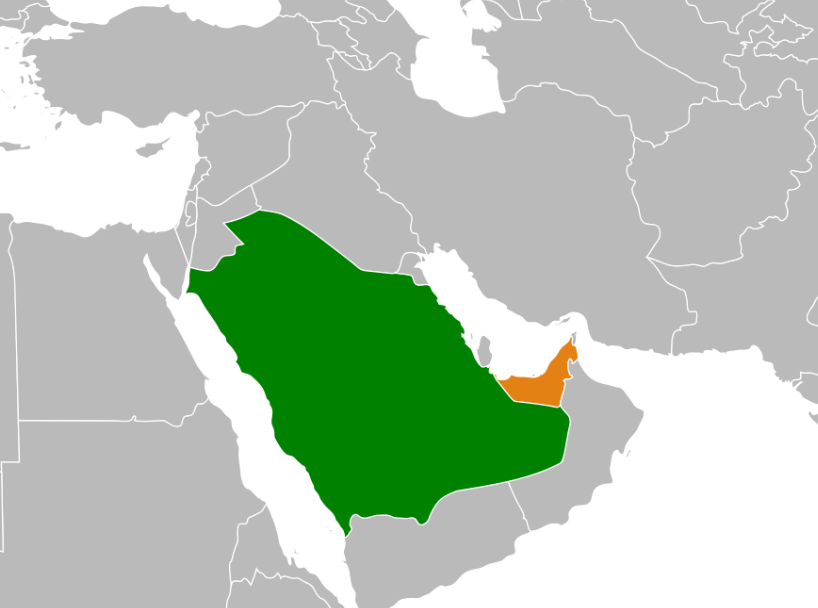
The war in West Asia is no longer just about Iran, Israel, or the Strait of Hormuz. It is now exposing a deeper and more consequential transformation inside the Gulf itself. The old Gulf consensus that once held the region together under a broad Saudi-UAE strategic understanding is visibly cracking. What is emerging instead is a fragmented, multipolar Gulf order where every major state is recalibrating its security doctrine, oil policy, military alignments, and relations with external powers according to its own survival calculations.
The widening divergence between the United Arab Emirates and Saudi Arabia has become impossible to ignore. Only a few years ago, both countries stood shoulder to shoulder during the Qatar blockade, coordinated closely in Yemen, and projected themselves as twin pillars of a new Gulf order. Today, the same partnership is increasingly shaped by distrust, competing economic visions, and fundamentally different approaches towards Iran, Israel, and the ongoing regional conflict.
The UAE has emerged as one of the most aggressively anti-Iran actors in the Gulf. Abu Dhabi’s expanding strategic relationship with Israel under the Abraham Accords, its deepening security coordination with Washington, and reports of covert anti-Iran operations have transformed it into one of Tehran’s principal regional adversaries. Reports published in recent days suggest the UAE even carried out retaliatory strikes against Iranian territory following repeated attacks on Emirati infrastructure. Iran’s asymmetric retaliation has disproportionately targeted the UAE, including strikes on Fujairah and other strategic infrastructure, reflecting how vulnerable the Emirates has become due to its exposure to trade routes and energy flows.
Saudi Arabia, by contrast, appears increasingly cautious despite maintaining quiet defensive coordination with Washington. Riyadh has reportedly engaged in limited covert retaliation against Iran while simultaneously pushing diplomatic de-escalation behind the scenes. Unlike the UAE, Saudi Arabia understands that a prolonged regional war threatens the very foundation of its Vision 2030 transformation agenda. Stability, not escalation, is now central to Saudi calculations.
The divergence is visible across nearly every regional issue. The UAE wants stronger international intervention in the Strait of Hormuz and has openly stressed that unrestricted navigation must be guaranteed in any future US-Iran settlement. Saudi Arabia, meanwhile, has increasingly shown reluctance toward direct military escalation. Reports indicate Gulf states, including Saudi Arabia, even pushed Washington to pause aggressive naval operations in the Strait due to fears of wider regional destabilisation.
The economic fracture is equally important. Abu Dhabi’s decision to leave OPEC was not merely an oil policy dispute. It was a geopolitical statement against Saudi-led market management. The UAE no longer wants its production ambitions constrained by Riyadh’s price strategy. It is pursuing a broader model centred on logistics, AI infrastructure, trade dominance, and energy diversification. In many ways, the UAE increasingly sees itself less as a traditional Gulf monarchy and more as a global commercial hub protected by Western and Israeli security umbrellas.
At the same time, Saudi Arabia is consolidating a different axis. Riyadh’s growing defence coordination with Pakistan, improving ties with Turkey, cautious engagement with Iran, and pragmatic balancing with China and Russia suggest that Saudi Arabia is attempting to position itself as an autonomous regional power rather than merely an American security client. This emerging alignment increasingly overlaps with broader regional actors seeking strategic flexibility instead of bloc politics.
India now finds itself trapped between these shifting fault lines.
For decades, New Delhi’s greatest strength in West Asia was balance. India maintained working relations with Iran, Saudi Arabia, Israel, the UAE, Qatar, and even rival regional camps simultaneously. That strategic ambiguity protected India’s energy security, diaspora interests, and diplomatic flexibility.
But the signals coming from New Delhi during the current conflict suggest that this balance is beginning to erode.
Prime Minister Narendra Modi’s unusually strong condemnation of Iranian attacks on the UAE, repeated high-level outreach to Abu Dhabi, and the broader deepening of the India-UAE-Israel-US strategic framework are increasingly being noticed across the region. Modi’s upcoming visit to the UAE, his eighth since 2014, further reinforces the perception that India is moving closer to the Emirati-Israeli strategic camp.
There are understandable reasons for this. The UAE hosts more than four million Indians. Bilateral trade exceeds $100 billion annually. India’s energy security is deeply linked to Gulf stability. The IMEC corridor, I2U2 framework, logistics cooperation, and strategic investments have made the UAE one of India’s most important external economic partners.
Yet foreign policy built excessively around one side of a rapidly shifting region carries long-term risks.
The Gulf order is changing faster than New Delhi appears willing to publicly acknowledge. Saudi Arabia is no longer fully aligned with the UAE. Turkey is asserting itself more aggressively. Iran remains capable of disrupting global trade despite sanctions and military pressure. Pakistan’s growing integration with Gulf defence structures adds another layer of complexity. China and Russia are steadily expanding their diplomatic space across the region while the United States itself appears divided between military escalation and negotiated de-escalation.
In such an environment, any perception that India has abandoned its traditional strategic balance could become costly.
India depends on all sides of the Gulf equation simultaneously. It needs Saudi energy, Emirati investments, Iranian connectivity routes, Qatari gas, Israeli defence cooperation, and broader regional stability. Picking sides in a region entering a prolonged phase of strategic fragmentation may deliver short-term diplomatic comfort but risks long-term geopolitical isolation.
The real lesson emerging from the Hormuz crisis is not simply about shipping lanes or oil prices. It is about the collapse of old assumptions. Gulf unity is weakening. Regional alignments are becoming fluid. West Asian powers are no longer behaving as subordinate actors under a single American-led security architecture. Instead, they are constructing overlapping, competing coalitions driven by survival, economics, and strategic autonomy.
India must recognise this reality before its own room for manoeuvre begins to shrink.
The era when New Delhi could quietly lean toward one camp while still maintaining trust across the region may not last forever. In a multipolar Gulf, strategic overcommitment to any single axis can quickly become a liability. And in West Asia, today’s tactical partner can become tomorrow’s geopolitical burden with remarkable speed.