

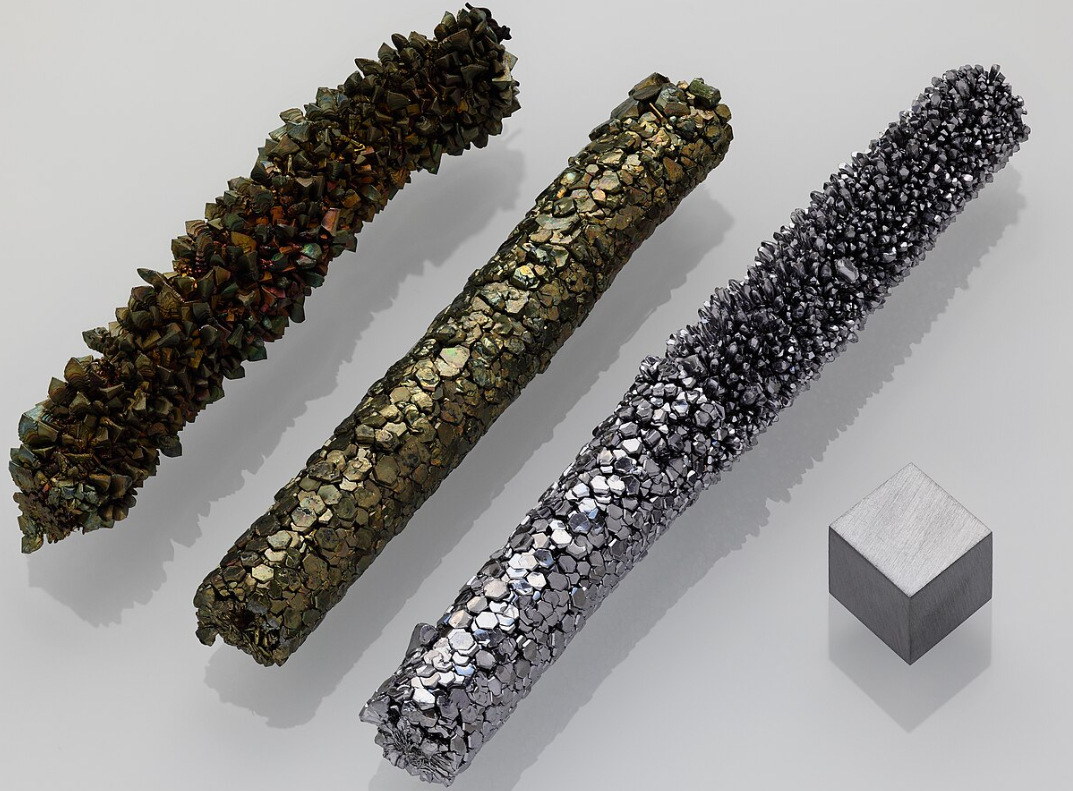
Vanadium (V, atomic number 23), a hard, silvery-grey transition metal in group 5 of the periodic table, is renowned for its remarkable ability to strengthen steel and its vivid color-changing chemistry. First discovered in 1801 by Andrés Manuel del Río in Mexico, the element was initially mistaken for chromium. It was rediscovered in 1830 by Nils Gabriel Sefström and named after Vanadis, a Norse goddess associated with beauty, reflecting the striking colors of its compounds. Although relatively modest in abundance in Earth’s crust (~120 ppm), vanadium occurs mainly in minerals such as vanadinite, magnetite, and certain petroleum deposits.
Despite often being overlooked outside metallurgy, vanadium is a strategic material in modern industry, energy storage, aerospace engineering, and even biology. Its ability to exist in multiple oxidation states and form exceptionally strong alloys has made it indispensable in technologies ranging from high-strength steel to large-scale renewable energy batteries.
1. Hidden Features: Color-Changing Chemistry, Multi-Valence Power, and Biological Curiosity
Vanadium’s electron configuration [Ar] 3d³ 4s² gives it flexible chemistry and several oxidation states.
A Rainbow of Oxidation States
Vanadium is famous for its color-shifting compounds. In aqueous solutions its oxidation states display distinctive colors:
• V²⁺ – violet
• V³⁺ – green
• V⁴⁺ (vanadyl ion, VO²⁺) – blue
• V⁵⁺ (vanadate) – yellow
This dramatic sequence is often used in chemistry demonstrations to illustrate oxidation-reduction reactions.
Exceptional Alloy Strength
Tiny amounts of vanadium dramatically increase the strength, toughness, and heat resistance of steel. Vanadium carbides form extremely hard microscopic particles that reinforce metal structures, enabling lighter yet stronger materials used in aircraft, tools, pipelines, and high-performance machinery.
Petroleum and Ash Deposits
Vanadium accumulates in certain crude oils and oil sands because ancient marine organisms concentrated it in organic molecules called porphyrins. During oil refining, vanadium ends up in heavy residues and petroleum ash, making oil deposits an unexpected industrial source of the metal.
Biological Curiosities
While not essential for humans, vanadium appears in trace amounts in some marine organisms. Certain sea squirts (tunicates) can concentrate vanadium in their blood cells at levels millions of times higher than seawater, a biological mystery still studied today. Some enzymes in bacteria also use vanadium instead of molybdenum to process nitrogen.
Isotopic Stability
Vanadium occurs naturally mostly as the stable isotope ⁵¹V, which accounts for more than 99.7% of natural vanadium. A second isotope, ⁵⁰V, is extremely rare and weakly radioactive with an extraordinarily long half-life, making it one of the rarest naturally occurring radioactive isotopes.
2. Covert Uses: High-Strength Steel, Energy Storage, Aerospace, and Catalysis
Global vanadium production is relatively small compared with major metals, yet its technological impact is enormous.
High-Strength Steel and Infrastructure
About 90% of vanadium production goes into steel alloys. Adding as little as 0.1% vanadium can dramatically improve strength and fatigue resistance. Vanadium steels are widely used in:
• construction beams and earthquake-resistant structures
• pipelines and railway tracks
• automotive components and tools
• high-performance aerospace parts
Energy Storage Batteries
Vanadium plays a central role in vanadium redox flow batteries (VRFBs), a promising technology for storing large amounts of renewable energy from solar and wind power. Because the electrolyte uses different oxidation states of the same element, the batteries can operate for decades with minimal degradation.
Aerospace and Titanium Alloys
Vanadium is a key component in titanium alloys such as Ti-6Al-4V, widely used in aircraft engines, spacecraft structures, and medical implants due to its exceptional strength-to-weight ratio and corrosion resistance.
Industrial Catalysts
Vanadium pentoxide (V₂O₅) is one of the most important industrial catalysts, especially in the contact process used to produce sulfuric acid, one of the world’s most widely manufactured chemicals. Vanadium catalysts are also used in oxidation reactions in petrochemical industries.
Advanced Materials and Glass
Vanadium compounds are used to produce specialty ceramics, colored glass, superconducting materials, and advanced coatings capable of resisting extreme heat and corrosion.
In summary, vanadium is far more than a steel additive. It is the color-shifting transition metal that demonstrates oxidation chemistry in vivid hues, the microscopic strength enhancer that reinforces modern infrastructure, the catalyst behind massive chemical industries, and the backbone of emerging grid-scale energy storage systems.
What fascinates you most about vanadium—the rainbow colors of its oxidation states, its role in ultra-strong steel, or its potential to store renewable energy for entire power grids? Let us know!