

Polonium (Po, atomic number 84), the rarest and most toxic naturally occurring element, is a silvery-gray, highly radioactive metalloid in group 16 (below tellurium and above livermorium). Discovered in 1898 by Marie and Pierre Curie from pitchblende ore, it was named after Marie’s homeland of Poland (Polonia in Latin). Polonium is so intensely radioactive that a single gram of the most common isotope, ²¹⁰Po, emits 4.5 × 10¹³ alpha particles per second and glows faint blue from air ionization. It is one of the few elements whose radioactivity is visible to the naked eye in the dark.
No stable isotopes exist. All 42 known isotopes are radioactive, with half-lives ranging from microseconds to 138 days. Global production is measured in micrograms per year, mostly as a byproduct of uranium processing.
1. Hidden Features: Extreme Alpha Emission, Volatility, and Relativistic Instability
Polonium’s electron configuration [Xe] 4f¹⁴ 5d¹⁰ 6s² 6p⁴ places it in group 16, but relativistic effects and nuclear instability dominate its behavior.
- Most Radioactive Naturally Occurring Element ²¹⁰Po (half-life 138.376 days, alpha decay to ²⁰⁶Pb) is the most common isotope. One gram produces ~140 watts of heat and delivers a lethal radiation dose in minutes if ingested or inhaled. A microgram is enough to kill an adult human within days. It was famously used in the 2006 assassination of Alexander Litvinenko (detected via gamma spectroscopy of its daughter ²¹⁰Pb).
- High Volatility & Toxicity Polonium is unusually volatile for a heavy metal—its oxide (PoO₂) sublimes easily at ~500 °C, and elemental polonium evaporates noticeably even at room temperature. This makes it extremely hazardous: alpha particles (short range but high energy) cause massive internal damage when inhaled or swallowed, while the element itself can be absorbed through skin in trace amounts.
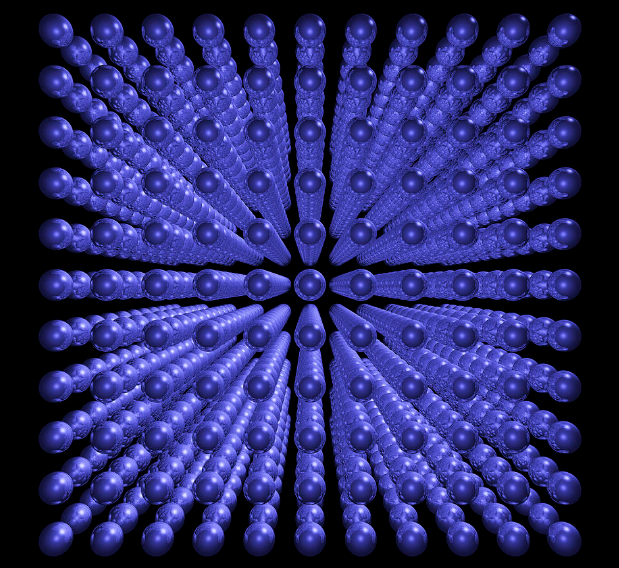
- Metallic yet Radioactive Freshly prepared polonium has a metallic luster and simple cubic crystal structure, but it rapidly tarnishes and self-heats. Its density (~9.2 g/cm³) and low melting point (~254 °C) are consistent with heavy chalcogens, yet its chemistry is strongly influenced by the inert-pair effect (favoring +2 over +4 states).
- Natural Occurrence Polonium occurs in trace amounts in uranium ores (~0.1 mg per tonne of uranium) from the decay of ²³⁸U. It is also found in tobacco leaves (concentrated from soil radon decay), explaining part of the radiation risk from smoking.
- Nuclear Quirks Polonium-210 is produced in reactors by neutron irradiation of bismuth-209. It was used in early neutron initiators for atomic bombs (the “Urchin” initiator in the Fat Man bomb) because alpha particles striking beryllium produce neutrons.
2. Covert Uses: Neutron Sources, Space Power, and Assassination History
Polonium has almost no industrial applications due to extreme toxicity and short half-life, but its properties make it uniquely valuable in a few high-stakes niches.
- Neutron Sources Polonium-beryllium (Po-Be) sources were once the standard portable neutron sources for oil-well logging, scientific research, and nuclear weapon initiators. They have largely been replaced by safer alternatives (Am-Be, Cf-252) due to polonium’s volatility and short half-life.
- Radioisotope Power (Historical) ²¹⁰Po was considered for early radioisotope thermoelectric generators (RTGs) because of its high power density (~140 W/g). It powered some Soviet Lunokhod rovers and was studied for space probes, but plutonium-238 proved far superior for long-duration missions.
- Targeted Alpha Therapy Research Polonium-210 itself is too short-lived and toxic, but its decay properties inform research into longer-lived alpha emitters (²²⁵Ac, ²¹³Bi) for cancer treatment.
- Scientific Tracer Trace amounts of ²¹⁰Po are used in atmospheric and oceanographic studies to track radon decay and particle scavenging in the environment.
In summary, polonium isn’t just another chalcogen—it’s the most toxic and intensely radioactive element that occurs naturally, the element that glows blue from its own decay, the one that killed Alexander Litvinenko in one of the most infamous radiological assassinations in history, and a fleeting radioactive beacon that marks the boundary between the relatively stable elements and the superheavies.
What’s your strongest reaction to polonium—its terrifying toxicity, the blue glow of a microgram sample, its role in the Litvinenko case, or simply the fact that Marie Curie isolated it from tons of pitchblende? Drop it below!