

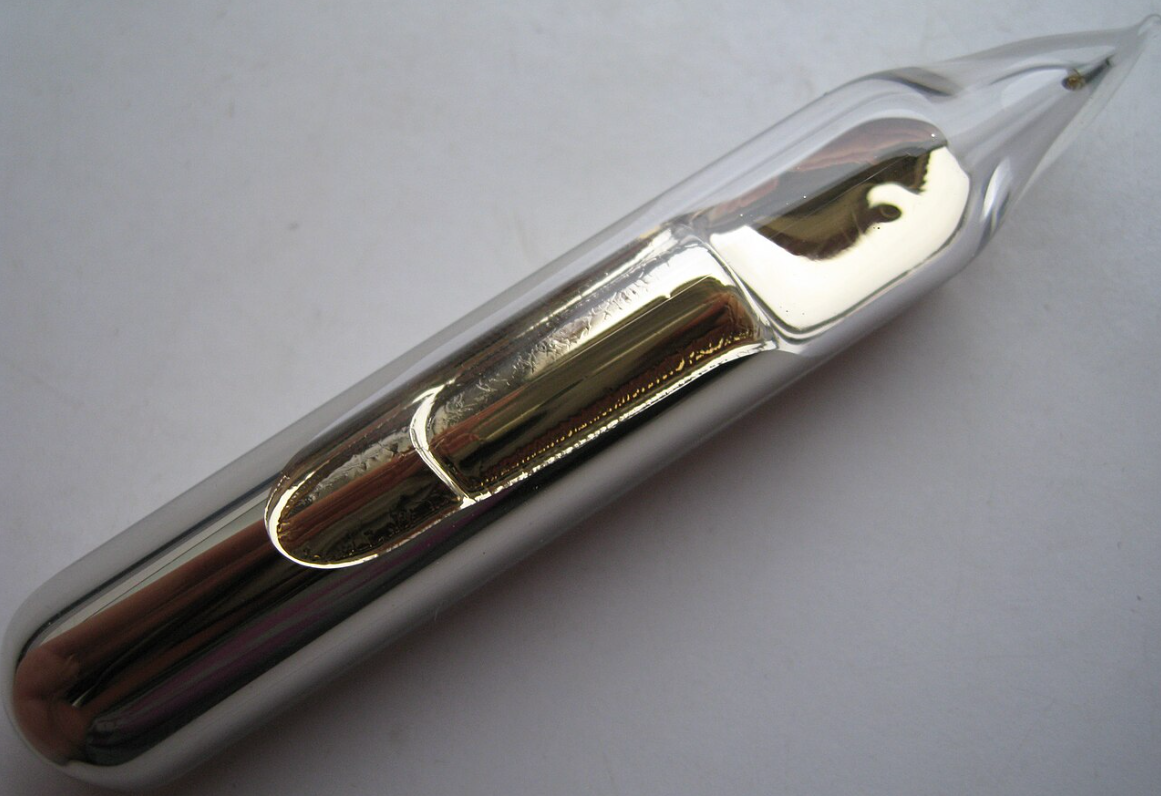
Caesium (Cs, atomic number 55), also spelled cesium in American English, is a soft, silvery-gold alkali metal in group 1—below rubidium and the most electropositive stable element known. Discovered in 1860 by Robert Bunsen and Gustav Kirchhoff through flame spectroscopy (its vivid blue lines gave it the name from Latin caesius, meaning “sky blue”), caesium is extremely rare in Earth’s crust (~3 ppm) and found mainly in pollucite and lepidolite. It is the softest solid element at room temperature (melting point 28.44 °C—just above ambient in warm rooms), and one of the most violently reactive metals, yet it underpins the definition of the second and powers the most accurate clocks ever built.
1. Hidden Features: Hyper-Reactivity, Atomic Timekeeping, and Quantum Oddities
Caesium’s electron configuration [Xe] 6s¹ gives it the lowest ionization energy of any stable element (~376 kJ/mol), making it extraordinarily eager to lose its single valence electron.
- Most Reactive Stable Metal Caesium reacts explosively with water—often shattering containers and igniting the hydrogen plume with a characteristic lilac flame. The reaction is more violent than rubidium’s due to lower ionization energy and larger atomic radius, releasing enough heat to melt remaining caesium. It ignites spontaneously in air when finely divided and reacts with ice at -116 °C. Caesium must be stored under inert gas or mineral oil; even trace moisture causes violent decomposition.
- Definition of the Second Since 1967, the second is defined as the duration of 9,192,631,770 periods of the radiation corresponding to the transition between two hyperfine levels of the ground state of caesium-133 (¹³³Cs). Caesium fountain atomic clocks (e.g., NIST-F2) achieve uncertainties of ~10⁻¹⁶ (1 second drift in ~300 million years)—the most precise timekeepers ever made, forming the backbone of UTC, GPS, telecommunications, and scientific experiments.
- Photoemissive & Low Work Function Caesium has one of the lowest work functions (~2.14 eV), making it highly photoemissive—used in photomultiplier tubes, image intensifiers for night vision, and early vacuum-tube electronics (caesium-coated cathodes).
- Quantum & Bose-Einstein Condensate Caesium-133 was used in early Bose-Einstein condensate experiments (though rubidium-87 became the standard). Its large scattering length and Feshbach resonances make it ideal for studying few-body physics, Efimov states, and ultracold molecule formation.
- Isotopic & Nuclear Notes ¹³³Cs is the only stable isotope; ¹³⁷Cs (half-life 30.17 years, beta/gamma emitter) is a major fission product in nuclear accidents (Chernobyl, Fukushima) and used in brachytherapy and industrial gauges.
2. Covert Uses: Atomic Clocks, Oil Drilling, Catalysts, and Research
Global caesium production is tiny (~20–30 tonnes/year as compounds), limiting it to ultra-high-value niches.
- Atomic Clocks & GPS Backbone Caesium beam and fountain clocks synchronize GPS satellites, cell networks, stock exchanges, power grids, and internet timing protocols. They define international atomic time (TAI) and UTC—essential for navigation, finance, and science.
- Drilling Fluids (Caesium Formate) Caesium formate brines are the densest, most environmentally friendly high-density drilling fluids—used in deep, high-pressure oil/gas wells to prevent blowouts and improve recovery. They offer low corrosivity, high lubricity, and compatibility with sensitive formations.
- Catalysts & Specialty Chemistry Caesium compounds promote certain reactions (e.g., caesium-promoted silver catalysts in ethylene oxide production, caesium in zeolite cracking catalysts).
- Photoelectric & Vacuum Devices Caesium-coated surfaces power photomultipliers in particle detectors (LHC, neutrino observatories), scintillation counters, and night-vision tubes.
- Medical & Industrial Isotopes ¹³⁷Cs sources power blood irradiators (preventing transfusion-associated graft-versus-host disease) and brachytherapy seeds.
In summary, caesium isn’t just the most reactive stable metal—it’s the atomic heartbeat that defines every second of modern time, the explosive guardian of deep-Earth drilling, and the photoemissive key to seeing in the dark and detecting the invisible.
What’s your favorite caesium fact—its role in defining the second, the lilac explosion with water, or its use in oil wells? Drop it below!