

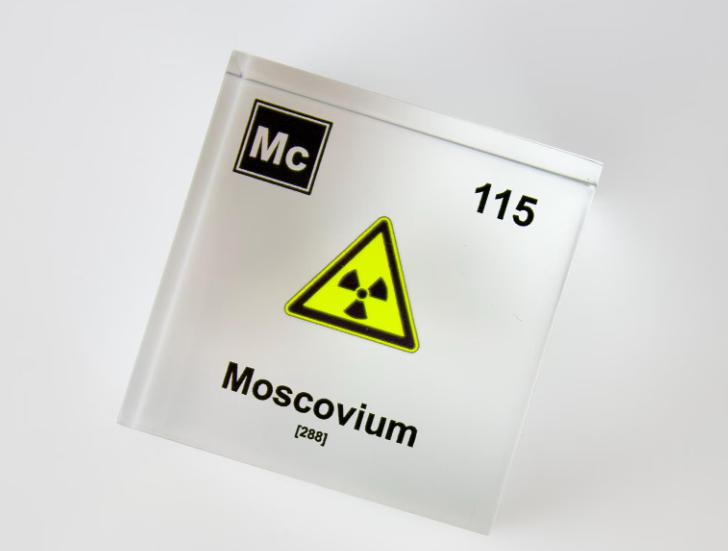
Moscovium (Mc, atomic number 115), a synthetic superheavy element in group 15 (the pnictogen group, below bismuth), is one of the most unstable and elusive members of the periodic table. Named after the Moscow region (honoring the Joint Institute for Nuclear Research in Dubna, Russia, where it was first synthesized), moscovium was discovered in 2003 by a Russian–American collaboration led by Yuri Oganessian and Vladimir Utyonkov. It was officially recognized by IUPAC in 2016. Like all superheavies beyond uranium, moscovium exists only in atom-at-a-time accelerator experiments, produced via fusion reactions (most commonly calcium-48 on americium-243), with production cross-sections in the picobarn range and half-lives measured in fractions of a second to seconds.
Moscovium sits deep in the “sea of instability,” yet it has become one of the best-characterized superheavies due to relatively longer-lived isotopes and successful decay-chain studies.
1. Hidden Features: Relativistic Pnictogen Behavior, Volatility Clues, and Nuclear Decay Chains
Moscovium’s high Z=115 triggers dramatic relativistic effects while still allowing limited single-atom chemistry and nuclear spectroscopy.
- Relativistic Effects & Predicted Chemistry The enormous nuclear charge accelerates inner electrons to relativistic speeds, contracting s and p₁/₂ orbitals and stabilizing higher oxidation states. Theory predicts moscovium should behave as a heavier analog of bismuth—forming volatile compounds like McCl₃ or Mc₂O₃ and showing group-15-like chemistry. However, the super-stabilized 7s² and 7p₁/₂ electrons (inert-pair effect on steroids) may push it toward +1 or +3 states with reduced reactivity. Some calculations even suggest semi-metallic or volatile behavior closer to a “relativistic pnictogen gas” under extreme conditions.
- Gas-Phase Chemistry Attempts As of 2026, no definitive gas-phase chemistry experiments on moscovium have been published (unlike flerovium, copernicium, or nihonium). Its short half-lives and low production rates make adsorption studies extremely challenging. Theoretical predictions suggest moscovium would be less volatile than bismuth but still form weak metallic bonds on gold surfaces—pending future experiments at GSI/FAIR, SHE Factory (Dubna), or RIKEN.
- Nuclear Properties & Decay Champion Known isotopes range from ²⁸⁷Mc to ²⁹⁰Mc (with recent unconfirmed candidates). The most stable is ²⁹⁰Mc (~0.65–0.8 seconds half-life, alpha decay dominant), followed by ²⁸⁹Mc (~0.22 s) and ²⁸⁸Mc (~0.17 s). All decay via alpha emission to nihonium (element 113) daughters, which then continue long decay chains ending in spontaneous fission. Recent 2024–2025 data from Dubna (using ⁴⁸Ca + ²⁴³Am) confirmed and refined these chains, providing precise alpha energies and branching ratios—critical for mapping shell effects near Z=115.
- Island of Stability Mirage Early hopes placed Z=115 near the predicted island of stability (centered around Z=114–126, N≈184). Reality: known moscovium isotopes have N=173–175—well short of the magic neutron number 184. No enhanced stability observed; fission dominates as N decreases.
2. Covert Uses: Pure Fundamental Benchmark, No Practical Payload
Moscovium produces no bulk material and has zero applications—its entire existence is measured in single atoms decaying in fractions of a second.
Its scientific importance is immense in frontier research:
- Relativistic Quantum Chemistry Testing Ground Even without direct chemistry, decay properties and theoretical extrapolations challenge multi-electron relativistic codes (Dirac–Coulomb–Breit + QED) for p-block superheavies—refining models for elements 113–120.
- Nuclear Structure & Decay Mapping Long decay chains from moscovium provide the richest data on single-particle levels, fission barriers, and shell effects in this mass region—guiding searches for longer-lived superheavies.
- Synthesis Technique Validation Moscovium production via ⁴⁸Ca + ²⁴³Am remains one of the most successful hot-fusion routes, informing next attempts at elements 119 and 120 using titanium-50 or vanadium-51 beams.
- Proof of Superheavy Reach Successfully detecting and confirming moscovium (with half-lives <1 s) demonstrates the maturity of recoil separators (e.g., TASCA, GARIS, DGFRS) and fast electronics—essential for pushing the periodic table further.
In summary, moscovium isn’t just another superheavy—it’s the pnictogen sentinel deep in the sea of instability, the element whose decay chains have given us the clearest glimpse of nuclear structure near Z=115, and a relativistic enigma that may one day reveal whether group 15 can still behave like bismuth at nature’s atomic edge.
Which superheavy group 15 element intrigues you more—bismuth (the rainbow heavyweight) or moscovium (the fleeting relativistic ghost)? Drop it below!