

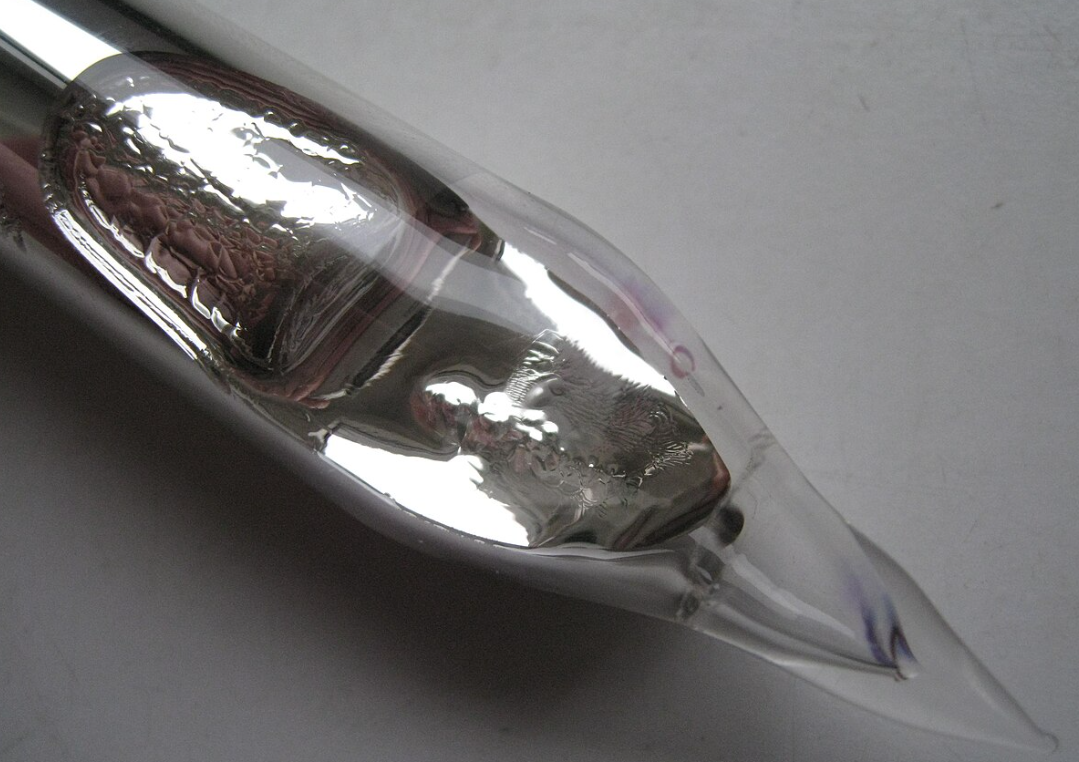
Rubidium (Rb, atomic number 37), a soft, silvery-white alkali metal in group 1 (below potassium and above cesium), is one of the most violently reactive elements known—yet it quietly powers the most precise clocks on Earth. Discovered in 1861 by Robert Bunsen and Gustav Kirchhoff through flame spectroscopy (its red emission lines gave it the name from Latin rubidus, “deep red”), rubidium is relatively abundant in Earth’s crust (~90 ppm) but rarely occurs in concentrated form. It is extracted mainly as a by-product of lithium and potassium processing from lepidolite, pollucite, and carnallite. Like its alkali cousins, rubidium reacts explosively with water, ignites spontaneously in air when finely divided, and must be stored under inert oil or argon.
Despite its extreme reactivity, rubidium’s atomic properties make it indispensable in ultra-precise timekeeping, quantum technologies, and specialized research.
1. Hidden Features: Violent Reactivity, Atomic Clocks, and Quantum Oddities
Rubidium’s electron configuration [Kr] 5s¹ gives it the classic alkali-metal traits amplified by its larger atomic radius.
- Hyper-Reactive with Water Rubidium reacts far more violently than potassium: it ignites instantly on contact with water, producing hydrogen gas that usually explodes due to the intense heat released (ΔH ≈ −200 kJ/mol). Larger pieces can detonate with enough force to shatter glass containers—making rubidium one of the most dangerous alkali metals to handle.
- Rubidium Atomic Clocks – The Gold Standard Rubidium-87 (27.8% natural abundance) has a hyperfine transition at exactly 6,834,682,610.904 Hz. This transition is the basis for rubidium atomic frequency standards—compact, low-power clocks used in:
- GPS satellites
- Telecommunications synchronization
- Scientific instruments
- Military systems Rubidium clocks achieve accuracies of ~10⁻¹² (1 second drift in ~30,000 years), bridging the gap between cheap quartz oscillators and expensive cesium fountain clocks.
- Quantum & Bose-Einstein Condensate Pioneer Rubidium-87 was the first element to form a Bose-Einstein condensate (BEC) in 1995 (JILA, Boulder) — a quantum state of matter at nanokelvin temperatures where atoms behave as a single coherent wave. Rb-87 BECs remain the workhorse for quantum simulation, atom interferometry, and precision gravity/magnetic sensing.
- Photoemissive & Laser Cooling Rubidium has one of the lowest work functions among metals (~2.16 eV), making it highly photoemissive—used in photomultiplier tubes and night-vision devices. Its D2 line (780 nm) is ideal for laser cooling and trapping in magneto-optical traps (MOTs).
- Isotopic & Nuclear Notes Rb-85 (72.2%) and Rb-87 are stable; Rb-87 decays to Sr-87 (half-life 48.8 billion years) and is used in rubidium-strontium dating of meteorites and ancient rocks.
2. Covert Uses: Atomic Clocks, Quantum Tech, Specialty Glasses, and Research
Global rubidium production is tiny (~2–5 tonnes/year as compounds), limiting it to high-value niches.
- Atomic Frequency Standards & GPS Backbone Rubidium oscillators are the heart of most GPS satellite clocks (cheaper and smaller than cesium), cell-tower synchronization, and scientific timing references. They keep global navigation and telecom networks aligned to nanoseconds.
- Quantum Sensing & Computing Rubidium atoms in optical lattices and BECs enable ultra-sensitive magnetometers, gravimeters, inertial sensors, and quantum simulation platforms. Cold-atom interferometers using Rb measure gravity with unprecedented precision for geophysical and defense applications.
- Specialty Glasses & Pyrotechnics Rubidium compounds lower melting points and improve electrical properties in certain glasses and ceramics. Rubidium salts produce deep red-violet flames in fireworks and military flares.
- Biomedical & Tracer Studies Rb-82 (positron emitter, half-life 76 seconds) is generated from Sr-82/Rb-82 generators for myocardial perfusion PET imaging—used to diagnose coronary artery disease with very low radiation dose.
- Research & Vapor Cells Rubidium vapor cells power precision magnetometers (SERF regime), atomic clocks in labs, and nonlinear optics experiments (four-wave mixing, electromagnetically induced transparency).
In summary, rubidium isn’t just another alkali metal—it’s the explosive red-line element that keeps GPS satellites ticking to billionths of a second, pioneered the first Bose-Einstein condensate, and quietly anchors the precision timing that underpins modern navigation, communications, and quantum research.
What’s your favorite rubidium quirk—its role in atomic clocks, the 1995 BEC breakthrough, or the sheer violence of its water reaction? Drop it below!