

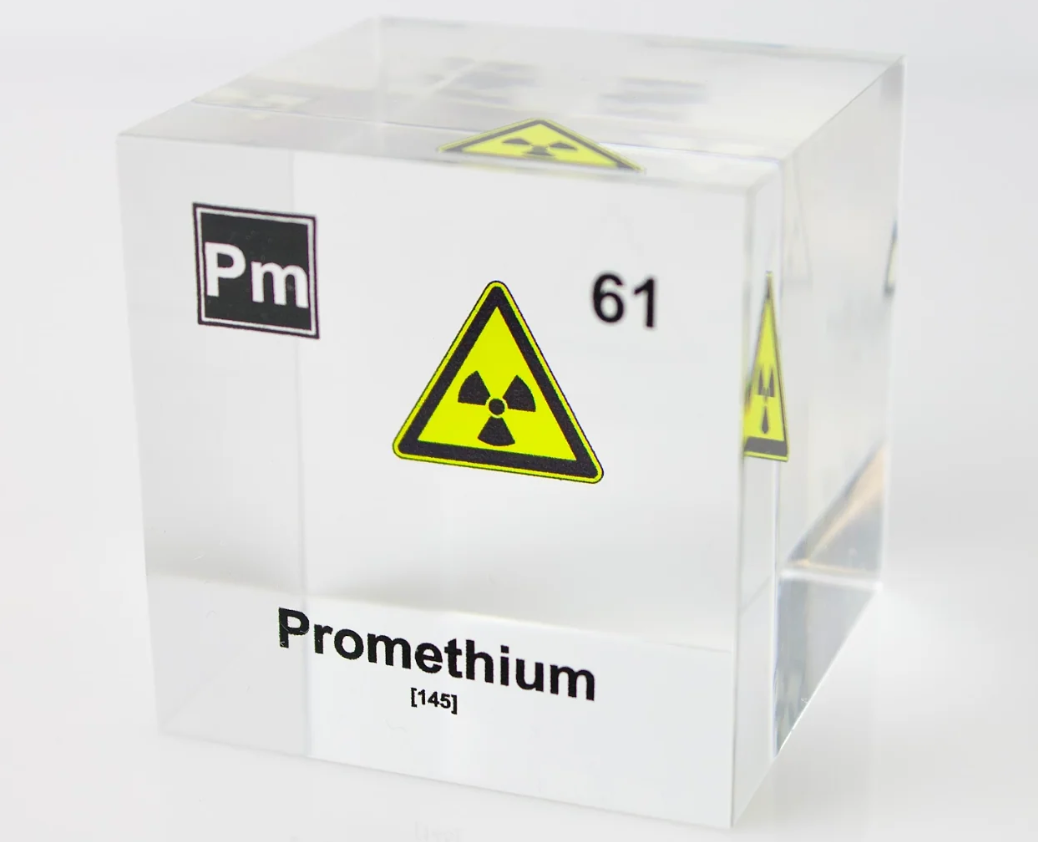
Promethium (Pm, atomic number 61), the only lanthanide with no stable isotopes, is one of the rarest and most enigmatic elements in the periodic table. Named after the Greek Titan Prometheus—who stole fire from the gods and gave it to humanity—this radioactive rare earth was the last of the naturally occurring elements to be discovered, purely because its instability left no primordial traces on Earth. First identified in 1945 by Jacob A. Marinsky, Lawrence E. Glendenin, and Charles D. Coryell at Oak Ridge National Laboratory (then Clinton Laboratories) during analysis of uranium fission products from the Manhattan Project era, promethium exists today almost entirely as a synthetic byproduct of nuclear reactors. With only trace natural occurrences from spontaneous fission or cosmic-ray interactions, and global quantities measured in grams at best, promethium remains a fleeting, difficult-to-study ghost among the rare earths.
1. Hidden Features: No Stable Ground, Beta Decay Dominance, and Lanthanide Contraction Keystone
Promethium’s [Xe] 4f⁵ 6s² configuration places it squarely in the lanthanide contraction zone, where 4f electrons poorly shield the nucleus, shrinking ionic radii dramatically.
- Complete Lack of Stable Isotopes All ~41 known isotopes (from ¹²⁶Pm to ¹⁶⁶Pm) are radioactive—the only lanthanide (and one of only two elements before bismuth) with no stable or long-lived primordial form. The longest-lived is ¹⁴⁵Pm (half-life 17.7 years, electron capture to ¹⁴⁵Nd, with ultra-rare alpha decay). ¹⁴⁶Pm lasts 5.53 years, while the most produced ¹⁴⁷Pm (beta decay to ¹⁴⁷Sm) has a half-life of 2.623 years. Meta-stable states like ¹⁴⁸mPm reach 41.3 days. This instability made promethium the last lanthanide discovered and the hardest to characterize until recent breakthroughs.
- +3 Oxidation State Dominance Like most lanthanides, promethium exists almost exclusively as Pm³⁺ in solution and solids—forming pinkish solutions and salts. Relativistic effects and 4f contraction give it properties intermediate between neodymium (60) and samarium (62), but its radioactivity prevented detailed study until 2024–2025.
- 2024–2025 Breakthrough: First Coordination Complex In a landmark 2024 study (published Nature, May 2024) and follow-ups into 2025, Oak Ridge National Laboratory scientists produced pure ¹⁴⁷Pm, complexed it with an organic ligand (e.g., DOTA-like chelator) in aqueous solution, and used X-ray absorption spectroscopy to measure Pm–O bond lengths (~2.4 Å) and coordination (9 oxygen atoms). This revealed promethium’s exact place in the lanthanide contraction series—bridging gaps in understanding ionic radii, hydration, and separation chemistry for all rare earths. The work opened pathways for purer, larger-scale production and better modeling of f-element behavior.
- Radioactive Glow & Beta Emission Pm-147’s pure beta decay (no gamma rays) produces low-energy electrons ideal for non-penetrating applications, while its scarcity (~0.5 kg naturally in Earth’s crust at any time) underscores its synthetic nature.
2. Covert Uses: Nuclear Batteries, Gauges, and Emerging Research Probes
Promethium’s tiny production (grams per year from reactors) limits it to niche, high-value roles.
- Atomic & Nuclear Batteries Pm-147 powers betavoltaic devices—converting beta decay electrons to electricity via semiconductors or phosphors + solar cells. Used historically in pacemakers, remote sensors, spacecraft instruments, and “cosmic clocks” for cosmic-ray studies; still explored for long-life, maintenance-free power in harsh environments (satellites, deep-sea probes, military tech).
- Thickness Gauges & Industrial Sensors Pm-147 beta sources measure sheet thickness in paper, plastic, and metal production—non-contact, precise, and low-radiation. Also used in luminous paints (pre-1970s) and static eliminators.
- Research & Potential Medical Tracers As the “missing link” lanthanide, promethium probes separation chemistry for nuclear waste partitioning and rare-earth refining. Emerging interest in Pm-149 or Pm-151 for targeted radiotherapy (beta emitters for cancer), though short half-lives and scarcity limit progress.
- Fundamental Lanthanide Insights 2024–2025 ORNL work on Pm complexes refines models for actinide/lanthanide separation in spent fuel reprocessing—critical for advanced nuclear cycles and waste management.
In summary, promethium isn’t just the rarest rare earth—it’s the radioactive keystone of the lanthanides, a beta-decay workhorse for long-life power, and—thanks to recent Oak Ridge breakthroughs—the final piece in understanding f-element chemistry that had eluded scientists for 80 years.
What’s your take on promethium—fascinating “missing” lanthanide, nuclear battery pioneer, or the ultimate example of an element too unstable to tame? Drop it below!