

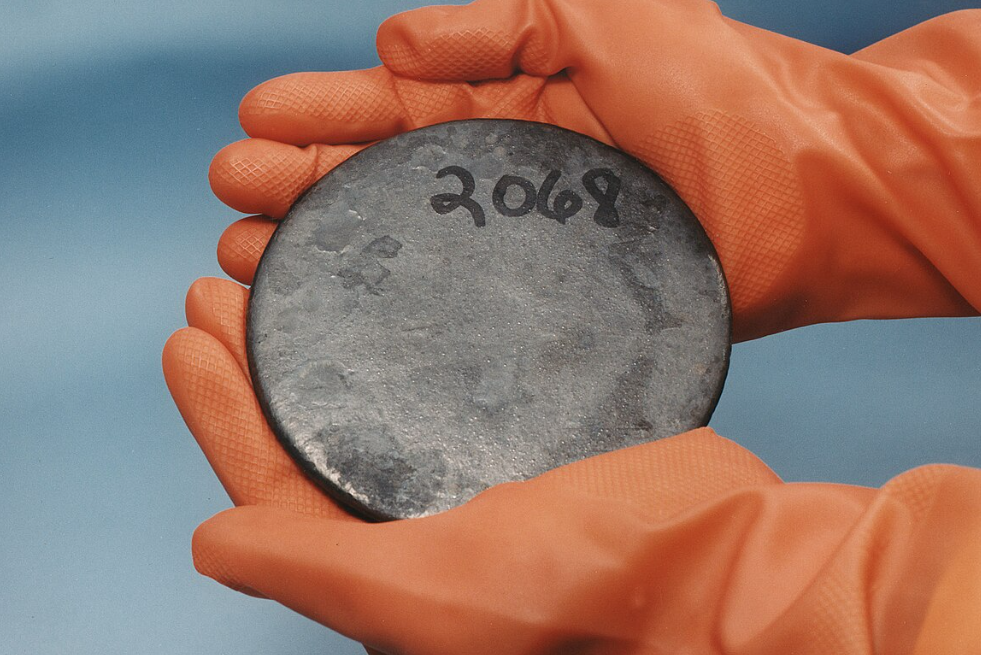
Uranium (U, atomic number 92), the heaviest naturally occurring element on Earth with a primordial isotope, sits at the far end of the actinide series and defines the nuclear age. This dense, silvery-gray metal was discovered in 1789 by Martin Heinrich Klaproth in pitchblende ore (naming it after the newly discovered planet Uranus), but its true power remained hidden until the 20th century. Uranium-235’s ability to sustain a chain reaction of neutron-induced fission—unleashed in 1938 by Otto Hahn and Fritz Strassmann, explained by Lise Meitner and Otto Frisch—changed history forever. Today, uranium fuels ~10% of global electricity, powers submarines and aircraft carriers, and remains one of the most geopolitically sensitive and carefully controlled elements on the planet.
1. Hidden Features: Fissionable Isotopes, Extreme Density, and Relativistic Chemistry
Uranium’s electron configuration [Rn] 5f³ 6d¹ 7s² reveals a complex actinide with multiple oxidation states and profound nuclear properties.
- Isotopic Split & Fission Magic Natural uranium consists of three isotopes:
- ²³⁸U (~99.27%, half-life 4.468 billion years, alpha decay) — the dominant primordial isotope
- ²³⁵U (~0.72%, half-life 704 million years) — the only naturally occurring fissile isotope (splits with thermal neutrons)
- ²³⁴U (~0.0055%, from ²³⁸U decay chain) Only ²³⁵U can sustain a chain reaction in light-water reactors without enrichment; weapons-grade uranium is >90% ²³⁵U.
- Density & Radioactivity At 19.1 g/cm³, uranium is nearly as dense as gold and tungsten—used in armor-piercing kinetic penetrators (“depleted uranium” munitions, DU, mostly ²³⁸U). All isotopes are radioactive; even “depleted” uranium emits alpha particles and weak gamma rays, requiring careful handling.
- Multiple Oxidation States & Colorful Chemistry Uranium exhibits states from +3 to +6, with +4 (U⁴⁺, green) and +6 (uranyl UO₂²⁺, yellow) most common. The linear uranyl ion (O=U=O)²⁺ is extraordinarily stable in aqueous solution due to strong covalent bonding, producing bright yellow-green fluorescence under UV light—a signature of uranium minerals (autunite, zippeite).
- Natural Reactors Gabon’s Oklo deposit hosted self-sustaining nuclear fission reactors ~1.7–2 billion years ago when ²³⁵U abundance was ~3%—the only known natural nuclear reactors, leaving isotopic fingerprints still studied today.
- Relativistic Effects Inner electrons in uranium move at ~60% the speed of light, contracting s and p orbitals and stabilizing higher oxidation states—contributing to the uranyl ion’s unusual linearity and the element’s rich coordination chemistry.
2. Covert Uses: Power Generation, Weapons, Depleted Uranium, and Medical Tracers
Uranium’s annual production (~55,000–60,000 tonnes U₃O₈ equivalent in recent years) is tightly regulated under the Nuclear Non-Proliferation Treaty.
- Nuclear Power Low-enriched uranium (3–5% ²³⁵U) fuels ~440 commercial reactors worldwide, supplying ~10% of global electricity and ~25–30% in countries like France, Ukraine, and the US. Pressurized water reactors (PWRs) and boiling water reactors (BWRs) dominate; small modular reactors (SMRs) increasingly use high-assay low-enriched uranium (HALEU, up to 19.75%).
- Naval Propulsion Highly enriched uranium (>90% ²³⁵U) powers submarines and aircraft carriers (US Nimitz/Ford classes, UK Astute/Vanguard, French Barracuda, Russian Yasen/Borei)—enabling decades of operation without refueling.
- Depleted Uranium (DU) Munitions & Armor DU (mostly ²³⁸U) is used in kinetic energy penetrators (M829 tank rounds, 30 mm GAU-8 cannon) due to extreme density and self-sharpening on impact. It is also used in tank armor (Chobham composite layers) for its hardness and density.
- Medical & Industrial Isotopes Uranium targets irradiated in reactors produce Mo-99 (decays to ⁹⁹ᵐTc for SPECT imaging), though accelerator routes are scaling up. Depleted uranium is used in radiation shielding and as counterweights in aircraft (Boeing 747 tail, until phased out).
- Geochemical Tracer U/Pb and U-series dating (²³⁸U–²⁰⁶Pb, ²³⁵U–²⁰⁷Pb) provide the most precise ages for Earth’s oldest rocks, meteorites, and lunar samples—establishing the 4.54 billion-year age of the planet.
In summary, uranium isn’t just another actinide—it’s the fission trigger that split the atom, lit the nuclear age, powers navies without surfacing, and quietly dates the solar system.
What’s your take on uranium—clean energy cornerstone, geopolitical flashpoint, or something else entirely? Drop it below!