

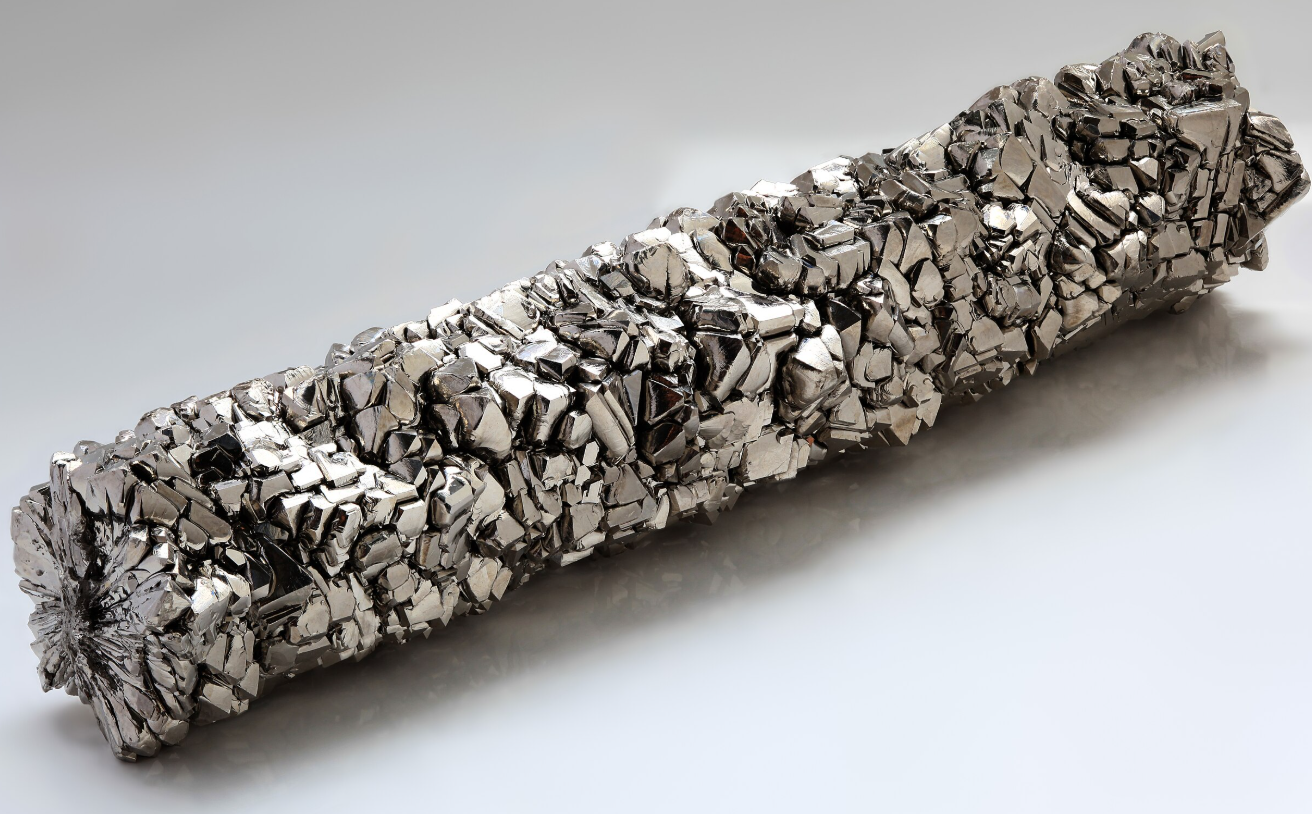
Titanium (Ti, atomic number 22), a lustrous, silvery-gray transition metal in group 4 (below zirconium and hafnium), is the ultimate paradox: as strong as many steels yet nearly half the density, as corrosion-resistant as platinum yet abundant in Earth’s crust (~0.57%, 9th most abundant element). Named after the Titans of Greek mythology for its formidable strength, titanium was discovered in 1791 by William Gregor in Cornwall, England (as “menachanite”), independently rediscovered and named by Martin Heinrich Klaproth in 1795. Pure metallic titanium wasn’t isolated until 1910 by Matthew A. Hunter, and commercial production via the energy-intensive Kroll process began in the 1940s. Today, titanium quietly powers aerospace, medicine, and the deep sea while hiding remarkable physical, chemical, and biological secrets.
1. Hidden Features: Strength-to-Weight King, Passive Oxide Shield, and Allotropic Versatility
Titanium’s electron configuration [Ar] 3d² 4s² gives it classic transition-metal bonding, but its properties are elevated by a perfect storm of factors.
- Unmatched Strength-to-Weight Ratio: Pure titanium has a tensile strength comparable to many steels (up to ~1000 MPa in alloys), yet its density is only ~4.51 g/cm³—about 60% that of steel and 40% less than nickel superalloys. This makes Ti-6Al-4V (the workhorse alloy) the gold standard for weight-critical applications.
- Ultimate Corrosion Resistance: Titanium forms a thin, tenacious, self-healing TiO₂ passive oxide layer instantly in air or water—even in aggressive environments like seawater, chlorine, nitric acid, and body fluids. This layer is stable up to ~400–500 °C and reforms if scratched, explaining why titanium lasts decades in marine, chemical, and biomedical settings where stainless steel or aluminum would fail.
- Allotropic Transformation & Alloying Magic: Titanium has two main allotropes: α (hcp, stable at low temperature) and β (bcc, stable above 882 °C). Alloying with α-stabilizers (Al, O) or β-stabilizers (V, Mo, Fe) creates α, near-α, α+β, or metastable β alloys with tailored properties—high strength, creep resistance, superplasticity, or low modulus for medical implants.
- Biocompatibility & Osseointegration: Titanium’s oxide surface is non-toxic, non-allergenic (except rare cases), and promotes direct bone bonding (osseointegration)—the reason it dominates dental implants, hip/knee replacements, spinal hardware, and craniofacial reconstruction.
- Superconductivity & Low-Temperature Behavior: Certain titanium alloys (e.g., Ti-Nb) become superconducting at ~9–10 K, used in MRI magnets and particle accelerators. Pure titanium shows very low thermal expansion and excellent cryogenic toughness.
2. Covert Uses: Aerospace Backbone, Medical Savior, and Deep-Sea Shield
Global titanium sponge production is ~200,000–300,000 tonnes/year, with ~50% going to aerospace—yet its strategic importance far exceeds volume.
- Aerospace & Defense Dominance: ~50% of titanium use is in airframes, engines, and fasteners (Boeing 787 ~15% Ti by weight, F-22 Raptor ~40%, hypersonic vehicles). It withstands high temperatures (up to ~600 °C in engines), resists fatigue, and saves massive weight—critical for range, payload, and maneuverability.
- Medical Implants & Prosthetics: Titanium and Ti alloys (especially Ti-6Al-4V ELI and β-Ti alloys like Ti-15Mo) are the gold standard for joint replacements, bone plates, dental implants, pacemakers, and vascular stents—chosen for biocompatibility, modulus close to bone, and MRI compatibility.
- Chemical & Desalination Plants: Titanium tubing and vessels handle wet chlorine, seawater reverse osmosis, and acidic brines in chemical processing and desalination—lasting 20–40 years where other metals corrode in months.
- Deep-Sea & Submersibles: Titanium pressure hulls (e.g., Russian Mir submersibles, Chinese Jiaolong, Limiting Factor for Five Deeps Expedition) reach full ocean depth (11 km) thanks to high yield strength, low density, and perfect seawater corrosion resistance.
- Sporting Goods & Consumer Luxury: Titanium golf clubs, bicycle frames, watch cases (e.g., Apple Watch Ultra, high-end Rolex), and eyeglass frames leverage its lightweight strength and hypoallergenic nature.
In summary, titanium isn’t just another metal—it’s the lightweight champion of strength, the corrosion-proof survivor of the harshest environments, the biocompatible foundation of modern medicine, and the silent enabler of the fastest aircraft and deepest dives.
What’s your favorite titanium application—or have you ever held a piece of the stuff and felt how unnaturally light it is for something so tough? Drop it below!