

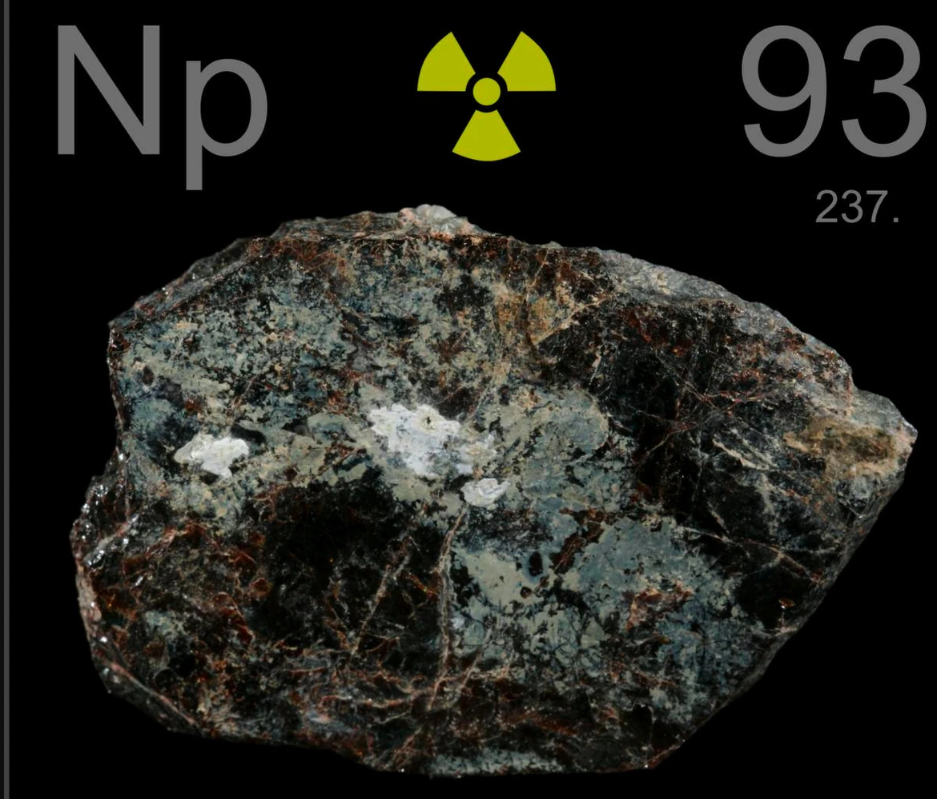
Neptunium (Np, atomic number 93), the first synthetic transuranic element and the fifth member of the actinide series, sits just beyond uranium in the periodic table. This silvery, radioactive metal was the pioneer that opened the door to the entire realm of elements heavier than uranium. Named after the planet Neptune (following uranium’s namesake), neptunium exists primarily as a byproduct of nuclear reactors and has no stable isotopes—all are radioactive, with half-lives spanning from days to millions of years. Produced atom-by-atom in the early days and now in kilogram quantities as reactor waste, neptunium reveals profound insights into actinide chemistry, nuclear fuel cycles, and even deep-space power generation.
1. Hidden Features: Multiple Oxidation States, Relativistic Quirks, and Isotopic Extremes
Neptunium’s electron configuration [Rn] 5f⁴ 6d¹ 7s² places it in a transitional zone where 5f electrons begin to participate actively in bonding, influenced by relativistic effects.
- Variable Oxidation States: Neptunium exhibits one of the widest ranges among actinides: +3, +4, +5, +6, and even +7 in strong oxidants (NpO₅⁻). The +5 (NpO₂⁺) and +6 (NpO₂²⁺) neptunyl ions are particularly stable in aqueous solution due to the linear O=Np=O structure—similar to uranyl but with distinct spectroscopic and complexation behaviors that make Np a key probe for actinide environmental migration.
- Relativistic Effects & Colorful Chemistry: Relativistic contraction stabilizes higher oxidation states, but neptunium’s colors shift dramatically: Np³⁺ (violet), Np⁴⁺ (yellow-green), NpO₂⁺ (green), NpO₂²⁺ (pinkish). These arise from f-f transitions modulated by spin-orbit coupling and ligand fields—offering a window into quantum chemistry at the heavy-element limit.
- Isotopic Range & Longest-Lived Champion: 25 known isotopes (225Np to 244Np). The longest-lived is ²³⁷Np (half-life 2.144 million years, alpha decay to ²³³Pa), followed by ²³⁶Np (~154,000 years) and ²³⁵Np (~396 days). Short-lived ²³⁹Np (2.356 days, beta decay to ²³⁹Pu) was the first discovered. This vast half-life span—from microseconds to megayears—makes neptunium ideal for studying nuclear decay systematics and long-term radiotoxicity.
- Nuclear Precursor Role: ²³⁷Np captures neutrons to form ²³⁸Np (beta decay → ²³⁸Pu), linking it directly to space-power isotopes. Trace natural ²³⁷Np exists from neutron capture on primordial uranium or cosmic-ray interactions.
2. Covert Uses: Pu-238 Precursor, Neutron Detection, and Fuel-Cycle Sentinel
Neptunium has no bulk commercial applications due to its radioactivity and handling challenges, but its “covert” roles in nuclear science are critical.
- Plutonium-238 Production for Space: The primary modern use—²³⁷Np is irradiated in reactors to yield ²³⁸Pu (alpha emitter, half-life 87.7 years) for radioisotope thermoelectric generators (RTGs) powering deep-space missions (Voyager, Curiosity rover, Perseverance, Dragonfly to Titan). Recent 2026 ORNL research used thermal decomposition and Raman spectroscopy to map neptunium oxide intermediates, refining Pu-238 production for future missions.
- High-Energy Neutron Detectors: ²³⁷Np fission thresholds make it sensitive to fast neutrons (>~1 MeV) while ignoring thermal ones—used in specialized detectors for reactor monitoring, safeguards, and fusion research.
- Nuclear Waste & Environmental Tracer: As a long-lived fission product byproduct, ²³⁷Np dominates long-term radiotoxicity in spent fuel (after Pu decays). Its mobility in groundwater (especially as soluble NpO₂⁺) is a key concern in geological repositories—driving studies on actinide speciation under disposal conditions.
- Fundamental Actinide Research: Neptunium serves as a “bridge” actinide—easier to handle in mg quantities than heavier ones—for spectroscopy, complexation, and redox studies that inform models for plutonium, americium, and curium behavior.
In summary, neptunium isn’t just the first element beyond uranium—it’s the gateway to transuranics, a multi-valent chemical chameleon, the longest-lived major actinide waste contributor, and the quiet precursor fueling humanity’s farthest robotic explorers.
What’s your take on neptunium—fascinating bridge element, tricky waste culprit, or the unsung hero of space RTGs? Drop it below!