

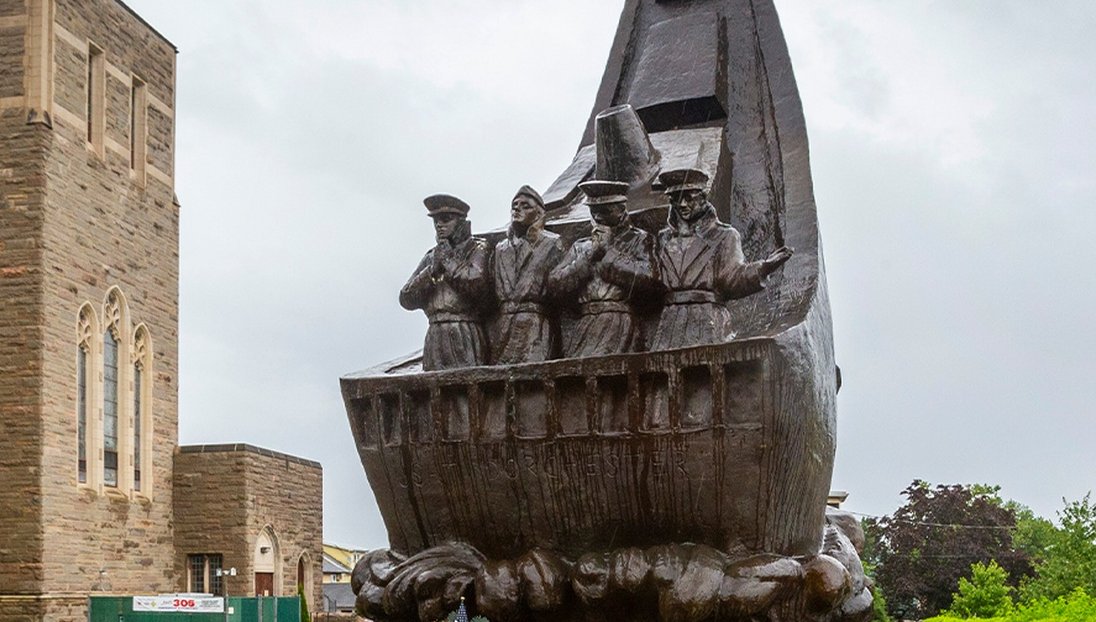
February 3 is observed in the United States as Four Chaplains Day, a day of remembrance that commemorates the extraordinary heroism of four U.S. Army chaplains during one of the most poignant maritime disasters of World War II.
On the night of February 3, 1943, the U.S. Army transport ship USAT Dorchester was torpedoed by a German U-boat (U-223) in the icy North Atlantic, about 150 miles off Greenland. The ship carried more than 900 men — soldiers, merchant mariners, and civilians — bound for Greenland. Within minutes the Dorchester was sinking fast in freezing waters, with only enough lifeboats and life jackets for a fraction of those on board.
The four chaplains aboard — George L. Fox (Methodist), Alexander D. Goode (Jewish), Clark V. Poling (Dutch Reformed), and John P. Washington (Roman Catholic) — immediately went into action. They helped load lifeboats, distributed life jackets, and calmed terrified men. When the supply of life jackets ran out, each chaplain removed his own and gave it to a soldier who had none. Witnesses later reported seeing the four men linking arms on the slanting deck, praying together in their respective traditions as the ship went down.
Of the 904 men aboard, only 230 survived. The four chaplains perished, but their selfless act of interfaith courage and sacrifice became one of the most inspiring stories of the war.
Significance:
- The story quickly spread and captured the American imagination, symbolizing unity across religious lines at a time when the country was fighting a global war against fascism.
- In 1948, Congress created a special non-military Four Chaplains’ Medal (sometimes called the Chaplain’s Medal for Heroism), awarded posthumously to the four men — the only time this decoration has ever been given.
- The date is recognized by the Immortal Chaplains Foundation and many veterans’ and interfaith organizations. It is also considered a feast day in the liturgical calendar of the Episcopal Church (USA), where the four chaplains are commemorated together on February 3.
Observances:
- Ceremonies: The primary event takes place at the Four Chaplains Memorial in Philadelphia (near the site of the former chapel at the Philadelphia Naval Shipyard), with wreath-laying, interfaith prayers, and readings from survivors’ accounts.
- Interfaith services: Churches, synagogues, and military chapels across the country hold special services, often involving clergy from multiple denominations reading from the chaplains’ own writings or prayers.
- Educational programs: Many schools, military bases, and veterans’ groups present lessons or films about the event (including the 1954 book Sea of Glory by Francis Beauchesne Thornton and various documentaries).
- Symbolic acts: Some organizations distribute “life jacket” symbols or hold candlelight vigils; the story is shared widely on social media each year (#FourChaplainsDay).
February 3 is not a federal holiday or public day off, but it remains one of the most moving and unifying days of remembrance in American military and religious history — a powerful reminder that courage, compassion, and faith can transcend differences even in the darkest moments.
A line often quoted from survivor accounts: “They gave their life jackets to others — and went down with the ship, arm in arm.”
On February 3, the United States remembers four chaplains who proved that true heroism knows no creed. 🇺🇸