

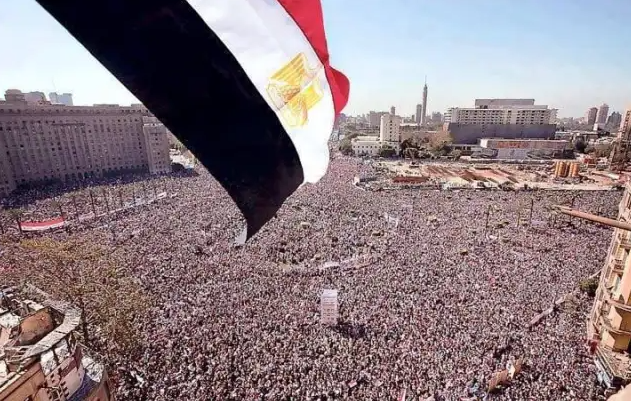
On January 25, 2026, Egypt commemorates Revolution Day (also known as the January 25 Revolution or Thawrat 25 Yanayir), marking the 15th anniversary of the start of the 2011 Egyptian revolution that toppled President Hosni Mubarak after 30 years in power.
The revolution began on January 25, 2011, when hundreds of thousands of Egyptians took to the streets — inspired by Tunisia’s Jasmine Revolution — to protest police brutality, corruption, economic hardship, unemployment, and political repression under Mubarak’s regime. Protesters chose January 25 deliberately, as it was already National Police Day (commemorating the 1952 Battle of Ismailia against British forces), turning a state holiday into a day of defiance against state security forces. Demonstrations erupted across cities, with Tahrir Square in Cairo becoming the epicenter of the 18-day uprising. Chants of “Bread, Freedom, Social Justice” and “The People Want the Fall of the Regime” echoed nationwide.
By February 11, 2011, after massive protests, military intervention, and Mubarak’s refusal to step down initially, the president resigned, handing power to the Supreme Council of the Armed Forces (SCAF). The revolution was hailed as a triumph of people power, part of the broader Arab Spring, leading to Mubarak’s trial, constitutional reforms, and Egypt’s first democratic elections in decades.
Significance in 2026:
- The day reflects on the revolution’s demands for dignity, freedom, and justice, while also highlighting the complex aftermath — including subsequent political shifts, the 2013 events, and ongoing debates about democracy, stability, and reform.
- It coincides with National Police Day (Eid al-Shurta), honoring the 1952 police martyrs in Ismailia, creating a dual observance on the same date.
Observances in 2026:
- As a public holiday, government offices, schools, and many businesses close (with some sources noting adjustments for private sector employees, e.g., to January 29 in certain announcements to align with the calendar).
- Official commemorations: Ceremonies focus on police valor and national security; President Abdel Fattah El-Sisi typically delivers a speech praising the armed forces and police for protecting the state and people.
- Public reflection: While large-scale street protests are tightly controlled, the day prompts quiet remembrance among activists, families, and citizens — through social media tributes, documentaries, archival footage, and discussions on the revolution’s legacy.
- Media coverage: State and independent outlets broadcast historical programs, survivor stories, and analyses; Tahrir Square and other sites see symbolic gatherings or security presence.
- Dual symbolism: The government emphasizes police heroism (from 1952 and beyond), while some civil society voices recall the 2011 demands for reform and accountability.
Revolution Day remains a poignant milestone — a reminder of the power of collective action, the high cost of change, and Egypt’s ongoing journey toward stability and aspirations for justice.
A chant from 2011 that still resonates: “Al-sha’b yurid isqat al-nizam” (“The people want the fall of the regime”).
On this day, Egypt reflects on a transformative chapter that reshaped the nation and inspired the region. 🇪🇬