

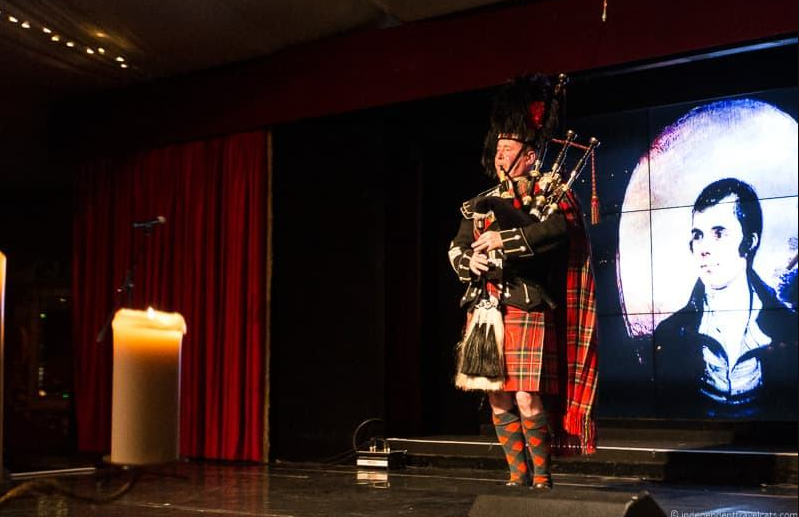
On January 25, 2026 (Sunday), Scotland and Scottish communities worldwide observe Burns Night (or Burns Nicht in Scots), an annual celebration of the life, poetry, and legacy of Robert Burns (1759–1796), Scotland’s national bard and one of the world’s most beloved poets.
Burns Night falls on the anniversary of Robert Burns’ birthday (born January 25, 1759, in Alloway, Ayrshire). The tradition began shortly after his death when friends gathered to honor him with informal suppers featuring his favorite foods, recitations of his works, and toasts. The first formal Burns Supper took place in 1801 (on July 21, his death anniversary), but by the mid-19th century, January 25 became the standard date for global celebrations.
Burns’ poetry — written in Scots and English — captures themes of love, nature, equality, social justice, and Scottish identity. Iconic works include “Auld Lang Syne” (the world’s New Year’s anthem), “A Red, Red Rose”, “Tam o’ Shanter”, “To a Mouse” (“The best-laid schemes o’ mice an’ men…”), and “Address to a Haggis”. His egalitarian spirit (“A man’s a man for a’ that”) resonates deeply, making him a symbol of Scottish pride and human brotherhood.
Burns Supper Traditions (Typical Running Order):
- Piping in the guests — A bagpiper welcomes arrivals with traditional tunes.
- Chairman’s welcome — The host (chairperson) opens with remarks and introduces the evening.
- The Selkirk Grace — A short grace by Burns: “Some hae meat and canna eat, And some wad eat that want it; But we hae meat, and we can eat, Sae let the Lord be thankit.”
- Piping in the haggis — The star of the meal: A bagpiper leads a procession carrying the haggis (a savory pudding of sheep’s heart, liver, lungs, oatmeal, suet, onion, and spices in a stomach casing) to the table.
- Address to a Haggis — The host dramatically recites Burns’ famous poem, praising the “Great Chieftain o’ the Puddin-race!” With a dramatic flourish, the speaker “stabs” the haggis at the line “His knife see rustic Labour dight,” then everyone toasts: “The haggis!”
- The meal — Haggis served with neeps (mashed turnips) and tatties (mashed potatoes), often accompanied by Scotch whisky.
- Immortal Memory — A guest delivers a thoughtful speech on Burns’ life and works.
- Toast to the Lassies — A humorous speech by a man praising women (inspired by Burns’ love for them).
- Reply to the Laddies — A witty response by a woman.
- More poetry and songs — Recitations of Burns’ works, songs, and ceilidh dancing (often with bagpipes or a band).
- Closing — Final toast: “Auld Lang Syne” sung arm-in-arm, followed by the host’s thanks.
Celebrations in 2026:
- From Glasgow’s whisky festivals and ceilidhs to Edinburgh’s pub suppers and Dumfries’ winter festivals, Scotland hosts hundreds of events — traditional formal suppers, casual home gatherings, modern twists (vegan haggis, comedy nights), and large public celebrations.
- Burns Clubs worldwide (over 2,000 globally) organize suppers, while diaspora communities in the UK, Canada, Australia, the US, and beyond join in.
- The day promotes Scottish culture, literature, and hospitality — often with live music, whisky tastings, and Burns poetry readings.
Burns Night is not a public holiday in Scotland (schools and offices usually open), but it unites Scots and admirers in joyful tribute to a poet whose words remain timeless.
A beloved Burns line often quoted: “O wad some Power the giftie gie us / To see oursels as ithers see us!” (from “To a Louse”)
On Burns Night 2026, raise a glass to the Bard — Scotland’s eternal voice of heart, humor, and humanity. 🏴