

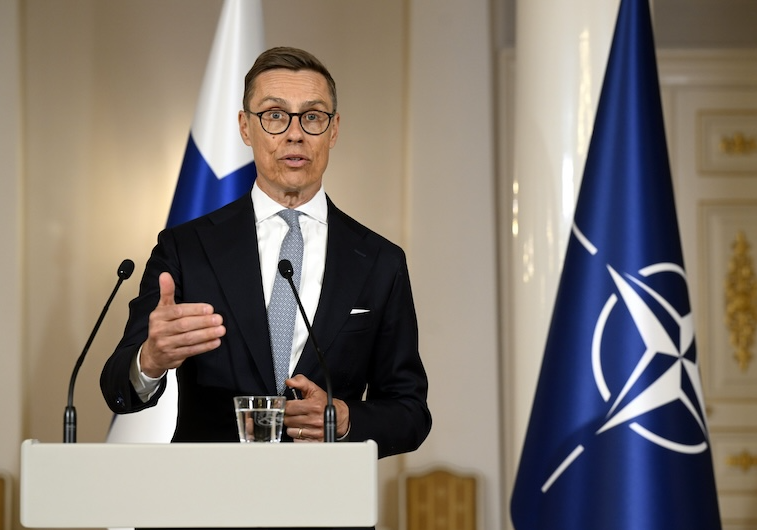
Cai-Göran Alexander Stubb is a Finnish politician, academic and diplomat who became the 13th President of Finland on 1 March 2024. His career has taken him through European institutions, Finnish government, financial diplomacy and international academic leadership. Having served as foreign minister, prime minister and finance minister, he entered the presidency with extensive experience of European affairs and international relations. His leadership has increasingly focused on European security, support for Ukraine, transatlantic relations and the changing structure of the international order.
Born on 1 April 1968 in Helsinki, Finland, Stubb grew up in a bilingual Finnish-Swedish family. His father, Göran Stubb, was a prominent figure in Finnish ice hockey administration, while his mother, Christel Stubb, came from a Finnish-speaking background. Growing up in a bilingual environment gave him an early familiarity with Finland’s two national languages and different cultural traditions. He attended Finnish-speaking and Swedish-speaking schools before completing his general upper secondary education and military service.
Stubb pursued higher education in the United States and Europe, building an academic foundation in political science and international relations. He graduated from Furman University in South Carolina in 1993 with a Bachelor of Arts degree in Political Science. In 1994, he obtained a diploma in French language and civilisation from the Sorbonne University in Paris. He subsequently completed a Master of Arts degree in Political Science at the College of Europe in Bruges in 1995. His academic journey culminated in a PhD in International Relations from the London School of Economics and Political Science in 1999. His doctoral research examined flexible integration within the European Union, a subject that would remain central to his political and diplomatic career.
Before entering elected politics, Stubb worked in research and European affairs. From 1995 to 1997, he served as a researcher at Finland’s Ministry for Foreign Affairs, followed by doctoral research at the Academy of Finland. He later worked at Finland’s Permanent Representation to the European Union in Brussels, first as a researcher and then as a counsellor. These positions gave him direct exposure to European policymaking at a time when the European Union was developing its institutional and political framework following the Maastricht Treaty.
Between 2001 and 2003, Stubb served as an adviser to European Commission President Romano Prodi. He also worked as a visiting professor at the College of Europe, contributing to academic discussions on European integration. His experience in Brussels strengthened his understanding of the relationship between national governments and European institutions, while establishing his reputation as a specialist in European affairs.
Stubb entered electoral politics in 2004, when he contested the European Parliament elections as a candidate of Finland’s National Coalition Party. He was elected with the second-highest number of votes in Finland and served as a Member of the European Parliament from July 2004 to April 2008. During this period, he became known for his engagement with European integration, institutional reform and the Union’s external relations. His parliamentary experience also provided a platform for his transition into Finland’s national government.
In April 2008, Stubb was appointed Finland’s Minister for Foreign Affairs in the government led by Prime Minister Matti Vanhanen. He held the position until June 2011, representing Finland during a period of significant international and European developments. His tenure coincided with the financial crisis and the European Union’s efforts to respond to economic instability. He also served as chairman of the Organization for Security and Co-operation in Europe in 2008. During that year, he became involved in diplomatic efforts surrounding the Russia-Georgia war, including his role in the international response and peace mediation efforts.
Following the 2011 parliamentary election, Stubb entered Finland’s Parliament and became Minister for European Affairs and Foreign Trade in June 2011. He held the portfolio until June 2014, working on European Union policy, trade relations and Finland’s economic engagement with international markets. The position placed him at the intersection of domestic economic priorities and European decision-making.
In June 2014, Stubb was elected chairman of the National Coalition Party, succeeding Jyrki Katainen. He subsequently became Prime Minister of Finland, serving from June 2014 to May 2015. His government faced economic difficulties, structural challenges and debates over Finland’s competitiveness. Although his premiership lasted less than a year, it marked the highest executive office he had held before his election as president. After the 2015 parliamentary election, he became Minister of Finance in Prime Minister Juha Sipilä’s government, serving until June 2016. His time in the finance ministry brought him closer to questions of public expenditure, economic reform and fiscal policy.
After leaving the government, Stubb continued to work in European financial and institutional affairs. In August 2017, he became Vice-President of the European Investment Bank, a position he held until 2020. His work at the institution expanded his experience beyond national politics and gave him exposure to the role of development finance and investment in supporting European economic priorities.
In May 2020, Stubb became Director and Professor of the School of Transnational Governance at the European University Institute in Florence, Italy. The position allowed him to return to academic and policy work, focusing on international governance, European affairs and the challenges facing the multilateral system. He remained in the role until February 2024, taking leave in October 2023 to contest Finland’s presidential election. He also chaired the board of the Crisis Management Initiative, a conflict mediation organisation founded by former Finnish President Martti Ahtisaari, from 2017 until 2024.
Stubb announced his presidential candidacy as an independent candidate supported by the National Coalition Party. In the first round of voting on 28 January 2024, he secured the highest share of the vote but did not obtain an outright majority. He advanced to the second round against former Foreign Minister Pekka Haavisto. On 11 February 2024, Stubb won the presidential election with approximately 51.6 per cent of the vote, compared with Haavisto’s 48.4 per cent. He was inaugurated on 1 March 2024, succeeding Sauli Niinistö.
His election came at a defining moment in Finland’s security and foreign policy. Finland had joined NATO on 4 April 2023, ending decades of military non-alignment following Russia’s full-scale invasion of Ukraine. Although the decision to join the alliance preceded Stubb’s presidency, his administration assumed responsibility for consolidating Finland’s new security position within NATO. The country’s long border with Russia, its geographical location in Northern Europe and its historical experience of relations with Moscow have made security and defence central to his presidential agenda.
As president, Stubb has emphasised Finland’s commitment to NATO, European cooperation and continued support for Ukraine. He has argued that any sustainable settlement to the Russia-Ukraine war must include credible security guarantees for Kyiv. At the Coalition of the Willing summit in Paris on 6 January 2026, he stressed the importance of strong commitments from Europe and the United States to support Ukraine’s defence and security after a possible ceasefire. He also stated that Finland would participate in a multinational force supporting Ukraine in a manner consistent with its national decision-making processes.
His position on Ukraine has been accompanied by an effort to maintain transatlantic cooperation. Stubb has sought to preserve close relations with the United States while emphasising that European countries must take greater responsibility for their own security. In February 2026, he argued that Finland and Europe needed to recognise changes in American foreign policy and reassess their security assumptions. His approach reflects the challenge of maintaining the transatlantic partnership while preparing Europe for a more uncertain international environment.
At the Munich Security Conference in February 2026, Stubb participated in discussions on transatlantic relations, European defence and the future of the multilateral system. He also met Ukrainian President Volodymyr Zelenskyy and senior representatives from the United States and other countries. His engagement has reflected an effort to position Finland as an active participant in discussions on European security rather than simply a country responding to developments along its eastern border.
Beyond European security, Stubb has sought to articulate a broader understanding of global power relations. His approach places importance on cooperation between established powers, emerging economies and the wider international community. In his 2025 book The Triangle of Power: Rebalancing the New World Order, he examined the changing relationship between the United States, China and the Global South. He has argued that the international system can no longer be understood solely through the traditional framework of Western leadership and great-power competition. His interest in the Global South also reflects an effort to understand how countries outside the traditional centres of power are influencing global institutions and international decision-making.
Stubb has also addressed the growing importance of artificial intelligence and technological change in international security. During the 81st session of the United Nations General Assembly in September 2026, he co-chaired an international discussion on artificial intelligence with Kenyan President William Ruto. His participation reflected the growing recognition that technological developments are no longer confined to economic competition but are increasingly connected to national security, international governance and the balance of global power.
In his address to the UN General Assembly on 22 September 2026, Stubb presented cooperation and conflict as a defining choice for the international community. He warned that declining trust, disregard for international rules and weakening institutions were contributing to global instability. He also reiterated the importance of international cooperation at a time when armed conflicts and geopolitical competition were placing pressure on the existing international system. His address reflected his broader diplomatic argument that the future of international relations will depend on whether states can preserve cooperation despite their competing interests.
His foreign policy thinking has also been shaped by Finland’s experience as a small state operating alongside a major power. Stubb has repeatedly emphasised the importance of international law, collective security and multilateral institutions, while recognising that national interests and strategic capabilities remain central to international politics. His approach seeks to combine values, interests and power rather than treating them as separate elements of foreign policy.
In November 2026, Stubb continued to present his vision of European security and international cooperation during a speech at the Walther Rathenau Award ceremony in Berlin. He described the present period as a time of profound transformation, marked by the return of war to Europe, the growing strategic importance of economic dependencies and the use of technology as an instrument of power. He argued that Europe needed to strengthen its defence capabilities and remain directly involved in discussions concerning the future European security order. He also reiterated that support for Ukraine was closely connected to Europe’s own long-term peace and security.
Stubb’s international profile has been accompanied by recognition from several European and international institutions. In 2026, he received the Atlantic Council’s Global Citizen Award and the Center for European Policy Analysis Global Impact Award. His academic background and experience in European institutions have also contributed to his standing as a political figure who combines national leadership with an international outlook.
Alongside his political and diplomatic career, Stubb has remained an active writer. His publications have addressed European integration, international politics, Finnish identity and the changing global order. His 2017 autobiography, written with Karo Hämäläinen, offered an account of his personal and political journey. His 2025 book on the changing world order further developed his reflections on the relationship between major powers and the growing influence of the Global South.
Alexander Stubb’s journey from academic research and European diplomacy to the highest office in Finland reflects a career shaped by European integration and international engagement. His presidency has coincided with a period of major change in European security, particularly following Finland’s entry into NATO and the continuing war in Ukraine. He has sought to strengthen Finland’s position within the Western security framework while arguing for a wider understanding of global power relations and the need for renewed multilateral cooperation. His principal challenge will be to translate this international outlook into practical diplomatic influence while safeguarding Finland’s security and interests in an increasingly unpredictable world.
Alexander Stubb’s Quote
“We have outsourced European engagement with Russia for too long and I think that is irresponsible.”
17 November 2026, Interview with the Financial Times