

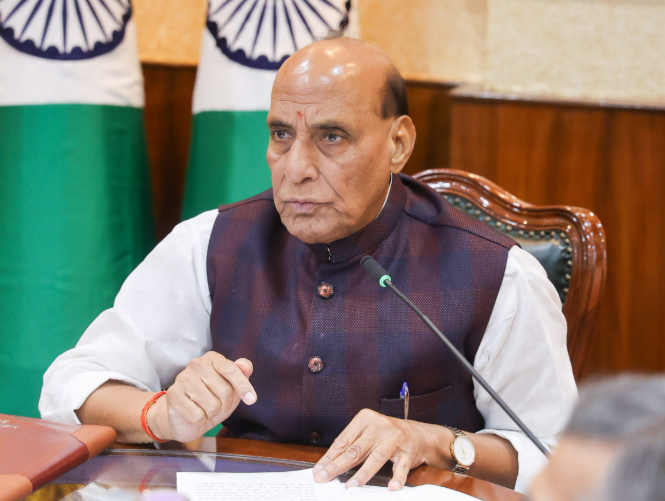
Rajnath Singh is one of the senior-most leaders of the Bharatiya Janata Party (BJP) and a prominent figure in India’s political and national security establishment. His political career spans nearly five decades, taking him from student activism and organisational responsibilities within the Rashtriya Swayamsevak Sangh (RSS) and the BJP to the chief ministership of Uttar Pradesh, the presidency of the BJP and several important Union Cabinet portfolios. Having served as India’s Home Minister from 2014 to 2019, he became Defence Minister in 2019 and retained the portfolio following the 2024 general election. His journey reflects the evolution of a political organiser into one of the country’s most experienced parliamentary and ministerial leaders.
Born on 10 July 1951 in Babhora village in the Chandauli district of Uttar Pradesh, Rajnath Singh grew up in a farming family. His parents were Ram Badan Singh and Gujarati Devi. He pursued higher education in physics at Gorakhpur University, where he completed his master’s degree. Before entering full-time politics, he worked as a lecturer of physics at K.B. Post Graduate College in Mirzapur. His early involvement in public life developed through student politics and organisational work. He was associated with the Akhil Bharatiya Vidyarthi Parishad (ABVP) and served in the RSS organisation in Mirzapur. These formative years introduced him to political mobilisation, ideological organisation and grassroots activity, laying the foundation for his subsequent career within the BJP.
Rajnath Singh entered electoral politics in the 1970s and was elected to the Uttar Pradesh Legislative Assembly in 1977. He gradually assumed responsibilities within the BJP’s organisational structure, becoming the party’s Uttar Pradesh state secretary in 1983 and state president of the Bharatiya Janata Yuva Morcha, the BJP’s youth wing, in 1984. He subsequently served as its national general secretary and became its national president in 1988. His organisational responsibilities expanded alongside his political career, and in 1988 he entered the Uttar Pradesh Legislative Council. This period established his position within the party’s leadership structure and gave him experience in both electoral politics and organisational management.
His first major ministerial responsibility came in 1991, when he became Education Minister in the Uttar Pradesh government. During his tenure, he introduced the Anti-Copying Act, aimed at addressing examination malpractice, and promoted the inclusion of Vedic Mathematics in the educational curriculum. In 1994, he entered the Rajya Sabha, where he served as a member of Parliament and became associated with the BJP’s parliamentary organisation. He also served as the party’s Uttar Pradesh president from 1997, a period during which he worked to expand its organisational presence. His political responsibilities subsequently extended to the Union Cabinet. In November 1999, he became Minister of Surface Transport in the government of Prime Minister Atal Bihari Vajpayee, where he was associated with the early implementation of the National Highways Development Project.
In October 2000, Rajnath Singh became Chief Minister of Uttar Pradesh, one of India’s most politically significant states. His tenure continued until 2002, placing him at the head of the state government during a period of political and administrative challenges. After leaving the chief minister’s office, he returned to the Union Cabinet in May 2003 as Minister of Agriculture and subsequently held responsibility for Food Processing Industries. During this period, initiatives including Kisan Call Centres and the Farm Income Insurance Scheme were introduced. His experience across state administration, agriculture and infrastructure strengthened his position as a senior national leader. He also continued to hold important organisational responsibilities within the BJP, maintaining a connection between the party’s national leadership and its state-level structures.
In December 2005, Rajnath Singh was elected National President of the BJP, succeeding L. K. Advani in the party’s leadership sequence. He held the position until December 2009, overseeing the organisation during a period that included the party’s preparations for the 2009 general election and its subsequent return to opposition. His presidency focused on strengthening the party organisation, expanding its political presence and addressing issues including national security, inflation and farmers’ concerns. He returned to the presidency in January 2013, succeeding Nitin Gadkari. During this second tenure, the BJP prepared for the 2014 general election, with Narendra Modi emerging as its prime ministerial candidate. The party secured a parliamentary majority in that election, and Rajnath Singh’s role as national president placed him among the central organisational figures behind its campaign and transition into government.
Following the BJP’s victory in 2014, Rajnath Singh was appointed Union Home Minister in Prime Minister Narendra Modi’s first government. His tenure from May 2014 to May 2019 involved responsibility for internal security, border management, policing and the country’s internal administrative security framework. During this period, the government addressed terrorism, Left-Wing Extremism, border infrastructure and security challenges in Jammu and Kashmir. He also oversaw the Ministry’s response to several major internal security developments and worked with central security agencies and state governments. His experience as Home Minister established his role as one of the principal figures in the government’s national security decision-making structure before he moved to the Defence Ministry in 2019.
In May 2019, following the BJP’s second consecutive general election victory, Rajnath Singh was appointed Defence Minister. His tenure has coincided with a period of significant changes in India’s defence planning, military modernisation and strategic environment. These have included the eastern Ladakh border confrontation with China, the expansion of indigenous defence manufacturing and efforts to strengthen India’s defence-industrial base. The Ministry of Defence continued its indigenisation initiatives through positive indigenisation lists intended to reduce dependence on imported military equipment. The period also saw increased attention to defence exports, domestic production and the development of military infrastructure along India’s borders. As Defence Minister, Singh has represented the government in discussions on military preparedness, strategic partnerships and India’s approach to regional security.
In June 2024, Rajnath Singh was re-elected to the Lok Sabha from Lucknow for a third consecutive term and was appointed Defence Minister for a second consecutive term in the third Modi government. His continuation in the portfolio placed him among the most experienced members of the Union Cabinet, with responsibility for overseeing India’s defence establishment during a period of evolving regional and global security challenges. His priorities include military modernisation, domestic defence production, technological development and strengthening the operational capabilities of the armed forces. He has also been associated with the government’s efforts to expand defence cooperation with international partners while promoting greater self-reliance in the production of military equipment. As of November 2026, he continues to serve as India’s Defence Minister and represents Lucknow in the 18th Lok Sabha.
Across his political career, Rajnath Singh has held responsibilities at almost every major level of India’s political and administrative system, from the state legislature and chief minister’s office to the leadership of a national political party and senior positions in the Union Cabinet. His career has included the management of party organisation, state administration, internal security and national defence. His successive roles as BJP president, Home Minister and Defence Minister have placed him within several important phases of the party’s political development and India’s governance. From his early years as a physics lecturer and student organiser to his present position as Defence Minister, his trajectory represents a long progression through the organisational and governmental structures of Indian politics.
Rajnath Singh`s Quote
“Peace cannot necessarily be achieved by a desire for peace but by the ability to deter war.”
5 November 2020, National Defence College address.