

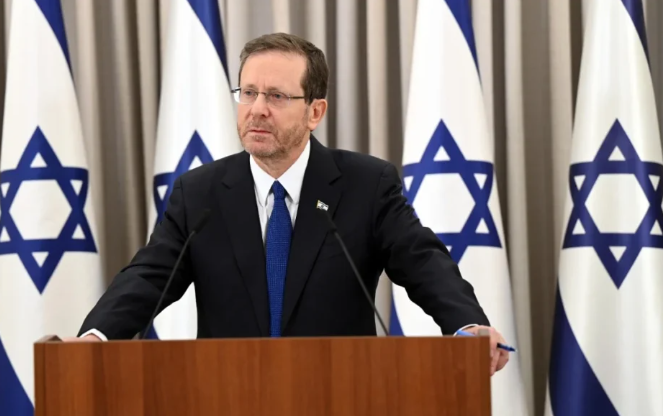
Isaac Herzog has established himself as one of the most prominent figures in Israel’s political establishment, with a career spanning parliamentary politics, ministerial administration, international Jewish affairs and the presidency. Born on 22 September 1960 in Tel Aviv, he belongs to a family with a long history of involvement in Israel’s political, diplomatic and religious institutions. His father, Chaim Herzog, served as Israel’s sixth president from 1983 to 1993, having previously held senior military and diplomatic positions, including head of the IDF Intelligence Directorate and Israel’s ambassador to the United Nations. His grandfather, Rabbi Yitzhak HaLevi Herzog, served as the first Ashkenazi Chief Rabbi of Israel, while his mother, Aura Herzog, was involved in several public and cultural initiatives. This family background exposed him to the country’s political traditions and public institutions from an early age. Herzog received his education in Israel and the United States, studied at Cornell University and subsequently obtained a law degree from New York University School of Law. He also served in the Israel Defense Forces’ Intelligence Corps before beginning his professional career as a lawyer specialising in communications law. His early experience combined legal training, military service and familiarity with government administration, providing the foundation for his eventual entry into national politics.
Herzog’s political career developed primarily through the Israeli Labour Party, where he gradually established himself as an important figure in the centre-left political establishment. He entered the Knesset in 2003 and subsequently served in several ministerial positions, including Minister of Housing and Construction, Minister of Tourism, Minister of Welfare and Social Services, and Minister of Diaspora Affairs. These responsibilities provided experience in domestic administration, social policy, housing, tourism and relations with Jewish communities abroad. In 2013, he was elected leader of the Labour Party, succeeding Shelly Yachimovich, and subsequently became Leader of the Opposition following the 2015 parliamentary elections. He led the Zionist Union alliance in the 2015 election against Benjamin Netanyahu’s Likud-led political bloc. Although the alliance did not form the government, his leadership established him as one of the principal figures in Israel’s parliamentary opposition. In 2018, he moved into a different area of public service when he was unanimously elected chairman of the Executive of the Jewish Agency for Israel. During his three-year tenure, he worked on immigration, Jewish community relations, organisational development and strengthening connections between Israel and Jewish communities worldwide. His transition from party leadership to the Jewish Agency also expanded his responsibilities beyond domestic electoral politics, bringing him into closer engagement with international institutions and Jewish organisations.
In June 2021, Herzog was elected Israel’s eleventh president by the Knesset, receiving 87 votes against 26 for his opponent, Miriam Peretz. He assumed office on 7 July 2021, succeeding Reuven Rivlin. His election marked a significant transition from an established party politician to the country’s constitutional head of state. Unlike the prime minister, who leads the government and directs executive policy, the Israeli president primarily performs representative, constitutional and public functions, including receiving foreign leaders, conducting diplomatic engagements, granting pardons within the constitutional framework and participating in national commemorations. Herzog entered the presidency with a stated commitment to addressing internal divisions and strengthening social cohesion. His inaugural address emphasised the responsibility to rebuild hope and bridge the divisions affecting Israeli society. This objective became particularly relevant during the intense domestic controversy surrounding the government’s proposed judicial reforms in 2023. Herzog engaged with political leaders and representatives from different sections of society in an effort to facilitate dialogue and prevent further escalation of the institutional confrontation. Although his mediation efforts did not produce a comprehensive political settlement, they demonstrated his willingness to use the public standing of the presidency to intervene in major national debates without directly controlling the government’s legislative agenda.
The events of 7 October 2023 and the subsequent Israel–Hamas war brought Isaac Herzog into one of the most demanding periods of his presidency. Following the Hamas-led attacks, he assumed a prominent role in representing Israel before international audiences, meeting foreign heads of state, government representatives and diplomatic delegations while addressing the country’s security concerns and the plight of those taken hostage. He participated in numerous diplomatic engagements aimed at maintaining international support for Israel, securing the release of hostages and highlighting the humanitarian and security consequences of the conflict. His presidential activities also included meetings with released hostages and their families, visits to affected communities and engagements with bereaved families. Throughout this period, Herzog used the international standing of his office to communicate Israel’s national concerns, maintain contact with foreign governments and draw attention to the continuing hostage crisis. The war consequently became a defining chapter of his presidency, significantly expanding the international visibility of his role as Israel’s head of state.
A significant dimension of Herzog’s public responsibilities has been his engagement with Jewish communities outside Israel. His experience as chairman of the Jewish Agency provided him with familiarity with the concerns, organisational structures and expectations of Jewish communities across different countries. As president, he has continued to place considerable emphasis on relations with the Jewish diaspora, addressing antisemitism, community security, Jewish identity and the relationship between Israel and Jewish populations abroad. His official engagements have included meetings with community representatives, religious leaders, political figures and international organisations. His February 2026 visit to Australia brought renewed attention to his efforts to address antisemitism and strengthen relations with Jewish communities, while his February 2026 visit to Ethiopia demonstrated the diplomatic and community dimensions of his presidential responsibilities. These engagements reflect a continuation of his earlier work at the Jewish Agency, although the presidency gives such activities a distinct national and diplomatic character. His international outreach has consequently become one of the most consistent features of his public profile.
Herzog’s public leadership style is generally associated with formal diplomacy, institutional engagement and an emphasis on national cohesion. His background in law, military intelligence, parliamentary politics and government administration has given him experience across several areas of public service. Unlike political leaders whose public identities are primarily shaped by electoral campaigns or executive policymaking, his presidential responsibilities require him to represent the state across political, social and international settings. He has frequently spoken about the importance of democratic institutions, national unity and the need to manage disagreements through dialogue. His involvement in the 2023 judicial reform controversy illustrated the limits as well as the possibilities of this approach. While the presidency provided him with a platform to encourage negotiations, it did not give him the authority to independently resolve disagreements between the government, parliament and judiciary. His political background also means that his interventions are not entirely detached from the ideological and institutional debates that have shaped Israeli politics. The distinction between his former role as a party leader and his present constitutional responsibilities remains important when assessing his public conduct.
Looking towards the remainder of his presidential tenure, Herzog’s position will continue to be defined by the responsibilities of Israel’s highest constitutional office and the challenges confronting its political institutions and society. His seven-year presidential term, which began in July 2021, is scheduled to conclude in 2028. His priorities include maintaining the presidency’s institutional standing, sustaining relations with Jewish communities worldwide, representing Israel internationally and addressing the divisions within Israeli society. His future public legacy will also be influenced by how his presidency is assessed in relation to the judicial reform controversy, the Israel–Hamas war, the hostage crisis and the country’s international diplomatic relationships. Although the Israeli president does not exercise the executive powers of the prime minister, the office carries considerable symbolic importance and provides an influential platform for national representation. Herzog’s experience across political parties, government departments, international organisations and constitutional responsibilities gives him a background distinct from that of many previous officeholders. His remaining years in the presidency will provide further evidence of how he balances these different responsibilities.
Isaac Herzog’s political journey represents the evolution of a public figure shaped by family heritage, legal education, military experience, parliamentary leadership and international engagement. From his early years in the Labour Party and his ministerial responsibilities to his leadership of the Jewish Agency and eventual election as Israel’s eleventh president, his career has encompassed several important dimensions of Israeli public life. His presidency has placed him at the centre of national debates and international attention, particularly during the judicial reform controversy and the war that followed the October 2023 attacks. His public record also reflects the challenges of occupying a constitutional office in a country experiencing deep political disagreements and sustained international scrutiny. While his influence differs fundamentally from that of Israel’s prime minister, his position gives him an important role in representing the state, engaging with foreign governments and addressing the concerns of Israeli society. His political legacy will ultimately be shaped not only by the offices he has held but also by how he has exercised the responsibilities and public authority attached to the presidency.
Isaac Herzog`s Quote
“You have my full support to conclude a deal that brings them home.”
25 December 2024 · Hanukkah address in Tel Aviv