

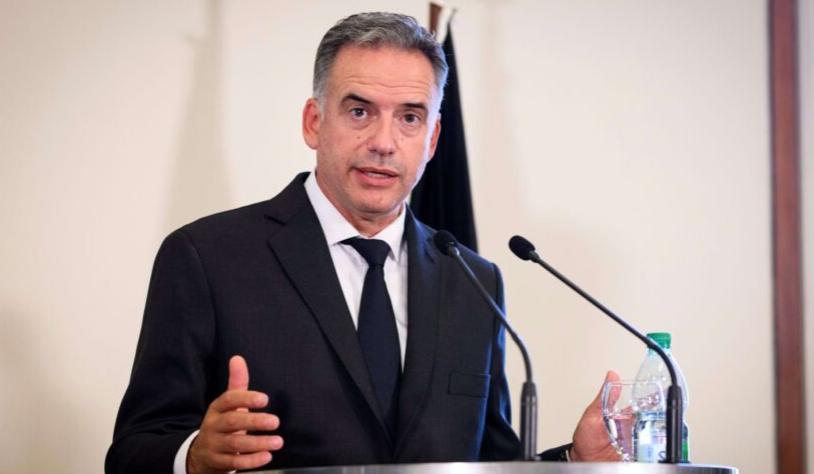
Born on 13 June 1967 in the department of Canelones, Orsi grew up in a rural environment before his family moved to the departmental capital. His father, Pablo Orsi, worked in agriculture, while his mother, Carmen Martínez, was a seamstress. The family later operated a small shop, where Orsi worked from an early age. His upbringing in a working-class household gave him direct exposure to the economic and social conditions of ordinary Uruguayans. He also developed an interest in traditional folk dancing and became involved in cultural activities, eventually performing with the folk dance ballet of the Canelones government.
Orsi completed his early education in Canelones before pursuing teacher training at the Instituto de Profesores Artigas in Montevideo. He qualified as a history teacher and spent more than a decade working in educational institutions across Canelones, Florida and Maldonado. His professional experience as a teacher brought him into contact with students and communities beyond the country’s capital. It also shaped his understanding of education as an important instrument of social mobility and public development. Unlike several political leaders who enter public life through party structures or professional business careers, Orsi’s early working life was closely connected with schools and local communities.
His political involvement began during Uruguay’s return to democracy following the military dictatorship of 1973 to 1985. He became active in the Broad Front, a left-wing political coalition established in 1971, and joined the Movement of Popular Participation (MPP) in 1989. The MPP was associated with former guerrilla movement members, including José Mujica, who later became president of Uruguay. Orsi gradually developed his political standing within the movement, combining grassroots activism with his professional work in education. His political outlook was influenced by the Broad Front’s emphasis on social inclusion, democratic participation and public welfare.
A major opportunity in his political career emerged in 2005, when the Broad Front took control of the Canelones departmental government. Under Intendant Marcos Carámbula, Orsi was appointed Secretary-General of the departmental administration. He held the position for two consecutive administrations, from 2005 to 2015. The role involved coordinating government departments, managing administrative responsibilities and supporting the implementation of local policies. It gave him substantial experience in public administration and established his reputation within the department before he sought elected executive office.
In May 2015, Orsi was elected Intendant of Canelones, becoming the head of the departmental government. His administration focused on supporting small producers, encouraging local economic development, expanding social inclusion programmes and promoting environmental protection. Canelones is one of Uruguay’s most important departments, with a diverse economy encompassing agriculture, industry, services and residential communities connected to the Montevideo metropolitan area. Managing the department required balancing the needs of rural producers with those of expanding urban and suburban populations.
Orsi’s first administration also placed emphasis on sports, cultural participation and community development. His government pursued policies intended to improve local infrastructure and strengthen the relationship between departmental institutions and residents. In September 2020, he secured re-election with support from more than 60 per cent of voters, providing him with a renewed mandate. His strong electoral position reflected the political support he had built through local administration and his standing within the Broad Front.
After nearly nine years as Intendant, Orsi emerged as one of the leading contenders to represent the Broad Front in the 2024 presidential election. In December 2023, the coalition’s national congress endorsed him as one of its presidential pre-candidates. He resigned from the departmental government in February 2024 to concentrate on his presidential campaign. His candidacy was supported by the MPP and received the backing of former president José Mujica, whose political influence remained significant within the coalition.
In the Broad Front’s internal election in June 2024, Orsi emerged as the winning presidential candidate. He subsequently selected Carolina Cosse, former Mayor of Montevideo and a prominent political figure in the coalition, as his running mate. The Orsi-Cosse ticket brought together two different political profiles within the Broad Front, combining Orsi’s experience in departmental administration with Cosse’s background in engineering, national government and the capital’s municipal leadership.
The first round of Uruguay’s presidential election took place on 27 October 2024. The Broad Front secured the largest share of the vote, but Orsi did not obtain the majority required to win the presidency outright. He therefore advanced to a second round against Álvaro Delgado, the candidate of the centre-right governing coalition. On 24 November 2024, Orsi won the runoff with approximately 49.8 per cent of the vote, defeating Delgado, who received around 45.9 per cent. The result returned the Broad Front to national government after five years in opposition and ended the presidency of Luis Lacalle Pou’s centre-right administration.
Orsi was inaugurated on 1 March 2025 as Uruguay’s 43rd constitutional president, with Carolina Cosse assuming the vice-presidency. His inauguration coincided with the 40th anniversary of the restoration of democratic government in Uruguay. In his address, he emphasised the importance of democratic continuity, political coexistence and national development. He presented his government not as an attempt to dismantle the achievements of previous administrations but as an opportunity to build on them through new policies and broader social participation.
His governing approach has generally been described as moderate within the wider left-wing political spectrum. Orsi has sought to combine social protection and public investment with fiscal responsibility, economic growth and an environment conducive to private investment. This position reflects the diversity of the Broad Front coalition, which includes groups with differing economic and ideological priorities. Maintaining cohesion within the coalition while negotiating with opposition parties in Parliament has therefore become an important part of his administration.
The government’s five-year budget, presented in August 2025, identified economic growth, investment, reducing inequality and strengthening public security as central priorities. It envisaged an increase in public resources of approximately 960 million US dollars by the end of the period. The administration also stressed fiscal responsibility and greater efficiency in public spending. Its policy agenda sought to expand social programmes while maintaining the economic credibility that has traditionally distinguished Uruguay within Latin America.
Social protection has been another important area of Orsi’s programme. In April 2026, he received the final report of the Social Dialogue process, which brought together political representatives, social organisations, academics and members of the public to examine the future of Uruguay’s social protection system. The discussions covered four principal areas: childhood protection, the national care system, support for working-age people, and pensions and retirement. The process was intended to establish a basis for future reforms through consultation rather than imposing changes without broader agreement.
Public security has also become a major test of his presidency. Uruguay has traditionally enjoyed a relatively stable institutional environment, but organised crime, drug trafficking, violent offences and prison conditions have increasingly featured in national political debate. On 26 March 2026, Orsi presented the National Public Security Plan for 2025–2035. The strategy contains 79 actions and 130 measures, covering crime prevention, digital investigations, police coordination, the criminal justice system and prison rehabilitation. It also seeks to strengthen the state’s capacity to respond to cybercrime and emerging forms of organised criminal activity. The plan reflects the government’s recognition that public security requires a combination of law enforcement, institutional coordination and preventive social policies.
In foreign policy, Orsi has placed importance on multilateralism, regional integration and the diversification of Uruguay’s international relationships. His approach seeks to preserve the country’s established diplomatic partnerships while expanding economic and political engagement with emerging powers. Uruguay’s position as a relatively small economy with significant agricultural exports makes access to international markets particularly important. The government has therefore pursued closer trade relations with major economies while maintaining its commitment to regional cooperation.
Relations with China have become an important element of this strategy. China is Uruguay’s principal trading partner, particularly for agricultural exports. On 3 February 2026, Orsi held a bilateral summit with Chinese President Xi Jinping in Beijing during a state visit. The meeting took place on the 38th anniversary of diplomatic relations between the two countries. The two governments signed more than ten cooperation documents covering trade, investment, science and technology, environmental protection, agriculture, fisheries, emergency management and communications. They also reaffirmed their commitment to deepening the China-Uruguay Comprehensive Strategic Partnership.
During the visit, Orsi described relations with China as a matter of national policy supported across Uruguay’s political spectrum. He reaffirmed Uruguay’s support for the One China principle and expressed interest in expanding cooperation in trade, investment, technological development and the green and digital economies. His engagement with Beijing demonstrated the importance his administration attaches to economic diversification and South-South cooperation. At the same time, Uruguay has sought to maintain constructive relations with the United States and European partners rather than frame its engagement with China as a choice between competing geopolitical blocs.
Regional integration has remained another central pillar of his diplomatic agenda. Uruguay is a founding member of the Southern Common Market, known as Mercosur, and Orsi has advocated making the bloc more outward-looking and economically effective. At the 68th Mercosur Summit in Paraguay on 30 June 2026, he reaffirmed his support for a more modern, dynamic and internationally connected regional organisation. Uruguay assumed the bloc’s rotating pro tempore presidency for the second half of 2026 under his leadership.
His priorities for Mercosur include implementing recently concluded trade agreements, expanding negotiations with external partners, improving border cooperation and strengthening regional action against organised crime. He has also stressed that integration should deliver practical benefits for citizens, including easier movement across borders, improved access to services and greater opportunities for businesses and workers. For Orsi, regional integration is not simply a diplomatic framework but a means of connecting trade, employment, infrastructure and social development.
The agreement between Mercosur and the European Union has been an important part of this agenda. Orsi has supported its implementation as a means of expanding market access, attracting investment and strengthening economic ties between South America and Europe. His government has also expressed interest in advancing trade negotiations with countries including Canada, India, Japan and the United Arab Emirates. Such efforts reflect Uruguay’s longstanding interest in reducing dependence on a limited number of export destinations.
Orsi has also placed Uruguay within broader discussions involving the Global South. His administration has emphasised cooperation through multilateral institutions and regional organisations, while seeking to preserve the principles of the United Nations Charter and the international trading system. The country’s diplomatic approach reflects an effort to maintain strategic flexibility and protect its national interests in a period of increasing competition among major powers.
His presidency has not been without difficulties. Uruguay’s economic growth has slowed, while fiscal pressures have limited the government’s room for public spending. The Broad Front’s ideological diversity has also required Orsi to balance demands from more progressive groups with the expectations of moderate voters and the private sector. Public security, employment, pensions and the cost of living remain politically sensitive issues. These challenges will test the administration’s ability to convert its policy commitments into measurable improvements during the remainder of its term.
Beyond the political arena, Orsi’s personal background continues to distinguish his public image. His experience as a history teacher, his connection to traditional folk culture and his years in local government have contributed to a political identity rooted in regional and community life. He has also maintained a relatively modest public profile compared with some of the more prominent political figures in Latin America. His rise from departmental administration to the presidency reflects the importance of local political experience within Uruguay’s democratic system.
Yamandú Orsi’s journey from a rural upbringing in Canelones and a career in education to the presidency of Uruguay represents a gradual progression through grassroots politics and public administration. His experience as Intendant provided the foundation for his national leadership, while his presidency has placed him at the centre of debates over economic development, social protection, public security and international cooperation. His approach combines the Broad Front’s traditional social priorities with a pragmatic emphasis on economic stability and diplomatic flexibility. The central test of his presidency will be whether he can maintain that balance while delivering tangible improvements at home and strengthening Uruguay’s position in an increasingly complex international environment.
Yamandú Orsi’s Quote
“No country should be forced to choose between models imposed from abroad.”
23 September 2026, 81st session of the United Nations General Assembly