

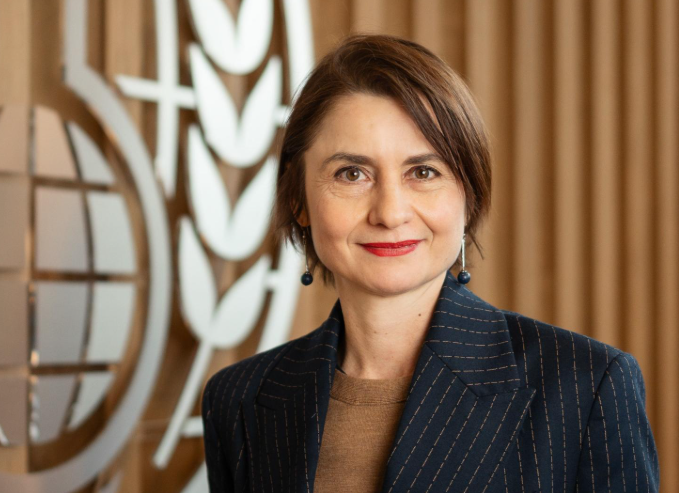
Sabrina Dallafior has emerged as an important figure in contemporary multilateral diplomacy, bringing extensive experience in international security, arms control and disarmament to one of the world’s most consequential diplomatic positions. A Swiss career diplomat, she became Director-General of the Organisation for the Prohibition of Chemical Weapons (OPCW) on 25 July 2026. Her appointment carries historic significance. She is the first woman and the first Swiss national to lead the organisation, taking responsibility for a role that requires diplomatic judgement, institutional leadership and the ability to work with governments holding sharply different political positions. Her career reflects the Swiss diplomatic tradition of international cooperation, negotiated solutions and engagement through multilateral institutions.
Dallafior was born in Basel, Switzerland. She studied Eastern European history and Russian studies before entering the Swiss diplomatic service in 2000. Her academic interests provided a foundation for understanding the political and historical developments shaping Europe’s eastern neighbourhood. The study of Eastern Europe and Russia was particularly relevant to a diplomatic career that would later involve security relations, international negotiations and the management of complex geopolitical questions. Rather than following a political career within Switzerland, she chose the professional diplomatic service, gradually building experience through assignments in bilateral relations and international organisations.
Her diplomatic career began at the Swiss Mission to the European Union in Brussels, where she served as an attaché. The assignment placed her in an important centre of European policymaking at a time when the relationship between Switzerland and the European Union required sustained diplomatic attention. Switzerland is not an EU member, but its economic, political and social connections with the bloc are extensive. Her early experience in Brussels introduced her to the complexities of European diplomacy and the importance of maintaining constructive relations with institutions beyond a country’s formal membership.
She subsequently served as First Secretary at the Swiss Mission to NATO, also in Brussels. This assignment broadened her exposure to European security structures and the transatlantic defence relationship. For a diplomat representing a country outside the alliance, engagement with NATO requires an understanding of the security concerns of its members while preserving Switzerland’s own foreign policy positions. Dallafior’s experience at the mission gave her an opportunity to work within this wider security environment and develop knowledge of the political and institutional dimensions of European defence.
Her subsequent responsibilities included leadership of the Swiss team dealing with the Organisation for Security and Co-operation in Europe (OSCE). The organisation provides a forum for addressing security, conflict prevention, arms control and political cooperation among states with different political systems and sometimes sharply conflicting interests. Dallafior’s involvement placed her within a diplomatic environment where consensus-building and sustained negotiation are essential. It also strengthened her understanding of the relationship between national security concerns and the broader objective of maintaining a cooperative European security order.
She later took on responsibilities at Switzerland’s Mission to the European Union in Brussels as Head of Political Affairs and Security Policy. The position required her to work on issues connecting European political developments with Switzerland’s security interests. Her responsibilities included engagement with European institutions and the management of political and security-related discussions. This experience contributed to a career that increasingly focused on multilateral security rather than conventional bilateral diplomacy alone.
Dallafior subsequently served in Bern as Deputy Head of the Human Security Division of the Swiss Federal Department of Foreign Affairs. Human security places the protection and safety of individuals alongside the traditional concerns of state security. It includes questions involving civilian protection, humanitarian consequences of conflict and the international responsibilities of governments. The assignment gave her experience in a policy area closely connected with the humanitarian principles that have long influenced Swiss diplomacy. It also broadened her understanding of how security policy affects people beyond the boundaries of military and strategic calculations.
Another responsibility involved leading Swiss delegations for bilateral dialogues with Nigeria and Senegal. These engagements reflected the wider geographical reach of Switzerland’s diplomatic relationships and demonstrated that her work was not confined to European security institutions. Her role in these discussions provided experience in managing relationships across different regional priorities and diplomatic traditions, adding an important bilateral dimension to her growing multilateral expertise.
One of the most consequential periods of her career began in 2016, when she became Switzerland’s Permanent Representative to the Conference on Disarmament in Geneva and Deputy Permanent Representative to the United Nations Office in Geneva. She held these positions until 2019. The assignment placed her at the centre of international negotiations on arms control and security, where diplomatic progress often depends on navigating disagreements between major powers and smaller states.
During her assignment, Dallafior held several important leadership responsibilities within international disarmament mechanisms. She served as President of the Conference on Disarmament and chaired the Working Group on effective treaty implementation of the Arms Trade Treaty. She also chaired the Article 5 Committee of the Anti-Personnel Mine Ban Convention and led Swiss delegations to the First Committee of the United Nations General Assembly. These positions required her to work with governments that often approached disarmament questions from different strategic perspectives.
The Arms Trade Treaty and the Anti-Personnel Mine Ban Convention address important questions concerning weapons and their humanitarian consequences. Dallafior’s responsibilities connected with these agreements required an understanding of treaty provisions, national implementation obligations and the need to maintain cooperation among states. Her work demonstrated an ability to operate within technical and politically sensitive negotiations where progress depends on building agreement rather than relying on public declarations.
Her presidency of the Conference on Disarmament was particularly significant because the forum has faced longstanding difficulties in advancing substantive negotiations. Differences among major powers, disagreements over priorities and the requirement for consensus have often restricted its ability to reach new agreements. Dallafior’s role in presiding over the body placed her within this challenging diplomatic process and gave her direct experience of the institutional limitations confronting international disarmament.
After completing her Geneva assignment, she became Consul General of Switzerland in Milan, serving from 2019 to 2023. The position shifted her work towards bilateral diplomacy and the practical management of Switzerland’s relationship with an important European partner. Milan is a major centre of business, finance, industry and culture, making the consulate an important point of engagement for Swiss citizens, companies and institutions. The assignment added a different dimension to her diplomatic experience, balancing the technical demands of international negotiations with the direct responsibilities of consular and bilateral representation.
In August 2023, Dallafior became Switzerland’s Ambassador to Finland. Her posting came at a consequential moment for European security. Russia’s full-scale invasion of Ukraine had transformed the strategic environment across the continent, while Finland’s accession to NATO in April 2023 marked a major change in its security position. As ambassador, Dallafior represented Swiss interests in a country whose security policy had undergone a historic transition, requiring diplomatic engagement with a changing European security landscape.
In an interview published by the Finland Chamber of Commerce in January 2024, she discussed the consequences of international crises for Switzerland. She highlighted the effects of the war in Ukraine, tensions between China and the United States and the conflict in West Asia. She explained that Switzerland’s highly internationalised economy made it particularly sensitive to geopolitical developments, given its dependence on global markets and international trade. Her remarks illustrated the connection between security developments and economic stability, a recurring concern in Swiss foreign policy.
She also addressed the relationship between Switzerland and the European Union, emphasising the importance of stable and sustainable arrangements. Although Switzerland is not an EU member, its economic and social links with European countries are extensive. Her comments reflected the practical approach required of Swiss diplomacy, which seeks to preserve national decision-making while maintaining access to cooperation with neighbouring states. The ambassadorial assignment in Finland brought together several themes that had shaped her earlier career, including European security, economic interdependence and the management of relations between countries with different institutional positions.
Dallafior’s experience in disarmament became the central qualification behind her selection to lead the OPCW. On 27 November 2025, the Conference of the States Parties appointed her Director-General for a four-year term, following a recommendation by the organisation’s Executive Council. The decision was reached by consensus, with her selection coming from a field of eleven candidates. Her appointment was significant not only for Switzerland but also for the organisation, which had previously been led exclusively by men and had never before had a Swiss Director-General.
She assumed office on 25 July 2026, succeeding Fernando Arias of Spain. Her responsibilities brought together the different strands of her career, including treaty negotiations, security policy, international cooperation and diplomatic leadership. The position requires her to work with member states, manage the organisation’s technical and administrative responsibilities and maintain confidence in its work across a politically divided international environment.
Dallafior’s professional background is particularly relevant to the diplomatic challenges associated with chemical weapons allegations. Her experience in international negotiations has involved working with states that hold competing views on security and accountability. As Director-General, she must maintain the credibility of technical investigations while ensuring that diplomatic disagreements do not undermine the implementation of international obligations. This responsibility places considerable importance on impartiality, evidence-based decision-making and consistent engagement with member states.
In her statement following her appointment, Dallafior identified upholding the international norm against chemical weapons as a central priority. She stressed the importance of investigating credible allegations, establishing scientific facts and denouncing confirmed cases of use. Her position reflects the principle that international prohibitions remain effective only when violations are addressed consistently. The diplomatic challenge lies in preserving cooperation while ensuring that the rules are not weakened by political considerations.
Her leadership also comes at a time when international security is being reshaped by technological developments. Advances in artificial intelligence, drone technology and dual-use chemicals may complicate the detection and monitoring of dangerous substances. Dallafior’s experience in arms control and treaty implementation provides a foundation for engaging with these emerging questions, although adapting international procedures will require cooperation among governments and scientific experts.
Political divisions among major powers present another challenge. International organisations dealing with security and disarmament often operate within an environment where governments disagree over investigations, accountability and the interpretation of evidence. Dallafior’s career has repeatedly placed her in settings where consensus is difficult to achieve. Her ability to maintain dialogue across political differences will therefore be an important measure of her leadership.
Her appointment also carries significance for Switzerland’s wider diplomatic presence. Switzerland has traditionally sought influence through international institutions, humanitarian diplomacy and support for rules-based cooperation. The selection of a Swiss diplomat to lead the OPCW reflects the country’s established engagement with disarmament and international security. It also places Dallafior in a position where her diplomatic experience must be translated into institutional leadership on a global scale.
Sabrina Dallafior’s career has developed across several areas of international relations, from European diplomacy and human security to arms control and disarmament. Her experience in Brussels, Bern, Geneva, Milan and Helsinki has given her exposure to both bilateral relationships and complex multilateral negotiations. She stands out as a diplomat whose professional journey has been shaped by the ability to work across institutions, regions and competing national interests. Her leadership at the OPCW will test that experience in one of the most demanding areas of international security, while her broader career reflects the continuing importance of diplomacy in managing a divided and uncertain world.
Sabrina Dallafior’s Quote
“Above all, we must, and we will, remember the victims of chemical weapons use in all that we do.”
25 November 2026, Day of Remembrance for All Victims of Chemical Warfare, The Hague, Netherlands.