

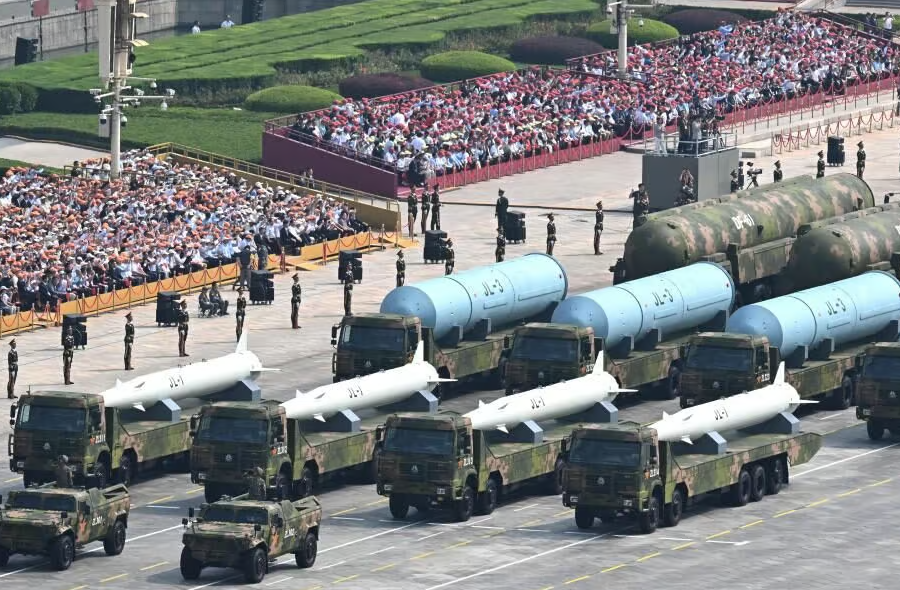
For decades China kept its nuclear force small and quiet. It followed a simple idea, keep just enough weapons to retaliate and avoid getting pulled into the kind of arms race that defined the Cold War. That approach has now been dropped. Under Xi Jinping, China is moving fast and openly toward something much larger, more complex and far more assertive.
In September 2025 Beijing made that shift visible. The military parade was not just a routine show of strength. It was carefully staged. Xi stood alongside Vladimir Putin and Kim Jong-un, sending a clear political signal about alignment and intent. But the real message was not in the optics at the top, it was in what rolled across Tiananmen Square. For the first time China showed a complete nuclear triad in public. Land based missiles, submarine launched systems and air delivered capability all presented together. This was something China had built quietly over time, but never displayed as a full system. That moment mattered because it marked a transition. China was no longer just maintaining a deterrent, it was demonstrating a full spectrum nuclear force.
This shift did not happen overnight. China’s nuclear programme goes back to the 1950s under Mao Zedong, with early Soviet assistance before relations collapsed. It tested its first nuclear weapon in 1964 and entered the nuclear club, but it never tried to match the United States or the Soviet Union. Even decades later under Hu Jintao, the arsenal remained small, often estimated below 300 warheads. That restraint was partly strategic and partly practical. China did not see value in building thousands of weapons it could not realistically use.
Xi changed that thinking. The expansion we are seeing now is not incremental, it is structural. Estimates suggest China has already crossed 600 warheads and could reach 1500 by 2035. More important than the numbers is the speed. This buildup has moved faster than most Western projections, and it has been done with very little transparency. Beijing does not clearly explain its goals, and that uncertainty is part of the strategy.
The logic behind this shift is not complicated. A small nuclear force is vulnerable. In a serious crisis, especially against a technologically superior adversary, there is always the risk that your deterrent could be neutralised before you can use it. That creates a situation where you are effectively checkmated at the start of a conflict. Xi’s response is to remove that risk. Build a force that cannot be taken out in one strike, and make sure it can survive long enough to respond.
There is also a broader way of thinking driving this. Xi appears to view global politics through a hard power lens where rising states inevitably come into conflict with established ones. From that perspective, tension between China and the United States is not temporary, it is structural. If confrontation is likely in the long term, then China needs to prepare for the worst case rather than hope for stability. This is where nuclear weapons come in. They are not just about retaliation, they are about shaping the behaviour of others before a conflict even begins.
Russia’s experience has clearly reinforced this view. Despite economic weaknesses, Moscow maintained a large nuclear arsenal. During the war in Ukraine, nuclear signalling played a major role in limiting how far Western countries were willing to go. From Beijing’s point of view, that lesson is hard to ignore. Nuclear weapons can create space. They can deter intervention and allow a country to act more aggressively at the conventional level without triggering a full scale response.
Xi backed this thinking with institutional changes. In 2015 he elevated China’s missile force into a full military branch, now known as the Rocket Force. This was not a symbolic move. It placed nuclear and missile capabilities at the same level as the army, navy and air force. It signalled that these systems were central to China’s military planning, not secondary. Once that shift was made, the expansion followed quickly.
One of the most visible parts of this buildup is the construction of missile silos. Satellite imagery revealed large fields of silos across remote areas of western China, with numbers exceeding 300. Beijing has never openly acknowledged them and at times has given vague explanations, but their purpose is obvious. What matters is that they are visible. Unlike mobile launchers or submarines, silos can be tracked. That visibility itself sends a message. It forces adversaries to account for them and increases the perceived size and readiness of China’s arsenal.
At the same time, China is building out all three legs of the nuclear triad. Land based intercontinental missiles remain the backbone. Submarine launched missiles are being improved with longer range systems designed to operate from within China’s constrained maritime environment. Air launched systems are being introduced to complete the triad and add flexibility. The goal is survivability through redundancy. If one part of the system is compromised, others remain available.
Geography plays a major role in how this force is designed. China’s coastline is not as open as that of the United States. It is effectively boxed in by what strategists call the first island chain, which includes Japan, Taiwan and the Philippines. These areas are closely monitored and aligned with Washington, making it difficult for Chinese submarines to move freely into the Pacific without being detected. As a result, much of China’s sea based deterrent is concentrated in the South China Sea, particularly around Hainan. New long range missiles are meant to compensate for this by allowing strikes from within these limited waters.
This is one reason Taiwan holds such strategic importance. Control over Taiwan would give China more direct and less constrained access to the Pacific. It would change the geometry of its naval and nuclear posture. For Chinese planners, this is not just about political reunification, it is about breaking out of geographic limits that restrict their military reach.
The technology being deployed adds another layer to this transformation. China is investing heavily in systems that make its missiles harder to intercept and more flexible in use. Multiple warheads on a single missile allow it to hit several targets at once or overwhelm missile defences. Hypersonic glide vehicles reduce reaction time and introduce manoeuvrability that traditional ballistic paths do not have. At the regional level, intermediate range missiles like the DF 26 are designed to target US bases and allied positions across the Pacific.
Some of these systems are dual capable, meaning they can carry either nuclear or conventional warheads. On paper that sounds like flexibility. In reality it creates ambiguity. In a crisis, an adversary may not know whether a deployed missile is nuclear or not. That uncertainty can push both sides toward worst case assumptions, increasing the risk of escalation even if neither side intends it.
China still maintains that it follows a No First Use policy. It claims it will not use nuclear weapons unless it is attacked with them first. That policy dates back to the early years of its programme and helped justify a smaller arsenal for decades. It also allowed China to present itself as a more restrained nuclear power compared to others.
Now that credibility is being questioned. A larger and more advanced arsenal does not automatically align with a purely defensive doctrine. There are signs that China is exploring options like launch under attack, where it would fire its weapons upon detecting an incoming strike rather than waiting for impact. This reduces vulnerability but comes with serious risks. Early warning systems are not perfect. In a tense situation, false alarms or misinterpretations can lead to decisions that cannot be reversed.
There is also growing discussion around the idea of limited nuclear war. Instead of an all out exchange, the thinking is that nuclear weapons could be used in a controlled way against specific military targets. That could mean strikes on bases, fleets or infrastructure rather than cities. The logic is to create pressure without triggering total destruction. The problem is that once nuclear weapons are used, even in a limited way, escalation becomes very hard to control.
The Taiwan scenario sits at the centre of this thinking. If China were to move against Taiwan, the United States would be the key variable. A stronger nuclear arsenal gives Beijing more confidence that it can deter American intervention or at least limit how far Washington is willing to go. The lesson from Ukraine is clear in this context. Nuclear signalling can shape the battlefield without being used directly.
Xi’s approach is built around preparing for the worst case. He assumes that a major conflict with US led powers is possible in the future. In that kind of scenario, nuclear weapons are the ultimate guarantee. They ensure that even if China faces setbacks, it cannot be easily overpowered. At the same time, they provide a shield that allows more aggressive moves at the conventional level.
What is happening now is not just a buildup of weapons. It is a shift in mindset. China is moving from a narrow deterrence model to a broader strategy where nuclear capability is integrated into overall power projection. The speed of this change, combined with the lack of transparency, is what makes it significant.
This transformation is already forcing reactions. The United States and its allies are reassessing their own positions, adjusting deployments and thinking about how to respond to a more capable and more confident China. That dynamic does not stay contained. It spreads, creating a more competitive and more uncertain nuclear environment.
China’s nuclear expansion is not random and it is not defensive in the old sense. It is calculated and aligned with a larger ambition. The goal is to remove vulnerability, shape the decisions of others and ensure that in any serious conflict, China cannot be ignored or easily contained. The direction is clear even if the final destination is not.
Documentary: