

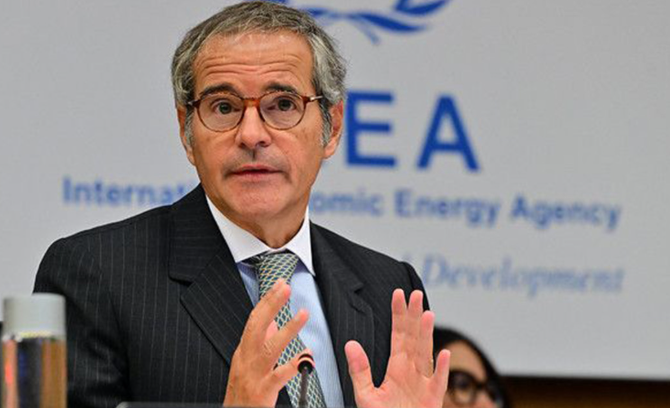
Rafael Mariano Grossi was born on 29 January 1961 in Buenos Aires, Argentina. He grew up in a country whose political and economic history was marked by periods of military rule, democratic transition and efforts to establish a stronger international position. His early interest in international affairs eventually led him towards diplomatic service, where he developed a specialisation in nuclear non-proliferation, disarmament and international security. Unlike political leaders who rise through electoral politics, Grossi built his career within Argentina’s foreign service and international institutions, gradually establishing himself as a specialist in some of the most sensitive areas of global diplomacy.
Grossi studied political science at the Pontifical Catholic University of Argentina before pursuing postgraduate studies at the Geneva Graduate Institute of International and Development Studies, where he obtained a master’s degree and a PhD in International Relations, International History and Politics. He also attended Argentina’s Diplomatic Academy as part of his professional preparation. In 1985, he joined Argentina’s Ministry of Foreign Affairs, beginning a diplomatic career that would take him through several international institutions and overseas assignments. His academic training and early professional interests increasingly focused on arms control, nuclear security and the role of international agreements in preventing the spread of weapons of mass destruction.
His early diplomatic assignments included service in Argentina’s foreign missions in Belgium and Luxembourg, as well as representation to NATO between 1998 and 2001. In 2002, he moved to The Hague to become Chief of Cabinet at the Organisation for the Prohibition of Chemical Weapons, a position he held until 2007. The organisation works to implement the Chemical Weapons Convention and prevent the development, production and use of chemical weapons. This appointment gave Grossi experience in multilateral diplomacy and the practical operation of international arms-control agreements. After returning to Argentina, he served as Director General for Political Affairs in the Foreign Ministry from 2007 to 2009, further strengthening his position within the country’s diplomatic establishment.
In 2010, Grossi entered a new phase of his career when he joined the International Atomic Energy Agency as Assistant Director General for Policy and Chief of Cabinet. He remained in these positions until 2013, gaining direct experience of the institution responsible for promoting the peaceful use of nuclear technology while verifying that nuclear materials and facilities are not diverted towards military purposes. In 2013, he was appointed Argentina’s ambassador to Austria and permanent representative to the IAEA and other international organisations based in Vienna. His diplomatic responsibilities increasingly centred on nuclear safeguards, international cooperation and the negotiations surrounding the global non-proliferation framework.
Grossi’s influence in nuclear diplomacy expanded further through his work with the Nuclear Suppliers Group, an international arrangement designed to regulate nuclear-related exports and prevent sensitive technology from contributing to weapons programmes. He served as its president from 2014 to 2016, becoming the first individual to hold the position for two consecutive terms. In 2015, he also presided over the Diplomatic Conference of the Convention on Nuclear Safety, which adopted the Vienna Declaration on Nuclear Safety following the Fukushima Daiichi nuclear accident in Japan. He was subsequently designated president of the 2020 Review Conference of the Treaty on the Non-Proliferation of Nuclear Weapons. These responsibilities established him as an experienced negotiator within the international nuclear framework before his appointment to lead the IAEA.
On 29 October 2019, the IAEA Board of Governors elected Grossi as Director General, and he formally assumed office on 3 December that year. He became the sixth head of the organisation and the first Latin American to hold the position. His appointment came at a time when international nuclear diplomacy faced mounting difficulties, particularly over Iran’s nuclear programme and the deteriorating relationship between Tehran and Western powers. As Director General, Grossi took responsibility for overseeing the agency’s safeguards and inspection activities, managing its international technical cooperation programmes and maintaining dialogue with governments over nuclear safety and non-proliferation. In March 2023, the Board of Governors unanimously reappointed him for a second four-year term beginning in December 2023.
One of the most demanding periods of his leadership emerged following Russia’s full-scale invasion of Ukraine in February 2022. The occupation of the Zaporizhzhia Nuclear Power Plant, one of Europe’s largest nuclear facilities, created serious concerns about the possibility of an accident in an active conflict zone. Grossi undertook direct diplomatic engagement with both Moscow and Kyiv, visiting the facility and pressing for arrangements to protect nuclear installations from military activity. In September 2022, the IAEA established a permanent presence at the plant, with experts monitoring its safety and security conditions. He subsequently advanced the concept of five concrete principles intended to protect the facility. His involvement made nuclear safety a prominent part of the international response to the war, requiring the agency to maintain technical oversight while navigating the positions of the two opposing sides.
Iran’s nuclear programme has been another major responsibility during his tenure. The IAEA has faced increasing difficulties in maintaining comprehensive monitoring and verification activities following changes in Iran’s implementation of its nuclear commitments and restrictions on inspection arrangements. Grossi has repeatedly called for greater transparency and cooperation, arguing that international confidence must rest on verifiable evidence rather than political assurances. In April 2025, during an interview with Le Monde, he emphasised that the IAEA would have to play a central role in verifying any future nuclear agreement between Iran and the United States. His approach has involved maintaining communication with Tehran and other governments while seeking to preserve the agency’s technical independence and credibility.
Beyond nuclear safeguards and international security, Grossi has sought to expand the IAEA’s contribution to development, healthcare, agriculture and environmental protection. Under his leadership, the agency advanced initiatives including Rays of Hope, which aims to improve access to cancer diagnosis and treatment, and ZODIAC, designed to strengthen the detection and prevention of zoonotic diseases. Other programmes, including Atoms4Food and NUTEC Plastics, have focused on agricultural productivity, food security and the application of nuclear technology to environmental challenges. He has also promoted the role of nuclear energy in addressing climate change and supporting the transition towards lower-carbon energy systems. These initiatives have broadened the public profile of the IAEA beyond its traditional responsibilities in nuclear verification and safety.
In November 2025, Argentina formally nominated Grossi as a candidate for the position of United Nations Secretary-General. His candidature placed him in a new international competition, extending his ambitions beyond the leadership of the IAEA to the highest administrative position in the United Nations system. On 21 April 2026, he participated in the interactive dialogue organised by the UN General Assembly as part of the selection process. His candidacy has drawn attention to his experience in multilateral diplomacy, nuclear security and negotiations involving governments with competing interests. The appointment process remains a decision for the United Nations member states, and his nomination represents a significant new chapter in his international career.
Rafael Grossi’s career has taken him from Argentina’s diplomatic service to senior positions in international organisations and the leadership of the IAEA. Over four decades, he has worked on chemical weapons disarmament, nuclear non-proliferation, international safeguards and the peaceful applications of nuclear science. His tenure has placed him at the centre of some of the most sensitive international issues, including the nuclear risks surrounding the war in Ukraine and negotiations over Iran’s nuclear programme. His nomination for United Nations Secretary-General has added another dimension to a career built largely through institutional diplomacy rather than domestic political office. He remains an important figure in international efforts to manage nuclear risks and strengthen cooperation among states.
Rafael Grossi’s Quote
“IAEA is here to stay and will maintain a continued presence at ZNPP.”
1 September 2022, following his visit to the Zaporizhzhia Nuclear Power Plant.