

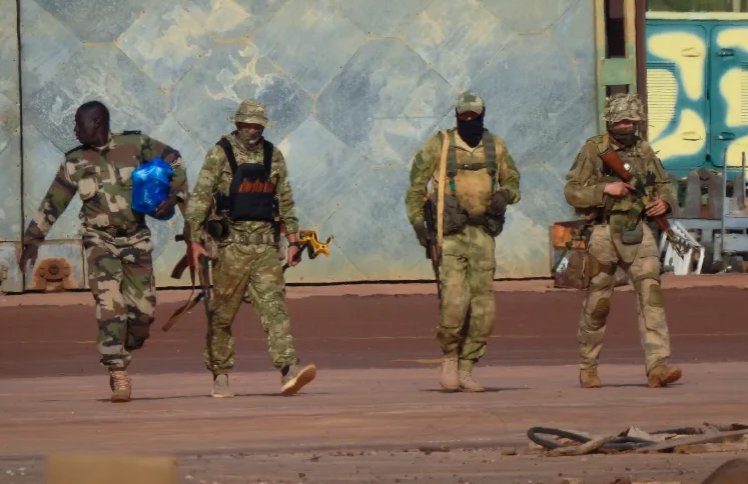
The weekend offensive that swept across Mali in late April 2026 has delivered one of the sharpest blows yet to the ruling military junta and, by extension, to Russia’s carefully built image as a dependable security partner in the Sahel. What unfolded was not a scattered insurgent push but a coordinated, multi front assault that exposed serious gaps in both control and response. At a time when Bamako has been projecting strength after cutting off Western military presence, the scale and reach of these attacks have disrupted that narrative in a matter of days.
On April 25, fighters from Jama’at Nusrat al-Islam wal-Muslimin launched synchronised strikes alongside the Tuareg aligned Azawad Liberation Front across key military and logistical points. The attacks hit northern strongholds including Kidal, Gao and Bourem, pushed into central Mali targeting Mopti and the Sévaré base, and even reached the outskirts of the capital Bamako with incidents reported near the airport and in Kati, the country’s most sensitive military garrison. This was not just a territorial push, it was a message that the state’s defensive grid can be penetrated at multiple levels simultaneously.
The most damaging setback came in Kidal, a town that had been showcased as a symbol of regained sovereignty after being recaptured in 2023 with Russian backing. After intense fighting, it slipped back into rebel control. Units of Russia’s Africa Corps withdrew alongside Malian forces, calling it a coordinated move with Bamako, but the visuals told a harsher story. Convoys of Russian personnel were seen exiting under rebel oversight, with reports that some heavy equipment including armoured vehicles was abandoned. There are also indications that regional mediation played a role in allowing a safe exit, further complicating the optics of control.
The shock deepened with the killing of Defence Minister Sadio Camara in a suicide truck bombing targeting his residence in Kati. A central figure behind Mali’s pivot away from France and the United Nations and toward Moscow, his death is both symbolic and operationally significant. The junta confirmed he was wounded during the attack and later died in hospital, declaring national mourning. Losing a key architect of the current security alignment at the same moment as territorial reversals has amplified pressure on the leadership.
Since the coups that brought Assimi Goïta to power, Mali has tied its security strategy closely to Moscow. French forces under Operation Barkhane exited in 2022, followed by the UN mission in 2023, creating space for Russian trainers, air assets and combat units to step in. The model was straightforward, security backing and political cover in exchange for strategic alignment and access to resources. This included expanding cooperation in gold processing, early stage lithium development, and discussions around energy projects ranging from solar to nuclear. For a period, this arrangement allowed the junta to project control and independence.
The latest fighting has exposed the limits of that arrangement. Despite deploying air power including helicopter gunships and reportedly long range strike capabilities, Malian and Russian forces failed to hold Kidal. Claims of heavy militant losses have circulated, but they have not translated into regained ground. More importantly, the ability of insurgents to coordinate across such a wide geography suggests growing operational depth. This is not an isolated flare up, it points to a structured campaign aimed at stretching state forces thin while targeting symbolic and strategic locations.
This is not the first warning sign. In mid 2024, a joint Malian Russian column suffered heavy losses in the north near Tinzaouaten, highlighting vulnerabilities in convoy operations and intelligence. Since then, the rebranded Africa Corps has taken a more measured approach compared to the earlier Wagner style offensives, but that shift has not prevented setbacks. Instead, it has raised questions about whether the current posture is sufficient against increasingly adaptive insurgent networks.
The wider Sahel picture is moving in a dangerous direction. JNIM has expanded its reach and coordination, while other groups such as the Islamic State Sahel faction are also looking to exploit any vacuum. The current offensive appears less about capturing the entire country and more about controlling corridors, isolating state forces, and forcing negotiations from a position of strength. If that pattern holds, Mali risks entering a prolonged phase where control is fragmented rather than decisively contested.
For Russia, the implications go beyond Mali. Its security footprint across countries like Burkina Faso, Niger and the Central African Republic is built on the promise of delivering stability where Western missions failed. A visible setback in one theatre weakens that broader positioning, especially at a time when its military focus remains heavily tied to other fronts. The credibility of the model, not just the deployment, is now under scrutiny.
Goïta has since reappeared publicly, meeting the Russian ambassador and signalling that the partnership remains intact. The official line from Bamako is that the situation is under control and that operations will intensify to regain lost ground. In the short term, increased air support and reinforcement are expected as both sides attempt to stabilise positions. But the reality on the ground is less forgiving. Kidal, once presented as proof of restored authority, is back under rebel control, and the narrative of momentum has been broken.
What comes next will define whether this is a temporary setback or the start of a deeper unraveling. The junta now faces the challenge of restoring credibility without appearing fully dependent on external backing, while Russia must demonstrate that its presence can deliver more than symbolic victories. In northern Mali’s vast and unforgiving terrain, control is never permanent, but the loss of initiative is far more dangerous. Right now, that initiative has clearly shifted.