
Europe is no longer debating whether China’s industrial rise is reshaping the global economy. It is now debating whether Europe itself can survive the consequences of that rise without abandoning the very free-trade principles it once promoted across the world.
Days before a major China policy debate in Brussels, a coalition of influential European Union members including Spain, Italy, the Netherlands, France and Lithuania pushed the European Commission toward a far more aggressive trade strategy aimed at confronting what they describe as “systemic and structural industrial overcapacity” originating from China. The language may appear technical, but the political message is unmistakable. Europe increasingly sees Beijing’s industrial model not simply as competition, but as a direct threat to its manufacturing base, technological sovereignty and long-term economic security.
For years, Brussels approached China through a balancing formula of engagement, dependence and cautious criticism. That era is ending rapidly. The new European mood is shaped by fear of what officials and economists now openly call “China Shock 2.0” — a second wave of industrial disruption driven not by cheap consumer goods, but by advanced manufacturing, electric vehicles, batteries, robotics, semiconductors and strategic industrial components flooding European markets at prices many European firms cannot match.
The paper circulated ahead of Friday’s debate calls for faster emergency tariffs, broader safeguard measures, tougher anti-circumvention mechanisms and even company-specific countervailing duties designed to target Chinese firms operating through global subsidiaries. European capitals are also discussing a new “resilience tool” that would force strategic industries to diversify suppliers and reduce dependence on any single external power. Behind the bureaucratic terminology lies a profound geopolitical shift. Europe is slowly moving from a market logic toward an economic security doctrine.
The significance of this moment lies not only in France’s traditionally hawkish position on China, but in the participation of countries like Spain and the Netherlands, which historically defended open trade. Spain has deepened economic ties with Beijing in recent years and actively welcomed Chinese investment. The Netherlands built much of its economic identity around free trade and global integration. Yet even these states are now aligning behind a harder industrial strategy as Chinese competition increasingly hits sensitive sectors across Europe.
At the center of the debate is the fear of deindustrialisation. European officials estimate that nearly one million industrial jobs disappeared between 2019 and 2025 as Chinese exports surged into European markets. Germany, long regarded as Europe’s industrial engine, is facing growing alarm over shrinking competitiveness, factory uncertainty and dependence on Chinese supply chains. A report by the Centre for European Reform warned that more than 400,000 German jobs linked to exports to China may already have been lost to China itself as Beijing moves up the value chain and directly competes with European industry.
The anxiety extends beyond automobiles or steel. European officials increasingly worry that China’s industrial overcapacity is becoming systemic across multiple sectors simultaneously. A recent European Parliament study concluded that Chinese overcapacity now affects most major industrial sectors and could intensify further due to Beijing’s strategic industrial policies and export-driven economic model.
European leaders also fear that the combination of American tariffs and Chinese industrial dumping could squeeze Europe from both sides. As Washington raises barriers against Chinese goods, many European policymakers believe those exports will simply be redirected toward Europe at even lower prices, intensifying pressure on already struggling European manufacturers.
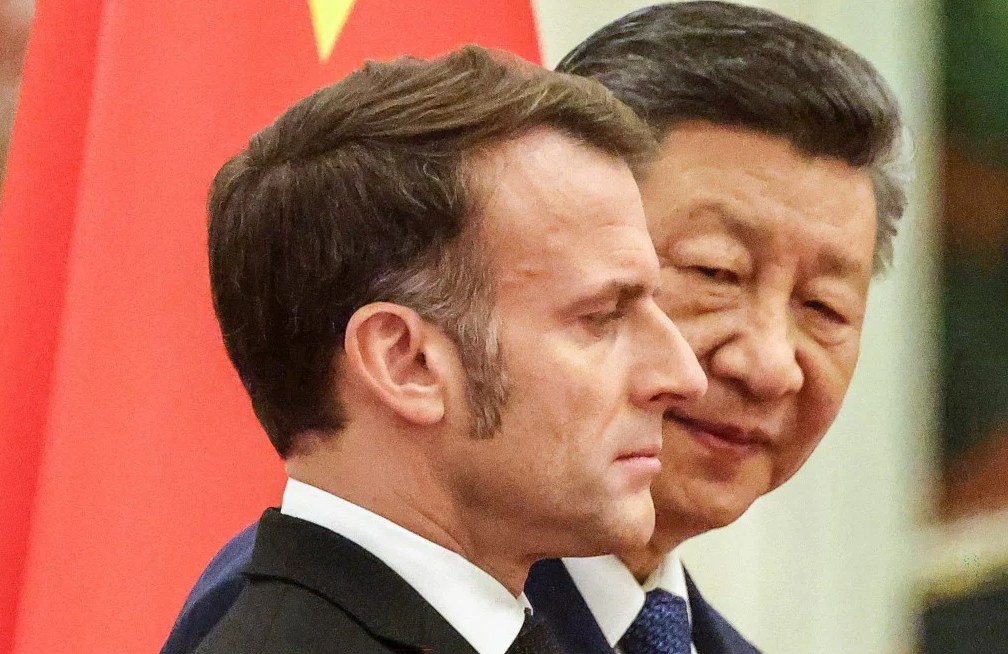
French President Emmanuel Macron has emerged as one of the strongest advocates for a tougher response. He recently called for a European equivalent of America’s “Section 301” trade mechanism, the same legal instrument frequently used by President Donald Trump to impose tariffs on Chinese imports. Macron’s message reflects a growing belief inside Europe that the continent can no longer rely solely on traditional anti-dumping investigations that often move too slowly to protect industries already under severe pressure.
But Europe’s dilemma is deeper than tariffs. The continent remains heavily dependent on Chinese manufacturing, particularly in clean energy technologies, batteries, critical minerals and industrial inputs. Officials fear that Europe risks becoming strategically vulnerable while simultaneously losing domestic industrial capacity. This contradiction now defines Brussels’ China debate. Europe wants Chinese markets, Chinese investment and access to Chinese supply chains, while also fearing that those same ties are hollowing out European industry from within.
China, meanwhile, rejects the accusations entirely. Beijing argues that Europe is weaponising the term “overcapacity” to justify protectionism and cover up its own structural weaknesses. Chinese officials warn that any new trade instruments targeting Chinese firms will trigger strong retaliation. Beijing also points out that European industries themselves benefited for decades from access to Chinese markets and low-cost production networks.
The dispute is therefore no longer just economic. It is becoming ideological and geopolitical. Europe increasingly frames the issue as one of resilience, sovereignty and industrial survival. China frames it as hypocrisy and Western fear of losing economic dominance.
Germany now finds itself under immense pressure to choose a direction. Berlin remains more cautious because of its deep economic exposure to China and the interests of major industrial exporters. Yet even Germany is facing mounting pressure from industry groups and political circles warning that Europe cannot remain passive while Chinese state-backed firms dominate sector after sector.
The coming Brussels debate may therefore mark the beginning of a historic transformation in Europe’s relationship with China. For decades, the European Union promoted globalisation as an economic philosophy. Now it is increasingly embracing strategic protectionism in the name of economic security.
The irony is impossible to ignore. Europe once urged the world to open markets, reduce barriers and trust global supply chains. Today, confronted by China’s industrial scale and state-backed economic power, Europe itself is moving toward tariffs, safeguards, resilience tools and industrial intervention.
What Brussels fears most is not merely Chinese competition. It fears irrelevance in a world where industrial power once again determines geopolitical power.