

The rapid expansion of unmanned aerial vehicles has transformed the modern battlefield. In Ukraine and West Asia, inexpensive drones have demonstrated their ability to destroy military equipment, threaten personnel, disrupt supply lines and challenge conventional air defence systems. Small multirotor and first person view drones are particularly difficult to counter because they fly at low altitudes, have small radar signatures and can manoeuvre rapidly. Equipped with cameras that transmit live video to operators, they can also conduct precision strikes against targets that would previously have required more expensive weapons.
For the People’s Liberation Army, countering these systems has become an increasingly important military requirement. The challenge is not limited to intercepting individual drones. Adversaries can deploy them in large numbers, using coordinated swarms to overwhelm sensors and exhaust defensive ammunition. A conventional air defence system designed to engage aircraft or missiles may be poorly suited to dealing with dozens of small, inexpensive targets. China is therefore developing a layered approach that combines electronic warfare, directed energy weapons, interceptor drones and conventional guns and missiles.
Electronic warfare forms an important part of this architecture. Many conventional FPV drones depend on radio frequency links to receive commands and transmit video, while satellite navigation helps determine their position and flight path. Disrupting these signals can interfere with control, navigation and targeting. Chinese defence companies have developed systems such as the vehicle mounted JN-1101 from China Electronics Technology Group Corporation and the CEW-102E integrated counter unmanned aircraft suite introduced by Poly Defence in 2024.
At the tactical level, portable systems such as the DZ-02 Pro, developed by Shen Zhou Ming Da High Technology, allow individual operators to respond to nearby drone incursions. More comprehensive platforms combine radar, electro optical sensors, radio frequency detection and jamming capabilities. This integration helps identify an approaching target and select an appropriate response. However, electronic warfare is not effective against every type of drone. Its performance depends on the communication and navigation systems used by the attacker.
The growing deployment of fibre optic controlled FPV drones in Ukraine has exposed this limitation. Unlike conventional radio controlled aircraft, these drones communicate with their operators through a physical optical cable that unwinds during flight. They are therefore highly resistant to conventional radio frequency jamming and produce fewer electromagnetic signals for detection systems to identify. Their growing use has forced militaries to reconsider defensive approaches that rely heavily on electronic disruption.
China’s response to fibre optic drones will consequently depend more on physical detection and interception. Radar, infrared and electro optical sensors can help identify incoming aircraft, while capture nets offer a possible means of stopping them at close range. Other approaches include interceptor drones equipped with cutting devices, lasers intended to sever the cables and barriers designed to entangle or damage them. These methods are still dependent on timely detection and accurate engagement, but they address a weakness that conventional jamming cannot overcome.
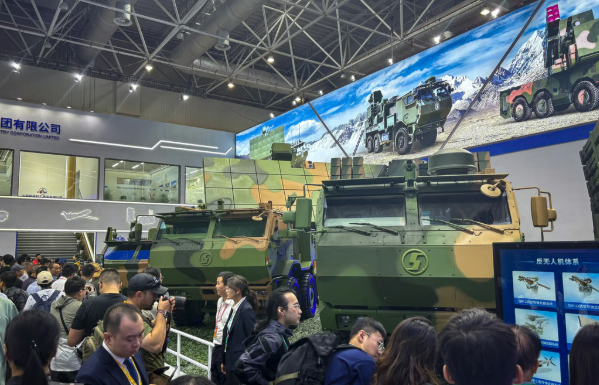
Directed energy weapons provide another important layer. High energy lasers can engage small aerial targets rapidly without requiring conventional ammunition for every interception. Their relatively low operating cost makes them attractive against drones that may be deployed repeatedly or in large numbers. China has developed several systems in this category. Norinco’s OW5 series was displayed during the Victory Day military parade in September 2025, while the Guangjian, or Light Arrow family, developed by the Aviation Industry Corporation of China, has featured in PLA counter drone exercises.
The LW series developed by China Aerospace Science and Industry Corporation includes the LW-30, marketed internationally as Silent Hunter. CETC has also developed the SkyShield and SkyDome families. These systems have attracted international interest, with some Chinese made laser platforms reportedly exported to countries including Saudi Arabia and Oman. Their reported operational use has added to interest in directed energy weapons as a relatively economical means of defending military installations against small drones.
The PLA Navy has also introduced the LY-1 shipborne high energy laser, designed to provide close range protection against incoming drones and missiles. Its appearance during a South China Sea exercise in August 2026 demonstrated China’s interest in incorporating directed energy weapons into naval formations. For warships, the ability to engage aerial threats without relying exclusively on conventional missile stocks could be valuable, particularly during repeated attacks. Nevertheless, laser performance remains dependent on factors such as weather, engagement distance, available power and the time required to maintain the beam on a target.
High power microwave weapons offer a different advantage. Rather than concentrating energy on one aircraft, they are designed to disrupt or damage electronic components across a wider area. This makes them particularly relevant against drone swarms, where several targets may approach a defended position simultaneously. China’s systems include Norinco’s Hurricane 3000 and the FK-4000 developed by China Aerospace Science and Technology Corporation. Both have been displayed as mobile platforms with integrated detection and engagement capabilities. Their potential lies in addressing multiple electronic targets during a single engagement, although effectiveness depends on the drones’ electronic protection and operating conditions.
The combination of lasers and microwave weapons reflects China’s effort to develop alternatives to conventional missile interception. Lasers can engage individual targets, while microwave systems may affect several drones within their effective coverage. Neither technology can replace every existing air defence capability, but both could reduce the pressure on conventional ammunition during prolonged attacks.
Conventional weapons remain essential, particularly when electronic disruption and directed energy systems fail. China’s PLB-625 combines a six barrel 25mm rotary cannon with short range surface to air missiles, allowing it to engage close aerial threats as well as larger drones and loitering munitions. The PGZ-09, widely fielded by the PLA, uses twin 35mm cannons with a combined rate of fire of 1,100 rounds per minute. Its programmable ammunition releases tungsten alloy sub projectiles in an airburst, creating a wider pattern intended to damage incoming targets.
China’s presentation of laser, microwave and gun missile systems as an integrated counter drone formation during the 2025 parade illustrated the direction of its military planning. Subsequent exercises have provided further evidence of this approach. In October 2026, footage released by Chinese state media showed PLA troops conducting live fire counter drone exercises involving lasers, high power microwave weapons, interceptor drones and anti aircraft guns. The scenarios included day and night operations against simulated drone threats and tested coordination between different defensive systems. The emphasis was on combining detection and interception capabilities rather than relying on a single weapon.
The threat also extends beyond conventional FPV aircraft to tactical loitering munitions. Weapons such as the American Switchblade 300 and Switchblade 600 combine aerial reconnaissance with precision strike capabilities. They can remain airborne while searching for targets, identify potential targets through onboard sensors and then carry out attacks. Their relatively small signatures and ability to approach from unexpected directions make them more difficult to counter than basic commercial drones.
Defending against these weapons requires early warning and the integration of multiple sensors. Radar, electro optical and infrared systems can help detect and track incoming targets, while electronic warfare may disrupt command links or satellite navigation in systems that depend on them. Guns, short range missiles and directed energy weapons provide additional interception options. China’s SkyDome system has also been associated with Xuanfeng interceptor drones, which are reportedly capable of launching up to 20 UAVs in a single sortie. These interceptors are designed to engage incoming drones through direct physical impact.
Using drones against other drones offers an alternative to conventional surface to air missiles. Interceptors can potentially provide a more favourable cost exchange against expendable aerial threats, while reducing the need to use larger weapons against relatively small targets. They may also offer greater flexibility than artillery in certain operating environments. Their effectiveness, however, depends on detection range, speed, guidance and the ability to engage several targets before they reach their objectives.
Long range one way attack drones present a different defensive problem. Iran’s Shahed 136 has demonstrated how relatively inexpensive aircraft can travel hundreds or thousands of kilometres to strike targets deep inside an opponent’s territory. Their fixed wing configuration, longer endurance and ability to operate in waves distinguish them from small multirotor drones. Although their relatively slow speed and limited manoeuvrability can make them vulnerable once detected, low altitude flight and small radar signatures complicate early warning.
Defence against these aircraft requires surveillance over a wide area, supported by radar networks and other sensors capable of detecting approaching threats. Electronic warfare can disrupt navigation and communication where the drone remains dependent on external signals, but autonomous capabilities and anti jamming protection may reduce its effectiveness. Physical interception can involve fighter aircraft, air to air missiles, aircraft cannons, ground based anti aircraft guns and short range air defence systems. Interceptor drones and high energy lasers may provide additional options against relatively slow moving targets.
The central difficulty is sustaining this defence against repeated attacks. Using expensive conventional missiles against mass produced one way attack drones can rapidly exhaust ammunition and create an unfavourable cost exchange. The growing interest in interceptor UAVs and directed energy weapons reflects the need for a more economical response. These systems could help preserve conventional air defence stocks for more sophisticated threats, although their practical value will depend on their reliability and ability to operate continuously.
Large medium altitude long endurance drones, including the American MQ-9 Reaper and China’s Wing Loong II, require a different approach. Unlike small FPV aircraft, these platforms have larger airframes, more substantial radar signatures and relatively predictable flight profiles. The MQ-9 can operate at altitudes of approximately 15,000 metres and conduct surveillance and strike missions over extended periods. Its size and operating characteristics make it more suitable for engagement by established air defence systems.
The financial calculation is also different. An MQ-9 is valued at tens of millions of dollars, with some export deals exceeding US$100 million. Against such a target, the use of fighter launched or ground based air defence missiles may be economically justified. Reports from the conflict with Iran have highlighted the vulnerability of these aircraft to air defence systems. However, claims by the United States and Iran about the number of MQ-9s lost or destroyed should be treated separately from independently verified figures.
China’s expanding counter drone programme reflects a broader change in military priorities. The PLA is actively trying to protect personnel, vehicles, naval formations and strategic installations against aerial threats that differ considerably in size, cost and technology. Electronic warfare remains useful against conventional radio controlled drones, but fibre optic systems expose its limitations. Lasers and microwave weapons offer potentially economical responses to repeated attacks, while interceptor drones and conventional guns provide additional means of engagement.
The decisive test will be whether these capabilities can operate together under realistic battlefield conditions. Military parades and controlled exercises demonstrate technological investment, but they cannot by themselves establish how reliably a system will perform against sophisticated swarms, changing communication methods and repeated attacks. China’s approach nevertheless reflects an important lesson from recent conflicts. Modern air defence cannot depend exclusively on expensive missiles or a single technological solution. It requires a flexible network of sensors and weapons capable of identifying different threats and responding at an appropriate cost. For the PLA, building that network is becoming an increasingly important part of preparing for the future of drone warfare.