

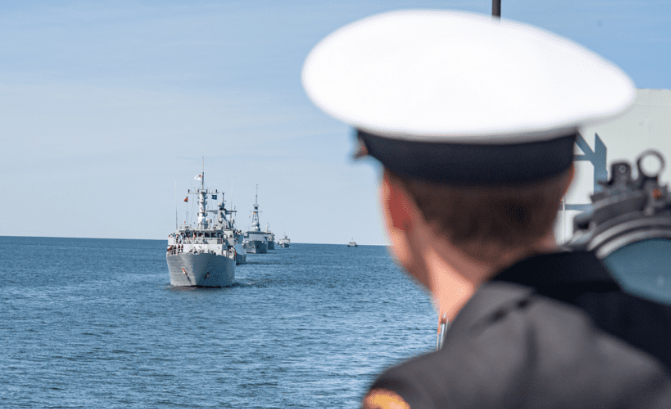
Britain’s new Northern Navies Initiative marks a significant shift in how northern European countries intend to organise their maritime defence. Signed aboard HMS Prince of Wales in Oslo, the agreement brings together the naval forces of the United Kingdom and its nine Joint Expeditionary Force partners in a more integrated framework covering the North Atlantic, Baltic Sea and High North. Its declared purpose is to strengthen collective security, improve readiness and ensure that allied forces can respond rapidly when a crisis develops. Beneath this commitment, however, lies a more consequential strategic reality. European governments are preparing for a prolonged period of confrontation with Russia, in which control of maritime routes, protection of underwater infrastructure and the ability to detect hostile military activity could become as important as conventional naval strength.
The agreement was signed by representatives of all ten JEF maritime nations during the International Sea Power Conference in Oslo. First Sea Lord General Sir Gwyn Jenkins described it as the culmination of nine months of work, arguing that closer cooperation was necessary because the threats facing participating countries were multiplying. The initiative seeks to make the JEF a maritime vanguard for NATO in northern European waters. Its forces are expected to act early, combine rapidly and transfer into NATO command if the alliance requires a larger response. This reflects a growing determination among European governments to prepare for a crisis before it develops into an open military confrontation. It also demonstrates Britain’s intention to retain a leading role in European security as regional governments reassess their defence responsibilities.
The strategic importance of the initiative is difficult to separate from Russia’s war against Ukraine and the deterioration of relations between Moscow and Western governments. The North Atlantic connects North America with Europe, while the Baltic Sea provides access to strategically important ports and commercial routes. The High North is equally significant because Russian naval forces operate from bases in the Arctic region, including facilities around the Barents Sea. These waters are central to submarine operations, maritime surveillance and the movement of military forces. Any disruption could affect European reinforcement plans, transatlantic communications and vital shipping routes. Britain and its partners therefore regard northern waters as an essential part of their wider defence architecture rather than a distant geographical frontier.
Russia is not mentioned in the British government’s central announcement, but the security calculations behind the policy are considerably clearer when considered alongside the wider defence programme. The Royal Navy is preparing to bring the first phase of Atlantic Net, part of Atlantic Bastion, into operation within months. Working with Ocean Infinity, the programme is intended to improve the detection of hostile underwater activity and protect critical infrastructure. It will use new surveillance capabilities to provide a clearer picture of activity beneath the surface, with NATO and JEF partners also expected to benefit. These plans make clear that Russian naval activity is a central consideration behind Britain’s changing maritime posture, even when official announcements present the initiative in broader terms of collective security.
The initiative’s greatest practical significance lies in interoperability. Allied navies have exercised together for years, but cooperation does not automatically mean that their forces can substitute for one another during a fast moving crisis. Different communications systems, training standards, maintenance arrangements and equipment can create delays precisely when speed is essential. The new framework seeks to reduce those barriers through common training, joint planning, compatible equipment and closer logistical support. A British frigate could transfer operational responsibility to a partner without interrupting an ongoing mission. A task group could direct allied sensors and uncrewed vessels, while a warship could refuel, repair or resupply in another participating country’s port. Such arrangements could extend the time allied ships remain operational and reduce dependence on national support facilities.
The proposed integration of autonomous systems is particularly important. The initiative envisages equipment designed to work across national command and control networks, allowing future platforms to operate as part of a combined maritime force rather than remaining confined to separate national fleets. This could increase the number of sensors and vessels available to commanders without requiring every country to possess identical equipment. Smaller navies could also contribute more effectively to a wider surveillance and response network. Yet technical compatibility is only one part of military integration. Governments must agree on command authority, information sharing, rules of engagement and responsibility for decisions during a crisis. These questions become especially sensitive when operations involve several countries and the possibility of direct confrontation with a nuclear armed state.
The Baltic Sea illustrates why such preparations are gaining urgency. The region has become a central theatre of European security following Russia’s invasion of Ukraine and the expansion of NATO’s northern membership. Commercial shipping, energy connections and communications infrastructure cross waters where military vessels and surveillance platforms operate in close proximity. Damage to cables or pipelines can disrupt essential services without resembling a conventional military attack. Establishing responsibility may also prove difficult, particularly when an incident involves civilian vessels or activity that falls below the threshold of open conflict. Improved maritime awareness and faster coordination could help participating countries investigate suspicious activity and protect vulnerable infrastructure. Their effectiveness, however, will depend on reliable evidence and the ability to distinguish deliberate hostile action from accidents or ordinary commercial activity.
The same challenges extend across the North Atlantic. Undersea communications cables carry enormous volumes of international data, while energy networks and other seabed infrastructure support modern economies. Their distance from shore can make inspection and repair difficult, and even limited disruption could have consequences far beyond the immediate location. The Greenland, Iceland and United Kingdom gap is particularly significant because it provides a maritime gateway between the Arctic approaches and the wider Atlantic. British investment in underwater sensors and autonomous surveillance is intended to improve the detection of suspicious movements in these waters. The resulting information could strengthen the ability of NATO and JEF partners to identify potential threats before they develop into serious disruptions.
The High North is changing for reasons that extend beyond military competition. Climate change is altering Arctic conditions, while economic interest in northern resources and maritime access is growing. The region remains environmentally demanding, with extreme weather, long distances and limited infrastructure complicating naval operations. Cooperation can help participating countries share experience, improve logistical support and develop capabilities suited to these conditions. Britain has also committed £100 million towards transforming the UK Commando Force into a warfighting formation focused on the High North, including plans to increase the number of Royal Marines regularly deployed there. This reflects the recognition that northern defence requires personnel capable of operating on land as well as at sea. Nevertheless, military expansion must be balanced with environmental stewardship and efforts to prevent the Arctic from becoming an increasingly militarised arena.
Britain’s ambitions also raise questions about the condition of its own navy. The government describes its fleet renewal as the most extensive rebuilding programme since the Second World War. The existing programme is expected to use 280,000 tonnes of new steel, rising to around 450,000 tonnes when planned programmes are included. Such figures indicate the scale of the intended industrial effort, but shipbuilding tonnage alone cannot demonstrate operational readiness. Modern naval power depends on available vessels, trained crews, functioning maintenance systems, ammunition stocks and sustainable operating budgets. The Northern Navies Initiative may allow Britain to share responsibilities with its partners, but cooperation cannot fully compensate for insufficient national capacity. Its credibility will depend partly on whether the Royal Navy can provide the ships and personnel required to fulfil its commitments.
This is the central practical test for London. The United Kingdom wants to lead a regional maritime network while rebuilding its fleet and expanding the use of autonomous technology. That approach could offer a realistic response to limited resources if allied vessels, sensors and support facilities genuinely become interchangeable. However, the system will require sustained investment, regular exercises and political commitment from every participant. A vessel may be technically compatible but unavailable because of maintenance requirements or national priorities. Governments may also hesitate to place their forces under another country’s operational direction during a sensitive confrontation. The agreement establishes a framework for overcoming these obstacles, but it cannot guarantee that every partner will make the same contribution when a crisis occurs.
The relationship between the JEF and NATO is therefore crucial. The initiative is not presented as a replacement for the alliance or as a separate collective defence treaty. NATO remains the principal framework for collective defence, while the JEF provides a smaller grouping in which closely aligned countries can cooperate more routinely and maintain a higher state of readiness. This division of responsibilities could improve European preparedness by allowing participating states to act before a larger alliance response becomes necessary. It may also provide political flexibility when governments want to coordinate a response without immediately activating NATO’s full command structure. Yet the relationship must remain clear. If regional arrangements duplicate existing responsibilities or create uncertainty about command, the additional structure could complicate rather than strengthen collective defence.
Moscow is likely to view the initiative through a different lens. When the plans were announced earlier, the Russian Embassy in the United Kingdom described them as an attempt to confront Russia in the Baltic region and increase what it called anti Russian hysteria in Europe. It warned that actions undermining Russian interests would receive the strongest response. Russian officials have repeatedly rejected British accusations of hostile activity and maintained that Moscow poses no threat to the United Kingdom. These objections do not establish that the initiative is offensive in purpose. Equally, Britain’s description of its plans as defensive does not mean that Moscow will interpret them as harmless. Military deployments are judged partly by their capabilities and proximity, not simply by the intentions declared by the governments organising them.
The danger lies in the interaction between these competing interpretations. Britain argues that stronger surveillance and closer cooperation are necessary because Russian activity presents growing risks. Russia portrays such preparations as evidence of Western hostility and warns of countermeasures. Each side can then cite the other’s response as justification for further military investment. This does not mean European governments should abandon defensive preparations or ignore threats to critical infrastructure. It does mean that deterrence requires credible communication alongside military capability. Clear explanations of the initiative’s scope, transparent exercises where possible and functioning channels for managing maritime incidents could reduce the danger of miscalculation. Without such safeguards, increased surveillance and more frequent encounters between military forces may create new risks even when neither side intends to initiate a wider conflict.
The changing character of naval warfare adds another dimension. Uncrewed surface vessels, underwater sensors and autonomous platforms can expand surveillance across large areas without relying exclusively on expensive crewed warships. Their value is increasingly apparent in modern conflicts, where relatively inexpensive systems can threaten much larger platforms. Integrating such technology across the JEF could allow participating countries to detect activity earlier and distribute information more quickly. But technological sophistication brings vulnerabilities of its own. Communications can be disrupted, data can be misinterpreted and automated systems may struggle in complex situations where routine activity and hostile action are difficult to distinguish. Investment in new platforms must therefore be accompanied by secure networks, human oversight and clear rules governing the use of force.
The Northern Navies Initiative is ultimately a test of whether regional cooperation can turn political unity into credible military capability. Britain and its partners have identified serious vulnerabilities in the North Atlantic, Baltic Sea and High North, particularly around undersea infrastructure and the movement of Russian naval forces. Their response combines shared planning, compatible equipment, autonomous surveillance and closer logistical support. These measures could strengthen deterrence and make hostile activity more difficult to conceal. Yet success will depend on available ships, sustainable investment, agreed command arrangements and the willingness of all ten nations to act together when circumstances become dangerous. The initiative should therefore be judged by operational results rather than the symbolism of its signing.
Europe’s northern maritime security is entering a more demanding period in which infrastructure protection, technological adaptation and conventional naval readiness are increasingly inseparable. Britain is seeking to organise its partners into a force capable of responding faster and operating more seamlessly, while NATO continues to provide the wider framework for collective defence. The strategic purpose is understandable, but the risk of miscalculation remains real. A stronger regional defence network can discourage hostile action if its capabilities are credible and its intentions are communicated clearly. If military preparations instead become another source of escalating suspicion, the northern waters could grow more dangerous for everyone who depends on them. The challenge for Britain and its allies is to strengthen deterrence without allowing the pursuit of security to become a permanent cycle of confrontation.