

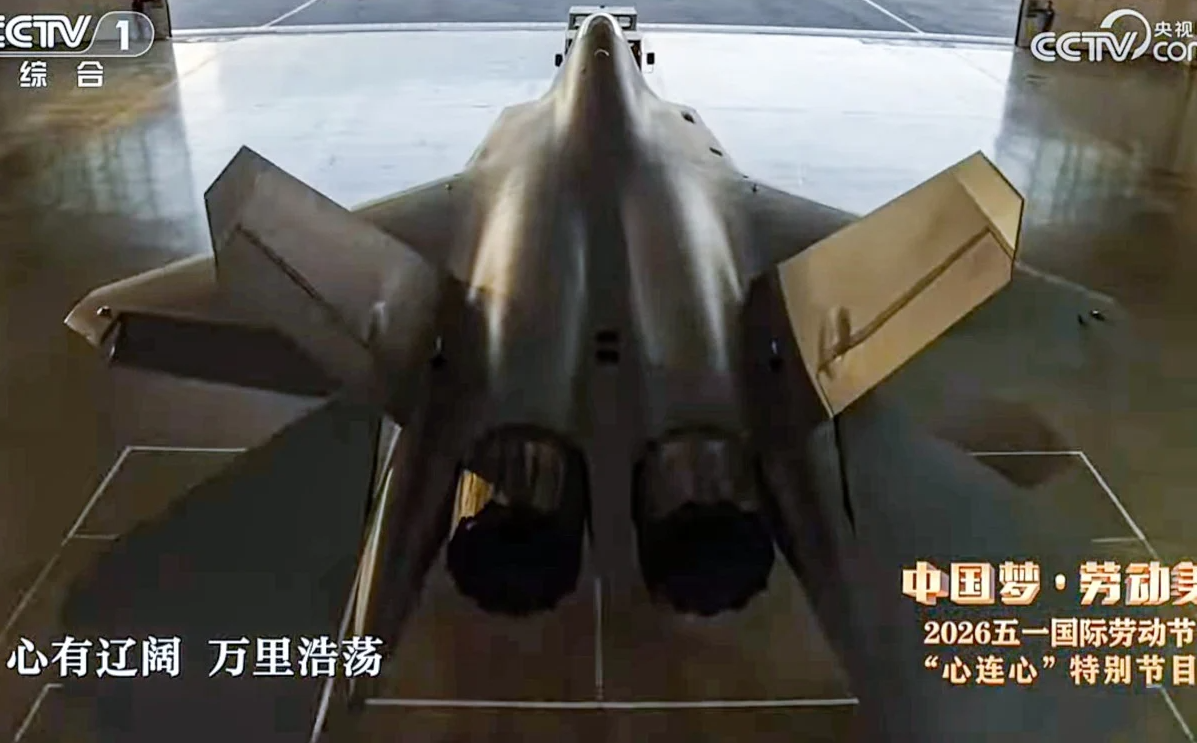
A recent South China Morning Post report offers what may be the clearest signal yet that China is preparing to move its fifth generation fighter programme from domestic deployment to the export market, with Pakistan emerging as the most likely first customer. The indication did not come through an official announcement, but through something far more telling in the language of defence signalling, a state broadcast.
Footage aired by China Central Television during its May Day special programme showed a version of the Shenyang J-35A rolling out of a hangar bearing the serial number 001 and, crucially, the logo of Aviation Industry Corporation of China rather than markings of the People’s Liberation Army Air Force. In the opaque world of defence exports, such details matter. The absence of PLA insignia and the presence of an industrial logo strongly suggest that this is not a standard service variant, but an export configured platform, now widely referred to as the J-35AE.
This is significant not because China has never displayed the aircraft before, it has, particularly at air shows such as Zhuhai in 2024, but because this is the first time a full scale, operational export variant appears to have been revealed rather than a conceptual model. Hong Kong based military commentator Liang Guoliang went further, describing the aircraft shown as a “complete product” ready for export, pointing specifically to the integration of a teal coated electro optical targeting system embedded within the fuselage. That detail is not cosmetic. External pods compromise stealth. Internal integration suggests a design that is operationally mature and aligned with fifth generation standards, including survivability against infrared tracking, laser interference, and multi spectrum detection.
If the aircraft is indeed export ready, the question shifts from capability to destination. On that front, the direction appears less ambiguous. Liang and other analysts see Pakistan as the natural first recipient, with potential interest from West Asian states further down the line. The reasoning is both strategic and political. Recent conflicts in West Asia, particularly tensions involving the United States, Israel and Iran, have reinforced a long standing concern among Gulf states about overdependence on a single security provider. Diversification is no longer theoretical. It is becoming policy.
Pakistan, however, sits at the front of that queue. Reports suggest that Islamabad has already agreed in principle to acquire around 40 J-35 stealth fighters as part of a broader defence package that includes the KJ-500 airborne early warning aircraft and the HQ-19 missile defence system. If confirmed, this would mark a milestone, the first export of a Chinese fighter with full stealth capability. It would also deepen a defence relationship that is already one of the most extensive in the world.
According to data from the Stockholm International Peace Research Institute, roughly 80 percent of Pakistan’s arms imports between 2021 and 2025 originated in China. The Pakistan Air Force already operates Chinese built J-10C fighters and co produces the JF-17, forming the backbone of its current combat fleet. The addition of a fifth generation platform would not just be an upgrade, it would be a doctrinal shift.
There are also signals that preparation is already underway. In June, AVIC released imagery showing a Pakistani pilot inside a J-35A cockpit, suggesting training or familiarisation has begun. This is often one of the final stages before induction, even if formal announcements lag behind.
Beyond bilateral ties, the development has wider implications for the global arms market. As Liang bluntly put it, competition at the cutting edge of military aviation is increasingly a two player field. Russia, once a dominant exporter, has seen its position erode, while countries like South Korea have advanced rapidly but remain outside the top tier of stealth technology. Today, the most advanced fighter segment is effectively contested between China and the United States, with France maintaining a strong but more limited presence in the broader export market.
China’s push with the J-35 series reflects that reality. Developed by the Shenyang Aircraft Corporation, the platform is Beijing’s second fifth generation fighter after the J-20, and is widely seen as its answer to the American Lockheed Martin F-35 Lightning II. The J-35A serves as the land based variant for the air force, while the J-35 is designed for carrier operations. This dual role flexibility is central to its export appeal. As analyst Song Zhongping noted, it allows potential buyers to integrate the aircraft across both air and naval domains, a rare capability at this level.
Technologically, the aircraft appears competitive. Analysts point to the integration of electro optical targeting and tracking systems that complement radar, improving detection while reducing exposure to enemy countermeasures. In pure performance terms, the gap between Chinese and Western fifth generation fighters is narrowing, if not already closed in certain areas.
Yet the final barrier is not technical. It is political. As Song observed, the primary constraint on Chinese military exports has never been capability, but alignment. The most likely customers are countries willing to prioritise operational effectiveness over ideological alignment with Western defence frameworks. In that sense, the J-35AE is not just a weapons platform. It is a geopolitical instrument.
The broader implication is hard to ignore. If Pakistan becomes the first foreign operator of a Chinese stealth fighter, it will signal a shift in the global defence landscape. Not just in terms of hardware, but in terms of influence. Air power has always been a marker of strategic alignment. The entry of a Chinese fifth generation jet into active export service would formalise a reality that has been building for years, the emergence of China as a credible, and in some cases preferred, alternative to Western military technology.
There is, however, a final layer of caution. Claims surrounding combat performance, including reports that J-10C aircraft shot down Indian jets, including a French made Rafale, during clashes near Kashmir last year, remain disputed by India. As with all such narratives, verification is contested and often shaped by strategic messaging.
Even so, the trajectory is clear. China is no longer just producing advanced fighters for itself. It is preparing to export them. And if the signals in this SCMP report hold true, that transition may already be underway.