

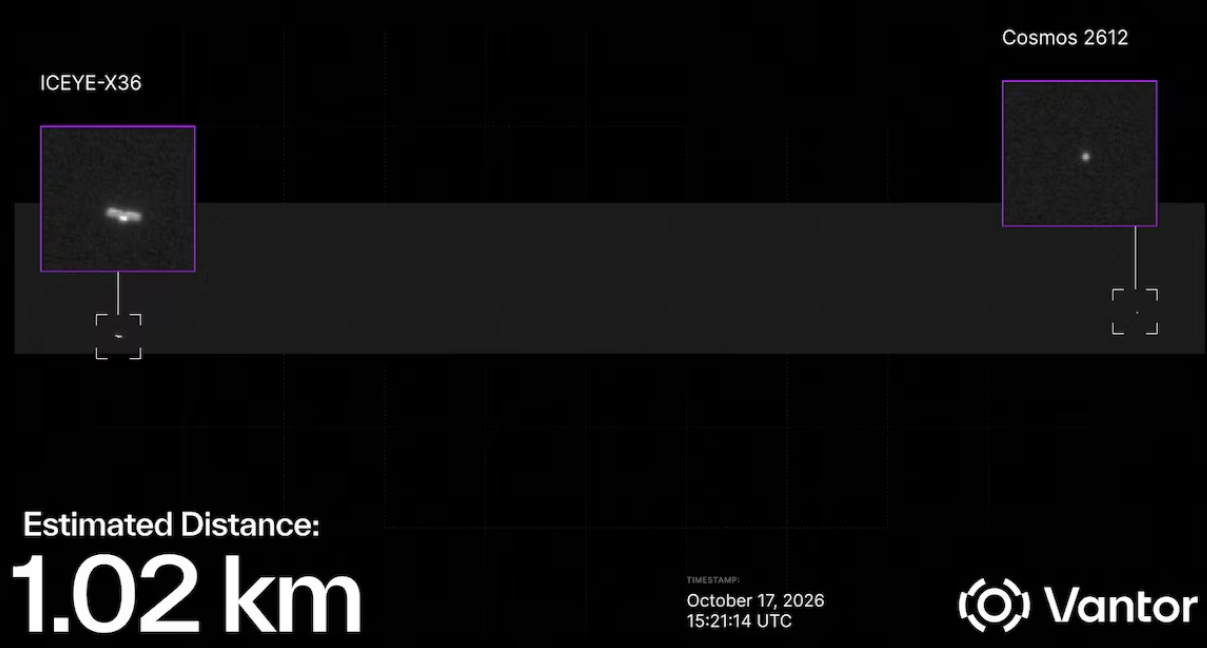
Russia’s repeated manoeuvres near a Finnish operated commercial satellite have raised fresh concerns about the growing vulnerability of civilian and commercial space infrastructure during armed conflict. In October, the Russian military satellite Cosmos 2612 approached ICEYE X36, a radar imaging satellite used by Western governments and military organisations, including Ukraine. The precise distance between the two spacecraft remains uncertain, with estimates ranging from around one kilometre to a few hundred metres or less. The encounter has prompted concerns that Moscow may have been rehearsing an operation against a commercial satellite supporting Ukraine. Although the available orbital data cannot establish that intention, the manoeuvres highlight a changing dimension of the Russia Ukraine conflict, where space based infrastructure is increasingly connected to military operations.
The significance of the incident lies partly in the role played by ICEYE. Its synthetic aperture radar satellites can collect images of the Earth’s surface in darkness and through cloud cover, providing information that is valuable for military planning and battlefield assessment. Unlike conventional optical imaging satellites, radar systems do not depend on clear weather or daylight. This makes them particularly useful for monitoring troop movements, identifying military equipment and assessing changes around strategic locations. The information they provide can contribute to the operational picture available to governments and armed forces. As a result, commercial satellites that were developed for civilian and commercial applications can become strategically important during a war.
Russia has repeatedly warned that Western commercial satellites supporting Ukraine could be considered legitimate targets. That position reflects Moscow’s broader argument that commercial space services are no longer detached from military activity when their data and communications contribute to the capabilities of an opposing force. The distinction between civilian infrastructure and military support is therefore becoming increasingly contested. A satellite may be privately owned and commercially operated, yet its services can have direct military value. This creates a difficult environment for companies whose systems serve both civilian customers and governments involved in an armed conflict.
The October encounter was not an isolated development. In May, four Russian satellites were positioned close to ICEYE X36, prompting the company to manoeuvre its spacecraft. Further Russian movements followed. In early October, Cosmos 2612 was observed hundreds of kilometres behind X36 before gradually closing the distance over several days. It eventually came within approximately one kilometre, with some estimates suggesting a substantially closer approach, before moving away by around 400 kilometres. The sequence has drawn attention because the Russian spacecraft did not simply pass through the same orbital region. Its movements appeared to involve a sustained effort to approach and remain near the commercial satellite.
Cosmos 2612 is publicly categorised as a servicing or inspection satellite. Russia launched it in April as one of six military satellites. Such a designation does not, by itself, establish that a spacecraft is designed to attack another satellite. Inspection satellites can be used to observe, examine and assess objects in orbit, and their manoeuvrability can serve several purposes. However, the same capabilities can also create risks when a spacecraft approaches another satellite without a clear explanation of its intentions. The concern is not simply that one satellite can get close to another, but that the approaching spacecraft may possess capabilities that are difficult for the other operator to assess in real time.
A close approach could serve different purposes depending on the technology carried by the spacecraft. It might allow an operator to inspect another satellite, observe its configuration or gather information about its functions. More concerning possibilities include interference with its operations, temporary disruption or physical damage. The available orbital information cannot confirm that Cosmos 2612 carried out any such activity, nor can it establish that an attack was planned. Nevertheless, the possibility that a military spacecraft can approach a commercial satellite at close range creates uncertainty for operators and governments. Even without an attack, repeated manoeuvres can force a satellite operator to respond, adjust its orbit and use fuel that would otherwise support its operational life.
The implications extend beyond ICEYE X36. Two other Russian satellites, identified as siblings of Cosmos 2612, have also attracted attention because their orbital planes are moving in the direction of another ICEYE spacecraft, X37. Both X36 and X37 are registered in the United States in public satellite catalogues. However, the convergence of orbital planes should not be interpreted as evidence that another close encounter is imminent. Updated orbital analysis indicated that the projected geometry did not, on its own, point to a close approach within the period examined. Further manoeuvres would be needed to change that assessment. The distinction matters because orbital paths can appear to converge without the spacecraft actually approaching one another at a dangerous distance.
The wider strategic concern is that space has become an increasingly important part of modern military capability. Armed forces rely on satellites for communications, navigation, intelligence gathering, surveillance and the coordination of operations. The war in Ukraine has demonstrated how commercial systems can supplement national military capabilities, allowing governments to obtain information and services that might otherwise be unavailable or more difficult to access. Commercial satellite operators are therefore no longer peripheral participants in conflicts. Their infrastructure can contribute to the effectiveness of military operations, making it more likely to attract the attention of states seeking to weaken an opponent’s technological advantage.
This development also changes the security calculations of commercial operators. A company may have customers across several countries and serve a wide range of civilian needs, but its services can acquire military significance during a conflict. The operator may consequently face pressure from governments, threats from opposing states and the practical challenge of protecting spacecraft that cannot be defended in the same way as infrastructure on Earth. Manoeuvring away from a potentially threatening object may reduce immediate risk, but it can consume limited fuel and affect the satellite’s operational life. A company must therefore weigh the cost of preserving its spacecraft against the importance of maintaining uninterrupted services for its customers.
The incident also highlights the growing importance of independent space surveillance. Commercial tracking organisations can monitor orbital movements and identify unusual behaviour that might otherwise remain difficult for the wider public to assess. Their analysis can help establish the sequence of manoeuvres, estimate the distance between spacecraft and distinguish ordinary orbital movement from deliberate changes in trajectory. However, tracking data has limits. It can show where a satellite has travelled and how its orbit has changed, but it cannot independently establish the instructions given to its operator, the equipment carried aboard or the intention behind a particular manoeuvre.
The United States has acknowledged the growing military importance of space and the possibility of hostile activity against its assets. American officials have raised concerns about Russian space capabilities, including the deployment of a space weapon within reach of critical national security satellites. The United States has also acknowledged deploying weapons in orbit. These developments indicate that major powers are preparing for a more contested space environment, even as the rules governing military activity beyond Earth remain incomplete and difficult to enforce. The concern is no longer limited to the possibility of destroying a satellite. Interference, surveillance, disruption and the threat of damage can all affect the reliability of space based services.
A direct attack on a commercial satellite could also produce consequences beyond the immediate military objective. Damage to a spacecraft may generate debris that threatens other satellites operating in nearby orbits. Such an outcome could affect unrelated commercial, civilian and government systems. The consequences would not necessarily remain confined to the country whose satellite had been targeted. Space infrastructure is interconnected, and an incident involving one spacecraft could create risks for other operators that have no direct involvement in the conflict. This makes restraint particularly important, especially in orbital regions where multiple states and commercial companies depend on the same operating environment.
The legal and political questions are equally significant. International space law establishes that states retain responsibility for national activities in outer space, including those carried out by non governmental entities under their jurisdiction. Yet the growing military use of commercial services complicates the practical distinction between civilian and military infrastructure. The fact that a private satellite provides information to a military customer does not automatically resolve every question about its status or the legality of attacking it. Any assessment would depend on the circumstances, the nature of the support provided and the applicable rules of international humanitarian law. Broad declarations that commercial satellites can be treated as legitimate targets risk creating uncertainty for operators and increasing the possibility of escalation.
Western governments and commercial satellite companies will need to treat the protection of space infrastructure as a more immediate security priority. This requires better coordination between governments and private operators, stronger monitoring of suspicious manoeuvres, improved resilience and clear procedures for responding to threatening approaches. Satellite operators also need to consider how they can maintain essential services if individual spacecraft are disrupted or disabled. Governments, meanwhile, must communicate their concerns with sufficient evidence and avoid allowing uncertainty to become a source of unnecessary escalation. Transparency about unusual orbital activity can help establish facts, but it cannot replace diplomatic engagement or practical measures to reduce the risk of confrontation.
The approach of Cosmos 2612 towards ICEYE X36 has not established that Russia attempted an attack or conducted a rehearsal. The available evidence supports concern about the nature and pattern of the manoeuvres, not a definitive conclusion about their purpose. That distinction should remain central to any assessment of the incident. Yet the strategic implications are difficult to ignore. As commercial satellites become increasingly important to military operations, they are also becoming more exposed to pressure and potential interference from rival states. The next phase of the Russia Ukraine conflict may not be defined only by developments on land, at sea or in the air. It may also be shaped by the contest over the infrastructure orbiting above them, where even an unexplained approach can create strategic uncertainty and raise the risk of a wider confrontation.