

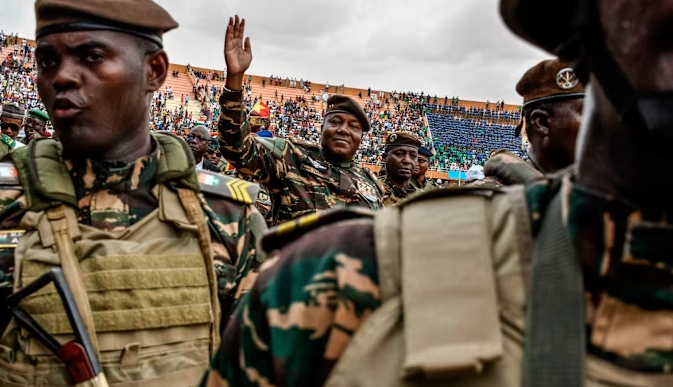
The failed mutiny that erupted in Niamey on August 29, was more than a fleeting security incident. It was a stress test of the entire post-coup order that General Abdourahamane Tiani has tried to consolidate since July 2023. Within hours, gunfire and explosions rocked the capital, mutineers seized Air Force Base 101 inside the Diori Hamani International Airport complex, and fighting spread to areas near the presidential palace and the state broadcaster. By nightfall, loyalist forces, backed decisively by Russia’s Africa Corps and supported logistically by Algeria, had regained control of the base and declared the uprising contained. State television announced that dozens of soldiers had been killed or detained, though independent verification of the figures remains elusive. What is clear is that the episode exposed fractures inside an army that has borne the brunt of a worsening insurgency in western Niger while being asked to guarantee the survival of a junta whose central promise was to make the country safer.
The sequence of events points to a carefully timed internal challenge rather than a spontaneous outbreak of indiscipline. Mutineers first took fellow servicemen hostage at Base 101, then opened fire and moved against what the Defence Ministry described as sensitive sites in the capital. The airport perimeter became a focal point of heavy exchanges, state television and radio were temporarily knocked off air, and the presidential palace came under direct threat. Government forces eventually retook the base after hours of fighting, with the Presidential Guard remaining loyal to Tiani throughout. Analysts and diplomats reported that the mutineers held out inside the airport complex until Russia’s Africa Corps intervened with both ground and aerial support, tipping the balance in favour of the regime. The precise size and leadership of the rebellion remain opaque. State media spoke of hundreds of participants, while independent outlets cautioned that such numbers could not be verified. What is better established is that some of those involved came from units deployed in southwestern departments such as Ouallam, Tera and Dosso, areas where the army has absorbed some of its heaviest losses fighting jihadist groups.
That geographic detail is not incidental. It ties the mutiny directly to the security crisis that helped bring Tiani to power in the first place. In 2023, he and fellow officers argued that the elected government had failed to contain armed groups and that only a military regime could restore order. Three years on, the threat has not receded. Nigerien forces continue to confront affiliates of al Qaeda and the Islamic State, especially in the volatile tri border zone with Mali and Burkina Faso. In recent months, attacks attributed to Islamic State Sahel have killed scores of soldiers, including an assault earlier in August that reportedly left around 18 troops dead. The airport complex itself has been targeted multiple times this year, with January and June attacks linked respectively to an Islamic State affiliate and to Jama’at Nusrat al Islam wal Muslimin, al Qaeda’s main Sahel franchise. For frontline units, the result is a relentless cycle of casualties, equipment shortages, and operational exhaustion that has already sparked earlier episodes of unrest, such as the 2025 Termit garrison mutiny over malnutrition and unpaid wages. The August 2026 uprising therefore arrived against a backdrop in which the very security situation used to justify the coup has continued to deteriorate, and the soldiers asked to fight it are increasingly willing to turn their weapons inward.
The role of Russia’s Africa Corps in suppressing the mutiny marks a qualitative shift in Niger’s security architecture. Africa Corps is a Kremlin controlled paramilitary formation that absorbed much of the Wagner Group’s African footprint after Yevgeny Prigozhin’s death in 2023. It operates under the Russian Ministry of Defence and includes many former Wagner personnel. In Niger, it is estimated to field between 200 and 300 troops, with its headquarters at Base 101 inside the airport complex. During the crisis, Nigerien authorities formally requested its assistance. Russia’s ambassador to Niger, Viktor Voropaev, stated on Russian media that the mutineers were neutralised particularly thanks to the intervention of Africa Corps, and that senior Nigerien officers visited the unit’s base to express gratitude. Independent analysts and diplomats confirmed that the force provided both ground and aerial support after loyalist units struggled to dislodge the rebels from the airport. This was not a case of Russian advisers observing from a distance. It was a direct combat role in helping a military government defeat an armed challenge from within its own ranks. That distinction matters. It shows that when the regime’s survival was at stake, Niamey could call on a foreign force already embedded inside the country and willing to fight on its behalf.
Russia’s gains from this arrangement extend beyond the immediate tactical success. Since the 2023 coup, Niamey has systematically reoriented its external partnerships. French forces, once central to counterinsurgency efforts across the Sahel, were expelled after relations with the junta collapsed. United States troops subsequently withdrew from Base 101 and other installations. Niger then joined Mali and Burkina Faso in the Alliance of Sahel States, a bloc of military led governments that has moved away from the Economic Community of West African States and deepened coordination on security and sovereignty issues. Moscow has cultivated close military ties with all three capitals. Africa Corps is part of that wider strategy, taking over much of Wagner’s former role while operating under tighter state control. The Niamey mutiny gave that partnership a new dimension. Russia was not merely helping Niger fight jihadists. It was helping the government survive an internal military revolt. Whether this translates into deeper political leverage over Tiani’s decision making remains an open question, but the episode clearly demonstrates the practical value of having a loyal, battle hardened foreign force on the ground when the regime faces an existential threat. For the Kremlin, this is a tangible return on its investment in the Sahel, and a signal to other regional actors about the kind of security guarantees it can offer.
Algeria’s involvement adds another layer to the regional geometry of the crisis. Niamey’s presidential office stated that Algiers provided military assistance during the mutiny. Reporting indicates that Algeria dispatched four fighter jets, a transport aircraft and a refuelling tanker to support the government. Algeria has long positioned itself as a key security actor in the Sahel, wary of spillover from jihadist violence and wary as well of Western military dominance on its southern flank. Its support for Tiani in this moment aligns with a broader preference for stability and state continuity, even when that means backing military regimes. The Alliance of Sahel States also issued political backing for Niamey, while Turkiye expressed solidarity and called for restraint. Turkish drones were reportedly among the assets targeted during the fighting, underlining how many external players now have a stake in the outcome of Niger’s internal power struggles. It is not yet clear whether Mali or Burkina Faso contributed direct military assets to suppress the mutiny, and their political support should not be read as evidence of troop deployments. Still, the pattern is unmistakable. Niger’s crisis management relied on a coalition of partners that excludes traditional Western allies and leans heavily on Russia, Algeria and its AES comrades.
The reversal of Western influence is one of the most striking features of this episode. France once maintained a major military presence in Niger as part of its wider Sahel counterinsurgency architecture. That footprint has now vanished, and Paris has no confirmed new military response to the 2026 mutiny. The United States, which operated a significant drone and intelligence hub at Base 101, withdrew its forces after the coup and has not re entered the picture. The United Kingdom had a much smaller role in Niger than France and has not announced any new security engagement tied to the uprising. In their place stands a security order in which Russian paramilitary forces, Algerian air assets, and regional political backing form the core of external support for the junta. This does not mean that Western intelligence or diplomatic channels are entirely irrelevant, but it does mean that when shots were fired in Niamey, the forces that mattered most on the ground were not French, American or British.
Whether Russia can solve Niger’s underlying security problem is a different question. Africa Corps may have helped the regime contain the immediate threat, but its intervention does not resolve the insurgency that continues to drain the army’s strength. Armed groups linked to al Qaeda and the Islamic State remain active across large swathes of western Niger and the broader Sahel. Nigerien soldiers continue to suffer heavy losses in ambushes, raids and bomb attacks. Tiani came to power promising greater security and sovereignty, yet three years later the armed group threat persists, and soldiers have mounted a serious internal challenge to his rule. Russia can provide personnel, training, and operational support, and it can help the regime survive coups and mutinies. There is no evidence from this episode that Africa Corps can by itself fix the governance deficits, economic pressures, and local grievances that fuel the insurgency or the discontent inside the ranks. The immediate challenge to Tiani has been contained, but the contradiction at the heart of his project remains. He seized power on the promise of making Niger more secure, yet his government now confronts both a persistent jihadist war and unrest within the very institution on which his rule depends.
For Russia, the crisis demonstrates the practical value of its growing security relationship with Niger. When the government faced an internal military crisis, Africa Corps was already on the ground and ready to intervene. That does not mean Russia has replaced Niger’s own armed forces. It does show how far Niger’s security architecture has shifted since 2023, from one heavily reliant on Western partners to one in which Russian forces now have a visible, combat capable supporting role. For the Sahel as a whole, the Niamey mutiny is a warning and a precedent. It warns military governments that their own armies can become the source of their greatest vulnerability when security promises go unfulfilled. It sets a precedent for how Russia and its regional partners may respond when those governments are threatened from within. The shots fired around Base 101 did not just test the loyalty of Niger’s Presidential Guard. They tested the resilience of an entire post-coup order and the external alliances that sustain it. The regime survived, but the tensions that produced the mutiny have not disappeared.