
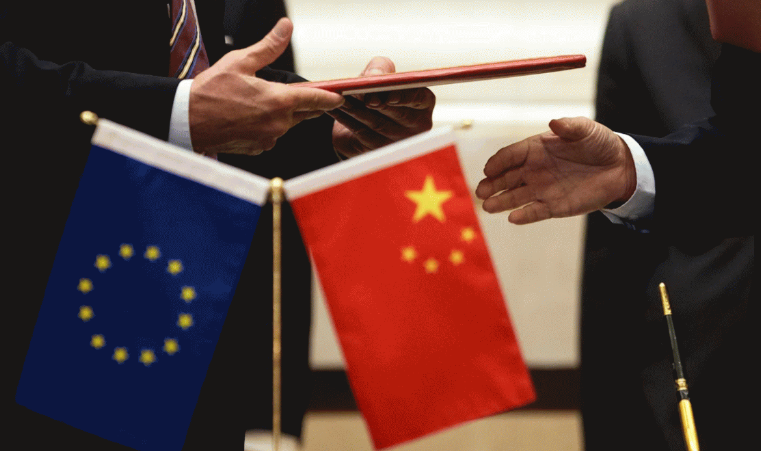
For decades, the European Union anchored its foreign policy in the comfortable assumption that economic interdependence would naturally cultivate geopolitical stability. That illusion has now been completely shattered. In an unpublicized but monumental shift, the twenty-seven foreign ministers of the European Union recently adopted a position paper entitled The Threats and Challenges We Face: Assessment of the EU Strategic Environment. Written by the External Action Service, this document represents the strongest official condemnation of Beijing ever issued by Brussels, crossing a definitive diplomatic threshold by aligning the European Union directly with the harder edged posture of the North Atlantic Treaty Organization.
By explicitly categorizing China alongside Russia as a revisionist power determined to reshape the global order in line with its own interests, Brussels has officially discarded the diplomatic pleasantries that previously defined its approach to the Far East. The document accuses both nations of actively fostering a return to a sphere of influence logic, challenging European territorial integrity and the international rules-based order. This is a profound departure from the past. The days when European leaders viewed Beijing as a benign trading partner that could be coaxed into global civic responsibility are gone, replaced by the stark realization that the Eurasian landmass is experiencing a structural realignment that directly threatens the democratic architecture of the West.
The most explosive element of this strategic shift lies in the language used to describe China’s relationship with the Russian war machine. For the first time in an official EU document, Beijing is explicitly branded as a key enabler and a crucial enabler of the invasion of Ukraine. This terminology reflects a deep and growing frustration within European capitals regarding China’s duplicity. While Chinese diplomats have spent more than four years claiming absolute neutrality in the conflict, the reality on the ground has told a vastly different story. The European External Action Service notes that the Sino-Russian partnership has evolved from mere rhetorical solidarity into a deep, functional system of military and economic support.
This evolution is corroborated by the latest intelligence updates from European leadership. Top EU diplomat Kaja Kallas recently sent shockwaves through the diplomatic community by revealing that Brussels now possesses verified reports indicating Chinese military personnel have been actively training Russian troops for the battlefield in Ukraine. This revelation shifts Beijing out of the category of a passive diplomatic bystander or an indirect economic beneficiary of the war. Instead, it places the Chinese state apparatus directly inside the logistical and operational matrix of the forces currently undermining European security. The training of combat troops represents a qualitative escalation that makes it impossible for Brussels to treat China as anything less than a direct strategic adversary.
Furthermore, economic research highlights that China has effectively become the dominant life support system for the Russian economy. Between 2021 and 2023, China’s share of Russia’s dual-use imports skyrocketed from roughly thirty percent to over sixty-six percent. By 2025, estimates from European sanctions monitors indicated that Chinese entities were supplying up to eighty percent of the critical microelectronics, machine tools, and components found inside Russian weaponry recovered from the battlefield. This economic lifeline, combined with a massive surge in Russian oil purchases that funds Moscow’s war treasury, demonstrates that the Kremlin’s aggression is structurally dependent on Beijing’s continuous material support.
The adoption of this paper exposes a fundamental shift away from the classic tripartite formula that has guided EU-China relations since 2019. For years, Brussels attempted to walk a geopolitical tightrope, labeling China simultaneously a partner for cooperation, an economic competitor, and a systemic rival. This new strategic assessment completely omits the language of partnership. The deletion of that single word reflects a tectonic shift in European strategic culture. It acknowledges that selective cooperation is no longer viable when one party is actively bankrolling the destruction of the European security architecture. The competitive and rivalrous aspects of the relationship have completely cannibalized the possibility of a constructive partnership.
Yet, even as the European Union achieves ideological clarity, it remains trapped in a agonizing paradox of economic interdependence. This internal tension was laid bare by the simultaneous revelation that the bloc has granted Ukraine a rare exemption to spend a portion of a six billion euro tranche of EU funds to purchase drone components directly from China. The carve-out from standard Buy European guidelines illustrates the messy, contradictory realities of modern warfare and economic supply chains. Drones have become the absolute arbiter of survival on the Ukrainian battlefield, accounting for an estimated 80% of Russian casualties. However, despite major efforts to revitalize the European defense industrial base, the continent remains utterly incapable of producing the volume of specialized components required to sustain Kyiv’s needs.
This drone dilemma exposes the deepest vulnerability of the West. While Brussels is busy drafting sanctions against Chinese firms that feed Russia’s industrial sector, Ukraine is forced to rely on those exact same Chinese supply chains to defend its territory. This creates a bizarre scenario where European taxpayer money flows into the Chinese tech sector out of sheer operational necessity. It is a powerful reminder that economic de-risking is a generational project that cannot be achieved by rhetoric alone. Until Europe can build a self-sustaining defense industrial ecosystem that replicates the scale and speed of East Asian manufacturing, its strategic autonomy will remain constrained by its material dependencies.
The strategic paper pulls no punches when addressing the broader economic warfare being waged by Beijing. The authors explicitly state that China is pursuing industrial dominance not merely as an economic objective, but as a deliberate geostrategic lever designed to create asymmetric advantages over the European Union. By building monopolies over critical raw materials, green technologies, and next-generation telecommunications, Beijing has constructed a sophisticated apparatus of economic coercion. European policymakers have watched with growing alarm as China demonstrates a continuous willingness to weaponize these dependencies against any state that challenges its political narratives, as seen in previous trade blockades against Lithuania and recent export restrictions on defense-related materials.
The European Union now recognizes that its massive trade deficit with China, which exceeded 350 billion euros, is not just a commercial imbalance but a severe national security risk. The Chinese domestic economy, plagued by a structural property crisis, slowing growth, and rising local debt, is attempting to export its way out of trouble by flooding global markets with heavily subsidized industrial goods. This overcapacity targets the very sectors Europe relies upon for its future competitiveness, such as electric vehicles, wind turbines, and advanced semiconductors. The strategy paper warns that if Europe permits its industrial core to be hollowed out by this economic deluge, it will lose the material capability to defend its political sovereignty.
This European awakening is occurring in a highly volatile global context, marked by massive uncertainty surrounding the trajectory of the United States. The strategy document mentions the United States only twice, but those brief references carry immense weight. Under the administration of Donald Trump, the transatlantic bond is undergoing its most severe stress test in generations. President Trump’s erratic foreign policy pronouncements, including his repeated public demands to purchase Greenland from Denmark and his continuous threats to scale back or review the foundational US security commitments to NATO, have sent shockwaves through European capitals.
The paper explicitly notes that the long standing American contribution to European defense is being reviewed, forcing the continent to assume far greater responsibility for its own security survival. This double pressure, a predatory, revisionist axis to the East and an increasingly transactional, unpredictable ally to the West, leaves Europe with no choice but to accelerate its journey toward genuine strategic autonomy. The document acknowledges that the intensifying strategic competition between Washington and Beijing will inevitably squeeze the European Union, forcing it to develop its own sharp power instruments rather than relying on the protective umbrella of the American military industrial complex.
The security threat is not confined to the borders of Eastern Europe. The External Action Service explicitly links European security to the stability of the Indo-Pacific region, detailing how China’s increasingly aggressive behavior in the South and East China Seas and across the Taiwan Strait poses a direct threat to global stability. A forceful alteration of the status quo around Taiwan would have a catastrophic impact on global trade, disrupting maritime shipping lanes that carry a massive portion of European commerce and cutting off the continent from the supply of advanced microchips. By including this language, the EU is signaling that it no longer views the defense of the Indo-Pacific as a purely American concern, but as an indispensable component of its own economic survival.
To transform this new conceptual clarity into effective policy, the European Union must overcome its greatest structural weakness, which is its own political fragmentation. Beijing’s diplomatic strategy has long relied on a sophisticated divide-and-conquer approach, offering lucrative bilateral investment deals to individual member states in exchange for diplomatic deference or the dilution of collective EU statements. The fact that this groundbreaking strategy paper had to be adopted quietly, without a major public announcement, underscores the lingering sensitivities and internal divisions within the Council of Foreign Ministers. Certain European capitals remain deeply hesitant to completely alienate their largest trading partner, fearing immediate economic retaliation.
However, the depth of the crisis in Ukraine and the blatant nature of the Sino-Russian alignment are rapidly narrowing the room for such diplomatic hesitation. The European Union has demonstrated a remarkable capacity for rapid institutional integration when it collectively recognizes an existential threat, as seen in the creation of the NextGenerationEU recovery fund and the coordinated deployment of unprecedented sanctions regimes against Moscow. The challenge now is to apply that same level of unity and urgency to its China policy. Brussels must tighten its anti-circumvention enforcement, close the loopholes that allow dual-use technologies to seep into the Russian military complex, and systematically reduce its critical dependencies on Chinese supply chains.
Ultimately, the new strategy paper marks the end of European innocence. It signals a collective recognition that the international rules-based order cannot be preserved through passive adherence to legal norms or nostalgic appeals to global trade agreements. In a world defined by a return to raw power politics and spheres of influence, the European Union must learn to speak the language of power. By naming China as a primary strategic challenge and a direct enabler of the existential threat on its eastern border, Europe has finally taken the indispensable first step toward its own defense. The path ahead will be exceptionally difficult, requiring painful economic adjustments and immense political discipline, but the alternative is to watch the global order be rewritten by the very autocracies that seek Europe’s decline.