

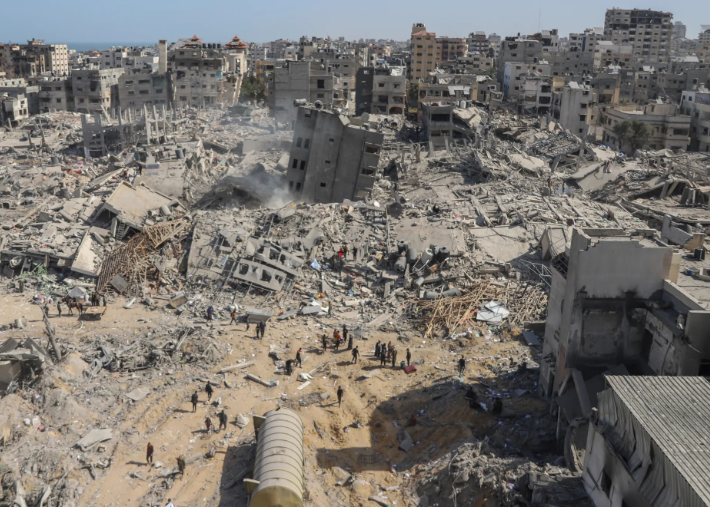
The milestone is as heavy as it is horrifying. 1000 days have passed since the Hamas-led slaughter of October 7, 2023, shook southern Israel, and in the nearly three years that have followed, the Gaza Strip has been transformed into an unmitigated wasteland of shattered concrete, shallow graves, and stalled human lives. 1000 days of industrial-scale bombardment, diplomatic theater, and compounding regional warfare have brought the Levant no closer to resolution. Instead, as the summer of 2026 burns across the region, the landscape reveals a terrifying reality: a fragile, deeply flawed United States-brokered ceasefire, enacted on October 10, 2025, is actively being dismantled by an expansionist Israeli military apparatus and a deeply cynical, neo-colonial American administrative experiment known as the Board of Peace.
What was packaged to the international community in late 2025 as a path toward regional stabilization has instead exposed itself as a dynamic mechanism of prolonged subjugation. Rather than a transition toward genuine sovereign reconstruction, the territory faces a meticulously engineered dead end. The structural architecture of the current truce is buckling under the weight of persistent, deliberate Israeli military advances and a total political deadlock designed to strip Palestinians of both their land and their international legal status. The tragedy of this moment is that it was entirely preventable. The ongoing horror in Gaza is no longer just the product of an initial spasm of retaliatory rage; it is the calculated result of a political leadership in Jerusalem that extended the war for its own survival, paired with an imperial administration in Washington that views international law not as a baseline for justice, but as an obstacle to be bypassed.
The illusion of tranquility under the current ceasefire is shattered daily by the ongoing, state-sanctioned loss of life. While the frequency of massive, unguided Israeli airstrikes has lessened since the formal implementation of the October 2025 agreement, targeted military operations have never truly ceased. Gaza’s Health Ministry has documented the deaths of 1053 Palestinians in the brief period following the formal declaration of the truce alone—a body count that features a staggering proportion of vulnerable civilians, including more than 350 women and children. This persistent violence reveals the hollow nature of the diplomatic phrasing generated in Washington and Jerusalem. For the families of a teenage girl struck down on her way to school, or the relatives of a mother killed alongside her one-year-old daughter in recent days, the word “ceasefire” is a cruel, mocking abstraction. This hypocrisy has fostered a toxic and entirely justified resentment among local populations, who look out across a landscape of ruins and see an international community paralyzed by indifference, or worse, complicit in their slow eradication.
The security environment on the ground has grown vastly more perilous due to an aggressive, unyielding expansion of the Israeli military footprint. When the ceasefire was reluctantly accepted by Prime Minister Benjamin Netanyahu’s government in late 2025, Israeli forces held slightly over half of the Gaza Strip’s geographical territory. In the months that have followed, under the guise of “buffer zones” and “security cordons,” the Israeli military has systematically encroached upon the remaining enclaves, explicitly declaring an ultimate objective to permanently occupy 70% of the total land mass. This brazen, creep-and-hold strategy drew a sharp, albeit toothless, warning from the United Nations in mid-2026. UN officials rightly emphasized that this steady territorial expansion creates immediate, lethal risks for civilians trapped in shifting zones that lack any clear demarcation on the ground. The human cost of these deliberate border realignments is further reflected in the more than 3400 individuals wounded since the truce supposedly began. While Israel continues to deploy its standard rhetorical shield, asserting that its forces exclusively target active militants who utilize civilians as human shields, the sheer, relentless volume of civilian casualties tells a fundamentally different story—one of an occupying force that views the entire population of Gaza as an existential demographic threat to be compressed, isolated, and broken.
While the physical war continues to grind away at Palestinian lives, an equally damning exposure of state cynicism has erupted within Israel’s own security establishment. In a series of extraordinary and highly critical public remarks, Major General Nitzan Alon, the former lead coordinator for Israel’s hostage negotiations, tore down the foundational mythology of the Netanyahu war cabinet. Alon, who managed the deeply sensitive hostage portfolio from the initial hours of the 2023 crisis until his departure in October 2025, stated definitively that the war could have been concluded a full year earlier than it actually was. A comprehensive agreement was entirely achievable by late 2024 or early 2025—an agreement that would have secured the return of the captives and mandated the disarmament of Hamas under far more stable, verified terms.
Instead, as Alon bravely illuminated, Benjamin Netanyahu and his extremist coalition cabinet repeatedly and deliberately sabotaged broader diplomatic alternatives. They opted instead for partial, short-term arrangements designed specifically to extend the timeline of the military operations. The reason for this delay was as transparent as it was corrupt: the prolongation of active warfare served as the ultimate political shield for a prime minister desperate to avoid a reckoning over his catastrophic intelligence failures and to postpone an inevitable general election. This insistence on pursuing a fraudulent mirage of “absolute victory” carried a tragic, unforgivable price. It resulted in the unnecessary deaths of scores of young Israeli soldiers and led directly to the execution or systemic neglect of up to 40 Israeli hostages who were known to be alive in captivity in late 2024, but who perished in the tunnels before their government deigned to prioritize their lives over political longevity.
This blistering internal critique completely dismantles the triumphant, revisionist narrative pushed by ultra-nationalist ministers like Bezalel Smotrich, who have brazenly attempted to claim political credit for the ultimate return or accounting of the hostages. Alon directly refuted these claims, explaining that Israel’s political leadership actively resisted total diplomatic resolutions until the autumn of 2025, when a collapsing domestic economy, mounting military exhaustion, and the heavy-handed, transactional intervention of United States President Donald Trump essentially forced Netanyahu’s hand. Without that external American pressure, driven by Trump’s desire for a clean geopolitical slate for his own administrative tenure, the Israeli cabinet would have extended the slaughter indefinitely, despite their total failure to achieve the total eradication of Hamas’s underground network. The fact that Alon’s chief deputy resigned in open protest, and that Alon himself remained only to mitigate the damage of a government normalizing structural violence, cements this conflict as one of the most morally bankrupt chapters in modern Israeli history.
The rot of this administrative policy is not confined to the perimeter of the Gaza Strip; it has actively poisoned the wider stability of the occupied West Bank, or Judea and Samaria as it is aggressively titled by the settlement movement. Under the distraction of the Gaza campaign, the Netanyahu government has actively normalized, funded, and protected violent Jewish militias operating with total impunity against Palestinian agricultural villages. The rapid, state-sanctioned approval of illegal outposts and massive settlement expansions throughout 2025 and mid-2026 has been executed with a clear, malicious strategic intent: to permanently shatter any remaining possibility of a contiguous, viable Palestinian state. This unchecked expansion is not a defensive measure; it is an ideological offensive that has fundamentally destabilized the broader region, creating localized tinderboxes and forcing an overextended military to act as a private security force for radical settlers. As Israel stumbles toward a critical general election in the autumn of 2026, the domestic national mood is one of profound trauma, deep division, and an overwhelming sense of betrayal. Netanyahu’s hollow projections of confidence can no longer mask the reality that over 60% of the Israeli public, according to recent data from the Israel Democracy Institute, believe he is unfit to lead and should be barred from running. The public anger over the pre-October 7 security failures, the absolute refusal to convene an independent state commission of inquiry, and the corrupt military exemptions maintained for ultra-Orthodox political partners have left the state a house divided against itself.
Yet, while Israel wrestles with its fractured soul, the two million Palestinians inside Gaza are wrestling with absolute, animal survival amid a sea of toxic rubble. Forced into sprawling, disease-ridden tent cities in areas like Al-Mawasi or left to seek shelter within the cracked concrete skeletons of bombed-out schools, an entire generation is being systematically unmade. The relentless, high-pitched buzz of Israeli surveillance drones overhead forms the permanent auditory backdrop to an existence defined by hunger, displacement, and the ever-present threat of sudden obliteration. The October 2025 ceasefire explicitly guaranteed an immediate, unhindered surge of vital humanitarian relief, including critical pharmaceuticals, field hospitals, and industrial fuel. Yet, over nine months into the agreement, international aid groups uniformly report that this promised influx has been deliberately choked out by Israeli bureaucracy.
The behavior of COGAT, the Israeli military body tasked with civilian coordination, borders on the Orwellian. In mid-2026, COGAT officials issued public statements boldly claiming that the volume of food entering the enclave far exceeds the basic nutritional requirements of the population, pointing to marginal adjustments made after a horrific, localized famine was declared in Gaza City in August of 2025. This self-serving narrative is flatly contradicted by every credible independent agency on the ground. All major border crossings remain subject to arbitrary, unannounced closures and suffocating restrictions. The United Nations humanitarian chief, Tom Fletcher, recently exposed the reality of this blockade, detailing how Israeli authorities utilize hyper-complex approval processes to ban essential medical supplies under the absurd classification of “dual-use” items. In a display of profound cruelty, even prosthetic limbs intended for children who have lost legs to artillery fire are routinely turned back at the border under the manufactured pretense that the components could be repurposed into weapons of war. With seventeen major hospitals completely non-functional and raw sewage flowing through the dirt pathways of refugee camps, the civilian population has been pushed past the limits of human endurance.
It is within this vacuum of human misery that the true geopolitical horror of the post-war planning reveals itself. Enter the United States-led Board of Peace, an international administrative entity established by the Trump administration in early 2026 to execute a post-war political framework for what it terms “New Gaza.” Led by a collection of western interventionists, including former British Prime Minister Tony Blair and former UN diplomat Nickolay Mladenov, the Board of Peace is not an agency of rescue; it is an instrument of imperial engineering. Operating behind closed doors, the board’s primary objective is to implement a political layout that isolates Hamas not by offering Palestinians a dignified alternative of self-determination, but by treating the entire population as a laboratory experiment in counter-insurgency.
The board’s operations have completely stalled over an impossible prerequisite: the total, unconditional disarmament of every faction in Gaza before a single brick of permanent reconstruction can be laid. While Hamas has indicated a willingness to transition toward a political framework, it refuses to surrender its entire defensive capability without verified, ironclad guarantees of safety and a clear timeline for Israeli withdrawal. Israel, conversely, refuses to permit the entry of a planned Palestinian technocratic administrative committee or the opening of commerce until every uniform is discarded. The Board of Peace has entirely adopted this lopsided Israeli narrative, effectively turning the denial of housing and clean water into a punitive lever to force total capitulation.
The ideological malice of the Board of Peace became undeniable when the body issued a public declaration stating that the United Nations Relief and Works Agency (UNRWA) “has no place in New Gaza.” This move represents a direct compliance with the decades-long Israeli desire to dismantle the UN agency. As both Hamas and the Palestinian Foreign Ministry have correctly noted, the assault on UNRWA is not a logistical debate about humanitarian efficiency; it is a calculated political campaign to liquidate the legal status of Palestinian refugees. UNRWA was established by a direct mandate of the United Nations General Assembly following the 1948 Nakba, and it stands as an international, legal witness to the historical rights of displaced Palestinians—most notably the right of return enshrined in General Assembly Resolution 194. By seeking to replace UNRWA with private, corporate Western contractors, the Board of Peace and its Israeli partners are attempting to erase the refugee issue through administrative fiat. The Palestinian Foreign Ministry’s insistence that UNRWA is an irreplaceable lifeline and a pillar of regional stability is a desperate defense of international law against an lawless attempt to rewrite the rules of global governance. Furthermore, the board’s rhetoric explicitly seeks to administratively sever Gaza from the West Bank and East Jerusalem, an imperial strategy of fragmentation aimed at destroying the very concept of unified Palestinian nationhood.
The dark reality of this transition plan was fully exposed in mid-2026 when a leaked draft resolution from the board’s highly secretive meetings in the Cypriot coastal resort of Ayia Napa was published by The Guardian. The contents of the leak are chilling. Far from acting as a benevolent administrative council, the documents revealed that the Board of Peace is actively seeking sweeping, absolute legal immunity for all of its international members, private security forces, and foreign contractors, completely shielding them from any form of criminal prosecution or financial accountability within Palestinian courts. Even more alarming, the draft outlines legal mechanisms to seize public facilities, land, and municipal properties across the Gaza Strip without providing a single dollar of financial compensation to local authorities. As regional experts have pointed out, if these documents are authentic—and the board’s panicked, vague dismissals suggest they are—the Board of Peace has transitioned from a diplomatic body into an unaccountable, colonial occupation authority. It represents a corporate-imperial entity designed to rule over a devastated population while enjoying total legal shield against allegations of corruption or human rights abuses.
This colonial logic is put into practice through Article 17 of the Trump administration’s regional framework, which outlines a terrifying counter-insurgency strategy known on the ground as the “pincer movement.” Under Article 17, the board is preparing to launch a pilot project in the Tal as-Sultan area near Rafah. The strategy completely outlaws permanent, structural reconstruction. Instead, it mandates the creation of temporary, gated humanitarian shelter compounds for “unarmed” civilians. The distribution of food, water, and basic medical care will be used as a weapon of behavioral modification: aid will flow only into these designated, verified “Hamas-free” zones. The explicit goal is to force a desperate, starving population to voluntarily migrate into these controlled sectors, effectively draining the surrounding territory until the resistance is left with no people, no land, and no resources.
Security inside these modern-day strategic hamlets is to be maintained by an international stabilization force based at Camp Amitai on the border, with foreign guards equipped only with batons to police the displaced population. Meanwhile, the heavily armored conventional forces of the Israeli military will fortify permanent strategic positions right behind a newly drawn territorial demarcation known as the “Yellow Line,” cementing a multi-layered, permanent occupation of seventy percent of the Gaza Strip. This dystopian vision has even drawn criticism from right-wing Israeli settler groups, such as the Israel Envelope Forum, who view any temporary civilian infrastructure as a tactical mistake that allows the resistance to breathe, showing that the only debate occurring within the occupying power is between total containment or total expulsion.
To compound this horror, the entire infrastructure of the Board of Peace is already collapsing under its own structural deceit. The grand international donor conference convened in February of 2026, which claimed to secure over seventeen billion dollars in global pledges for Gaza’s recovery, has suffered a catastrophic financial collapse. International donors, spooked by the massive economic fallout of the wider regional war that Netanyahu triggered with Iran on February 28, have quietly reneged on their financial commitments. The Board of Peace is broke, its secret meetings are cloaked in layers of paranoid security in Cyprus, and the technocratic Palestinian committee it was supposed to fund is entirely paralyzed.
One thousand days into this catastrophic war, the reality of West Asia cannot be hidden by the slick press releases of the Board of Peace or the defensive rhetoric of the Israeli government. The past 1000 days have proven that the current architecture of occupation, supported by American imperial ambition, is incapable of producing anything other than mass graves and regional instability. The war cabinet in Jerusalem prolonged the conflict to protect a corrupt political class; the administration in Washington designed a corporate occupation to erase the legal identity of an indigenous people. As Gaza sits in ashes, the international community faces a profound moral reckoning. To allow the current trajectory to continue is to validate a world where international law is meaningless, where legal immunity protects the powerful from the consequences of slaughter, and where the calculated starvation of two million people can be rebranded as a “Board of Peace.” 1000 days of war have not brought security to Israel, nor have they brought defeat to the Palestinian desire for freedom. They have merely stripped away the mask of the western international order, leaving behind a raw, unvarnished display of colonial cruelty that will haunt the conscience of the world for generations to come.