

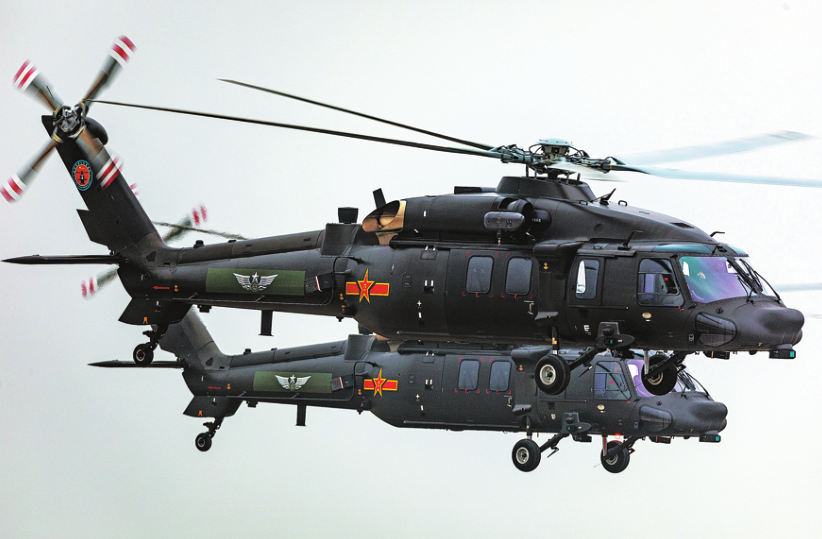
To the casual observer scanning the skies, distinguishing between the Harbin Z 20 and the Sikorsky UH 60 Black Hawk is an exercise in futility. The profiles are nearly identical, the physical footprints are structurally synchronized, and the overarching design philosophies seem entirely borrowed. Yet this striking visual symmetry is not a mere case of industrial espionage or superficial imitation. Instead, it represents the culmination of a multi decade, calculated geopolitical effort by Beijing to eliminate its most glaring military vulnerability. For a long time, the lack of a reliable, mass produced medium lift utility helicopter severely restricted the operational reach of the People’s Liberation Army. By successfully indigenizing and improving upon this classic Western aviation archetype, China has not only bridged a massive technological chasm but has also laid the foundation for an entirely new era of joint force power projection.
The historical trajectory of China’s helicopter deficiency explains the profound strategic importance of the Z 20. In the decades leading up to the turn of the century, Beijing’s domestic aviation sector lagged significantly behind the cutting edge systems fielded by the United States and the Soviet Union. The deficit became painfully apparent in high altitude environments like the Tibetan Plateau and along the disputed Himalayan border with India, where thin air and volatile weather patterns crippled standard rotorcraft. A temporary geopolitical thaw in 1984 allowed China to import twenty four civilian variants of the Black Hawk, designated as the S 70C. These American built platforms quickly became indispensable, serving as the only assets capable of executing demanding transport and rescue operations at ceilings exceeding four thousand meters. However, the subsequent Western arms embargo completely halted the supply of spare parts and new airframes, forcing Chinese commanders to rely on a dwindling, aging fleet while scrambling for alternatives.
To fill the immediate operational vacuum, the military turned to foreign procurement, acquiring hundreds of Russian Mi 17 and Mi 171 helicopters over the next two decades. While these robust machines satisfied general transport needs, they were far from a perfect solution. The Russian helicopters were too bulky to fit into the standard hangars of Chinese warships, and relying on an external supply chain for critical military components created an unacceptable strategic bottleneck. Simultaneously, domestic efforts yielded the light utility Z 9, based on a French design, and the heavy transport Z 8. Both platforms left the military caught between two extremes. The four ton Z 9 lacked the payload capacity for serious amphibious assault or robust anti submarine warfare, while the early thirteen ton Z 8 was far too cumbersome for agile, tactical deployments. The lack of a versatile, ten ton medium lift platform remained a critical missing link in the country’s defense architecture.
The formal initiation of the Z 20 program in 2010 aimed to definitively close this strategic gap. Following a maiden flight in 2013 and a high profile public debut during the 2019 National Day parade, the helicopter entered mass production, providing an entirely domestic alternative optimized for the most unforgiving environments. Although the exterior structure pays heavy homage to the Black Hawk, the Z 20 is fundamentally a modern aircraft that leverages twenty first century engineering to outperform its spiritual predecessor in several key metrics. The most critical divergence lies in the main rotor assembly, where the Z 20 utilizes a advanced five blade system rather than the traditional four blade configuration of the UH 60. This extra blade increases lift efficiency in the rarefied air of high altitude plateaus, significantly reduces acoustic signatures, and dampens structural vibration, which extends the operational life of the airframe during demanding maritime and mountain missions.
Beneath the composite skin, the technological updates become even more pronounced. The Z 20 features a fully electronic fly by wire flight control system, replacing the heavy mechanical linkages and hydraulic lines found in older variants of the Black Hawk. This upgrade reduces overall weight, streamlines maintenance logistics, and provides pilots with unmatched control precision when navigating hazardous terrain or landing on pitching warship decks. Powering this platform are twin domestic WZ 10 turboshaft engines, each producing sixteen hundred kilowatts of raw shaft horsepower. This output gives the Z 20 a slight power advantage over the standard American T700 engines, enabling a top speed of three hundred kilometers per hour, a combat radius of six hundred kilometers, and a service ceiling of six thousand meters. This allows it to carry eleven combat ready troops or four tons of external cargo deep into contested territory.
Having established a successful baseline design, Chinese defense engineers have rapidly adapted the platform into a highly specialized family of aircraft tailored for every branch of the armed forces. For the ground forces, the Z 20T assault variant transforms the utility transport into a formidable combat asset. Equipped with stub wings featuring multiple hardpoints, the Z 20T can carry an assortment of anti tank guided missiles, rocket pods, and auxiliary fuel tanks. A nose mounted electro optical and infrared targeting turret provides precision tracking capabilities, while upward facing exhaust nozzles mix hot engine gases with ambient air to significantly lower the infrared signature of the helicopter against shoulder fired surface to air missiles. This variant allows the army to insert air assault troops while simultaneously providing its own close air support.
The airborne forces have received their own tailored variant via the Z 20K series, which includes unique structural folding mechanisms that allow the helicopters to be tightly packed inside the cargo holds of Y 20 strategic transport planes for rapid deployment across long distances. Within this lineage, the attack optimized Z 20KA offers enhanced sensor suites and weapons hardpoints for special operations fire support, while the Z 20KS serves as a dedicated combat search and rescue platform. The Z 20KS is equipped with high capacity communication arrays, advanced medical suites, a rescue hoist, and powerful forward looking searchlights, ensuring that isolated personnel can be recovered from hostile environments. This multi variant deployment mimics the Western approach to tactical flexibility, ensuring that a single logistics chain can support a massive variety of mission profiles.
Perhaps the most profound strategic impact of this aviation family is felt across the maritime domain. The People’s Liberation Army Navy has long struggled with a deficit in shipborne aviation, particularly in the realm of anti submarine warfare. The introduction of the navalized Z 20J and Z 20F variants completely reshapes this dynamic. The Z 20J features anti corrosion treatments, enhanced landing gear, and folding rotors designed for compact shipboard hangars, allowing it to perform over the horizon amphibious insertions and ship to shore logistics. Meanwhile, the Z 20F functions as a dedicated anti submarine warfare asset. It features a prominent chin mounted search radome, a retractable dipping sonar, sonobuoy launchers, and a tail mounted magnetic anomaly detector. Operating from modern destroyers and aircraft carriers, the Z 20F provides a protective shield against hostile submarines, plugging a vulnerability that foreign adversaries have long sought to exploit.
Even the paramilitary domain has been integrated into this architectural overhaul through the Z 20WJ variant, operated by the People’s Armed Police. By stripping away specialized military grade electronic warfare suites and replacing them with domestic security communication networks and door mounted heavy machine guns, Beijing has created a highly effective tool for internal security. This variant excels at counterterrorism operations, narcotics interdiction, border patrol, and disaster relief, ensuring that domestic stability mechanisms possess the same logistical reliability and rugged performance as the frontline military units.
The ultimate testament to the versatility of the Z 20 platform is its role as the technological foundation for China’s next generation heavy attack helicopter, currently designated as the Z 21. Rather than designing a clean sheet heavy gunship to rival the American AH 64 Apache, engineers chose to utilize the proven WZ 10 engines, the five blade composite rotor system, and the advanced fly by wire controls of the Z 20. This design choice dramatically reduces research risks, production costs, and battlefield maintenance burdens. Since its initial flight test sightings in early 2024, the Z 21 has remained under accelerated development through 2026, featuring a slim, heavily armored tandem cockpit that places the weapons officer in front of the pilot. With an integrated chin cannon, large stub wings for heavy ordnance, and a comprehensive electronic warfare suite, the Z 21 will eventually replace lighter gunships as the primary armor crushing tip of the spear.
When viewed as an integrated ecosystem, the Z 20 family and its Z 21 offshoot provide Beijing with an unprecedented level of operational flexibility. In a potential high intensity conflict, such as a contingency in the Taiwan Strait, these platforms would form a synchronized vertical assault force. Heavily armed Z 21 gunships would neutralize coastal defenses and secure landing zones, followed closely by naval Z 20J transports launching from amphibious assault ships to insert waves of air assault troops over the horizon. Concurrently, the larger Z 8 fleets would fly in heavy equipment and logistical support, while Z 20F variants patrolled the surrounding waters to keep enemy submarines at bay. By systematically engineering a domestic solution to a thirty year supply vulnerability, China has turned a historical weakness into a cornerstone of its modern, multi domain military strategy.