

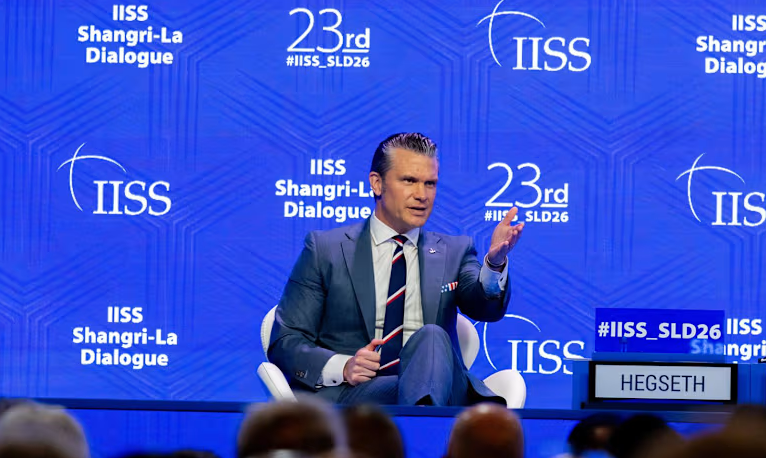
The 2026 Shangri-La Dialogue in Singapore was expected to provide one of the clearest signals yet about the direction of American strategy after the high profile summit between US President Donald Trump and Chinese President Xi Jinping in Beijing. Instead of delivering a speech centred entirely on confrontation with China, US Defence Secretary Pete Hegseth offered something more complex and strategically revealing. His address reflected an administration attempting to balance deterrence with diplomatic management, military expansion with alliance burden sharing, and Indo Pacific competition with multiple crises stretching from Europe to the West Asia.
The most striking aspect of Hegseth’s speech was not what he said about China, but how he said it. The language remained firm, but the tone was noticeably different from previous years. While reaffirming concerns over China’s military expansion and the growing capabilities of the People’s Liberation Army, Hegseth avoided the sharper rhetoric that had defined earlier American messaging. Last year, Washington openly warned that the Chinese military was rehearsing for a possible conflict over Taiwan and described the threat as potentially imminent. This year, Hegseth repeatedly emphasised stability, deterrence and communication. He described recent Xi-Trump talks as historic and stated that US-China relations were currently better than they had been in many years. He also called for expanded military to military communication mechanisms to reduce risks of miscalculation and unintended escalation.
Yet beneath the softer language, the strategic message remained unchanged. Hegseth reaffirmed that the centre of US military planning in Asia remains what American planners call deterrence by denial along the First Island Chain. This concept continues to shape Pentagon thinking regarding Taiwan, the East China Sea and the wider Western Pacific. Rather than threatening offensive escalation, the United States seeks to make any potential military action against regional partners prohibitively costly and operationally difficult. The objective is not conquest or confrontation but preventing any single power from dominating the Indo-Pacific security architecture.
Perhaps the most revealing omission in the speech was Taiwan itself. Unlike previous addresses where Taiwan featured prominently, Hegseth did not directly mention the island during his formal remarks. The silence was notable because Taiwan remains the most sensitive flashpoint in US-China relations. When questioned later about arms sales to Taipei, Hegseth declined to offer a definitive answer and instead indicated that future decisions would rest with President Trump. This cautious wording reflected a broader effort by Washington to avoid disrupting the diplomatic momentum generated by recent leadership level engagement with Beijing. The absence of strong public language on Taiwan suggests that the White House may currently be prioritising strategic stability over symbolic signalling.
The speech also demonstrated that the Trump administration increasingly views Indo-Pacific security through the lens of burden sharing. Hegseth repeatedly stressed that America would no longer carry a disproportionate share of global security responsibilities. He openly praised countries such as Japan, South Korea, Australia and the Philippines for expanding defence spending and military capabilities. South Korea received particular recognition after committing to raise defence expenditure toward the new American benchmark of 3.5 per cent of GDP. Hegseth made it clear that nations willing to invest seriously in their own defence would receive preferential treatment in arms sales, intelligence sharing and industrial cooperation. The message was straightforward. Partnership would increasingly be measured not by diplomatic statements but by military contributions.
India also emerged as an important component of this evolving strategic framework. Hegseth specifically highlighted India’s role in repairing and supporting US naval assets and praised growing defence cooperation between New Delhi and Washington. Simultaneously, Indian officials attending the Dialogue reaffirmed their commitment to a stable Indo-Pacific while expanding security engagements with both the United States and NATO partners. These developments illustrate how India continues to position itself as a major balancing force in the regional security landscape without formally entering alliance structures.
While China occupied much of the strategic discussion, Europe became the principal target of Hegseth’s criticism. The Defence Secretary repeatedly accused European allies of depending excessively on American military protection while underinvesting in their own armed forces. He argued that decades of warnings from Washington had been ignored and declared that the era of subsidised security guarantees was ending. According to Hegseth, countries unwilling to strengthen their military capabilities should not expect the same level of American commitment in the future. This rhetoric aligns with a broader shift within the Trump administration, which increasingly views NATO not as an unconditional security community but as a transactional partnership based on measurable contributions.
The West Asia also remained present in the background of the speech. Although Hegseth devoted limited time to discussing Iran during his formal remarks, his comments during the question and answer session were highly significant. He reiterated that President Trump remained committed to negotiations but simultaneously stressed that the United States retained the military capability to resume operations if diplomacy failed. The message reflected Washington’s attempt to combine diplomatic flexibility with overwhelming military deterrence. American officials continue to project confidence that they can simultaneously manage crises in the West Asia while maintaining strategic focus on Asia.
Another important element of the speech was the administration’s effort to present itself as restoring military strength after what it characterises as years of strategic drift. Hegseth repeatedly praised Trump’s proposed US$1.5 trillion defence budget and described it as a generational investment designed to expand American military dominance for decades. The emphasis on industrial production, military readiness and force modernisation reflected a broader shift away from the language of values driven foreign policy toward a more traditional power based approach. Washington’s message was that credibility comes not from declarations but from capabilities.
Beyond the specific policy announcements, the broader significance of Hegseth’s speech lies in what it revealed about the current American worldview. The United States is not retreating from Asia. If anything, it is attempting to deepen its military posture across the Indo-Pacific. However, it increasingly expects allies to assume greater responsibility for their own security while contributing more directly to collective deterrence. The administration’s preferred model is not dependency but distributed strength. Nations are expected to become stronger individually in order to strengthen the wider strategic network.
At the same time, Washington appears determined to avoid a direct collision with Beijing. The language of strategic competition remains intact, but it is now accompanied by an equally visible effort to maintain channels of communication and prevent escalation. The result is a policy that seeks to compete with China without triggering uncontrolled confrontation. Whether that balance can be maintained will become one of the defining questions of Indo-Pacific security in the years ahead.
The real takeaway from Shangri-La was therefore not that America has softened its position on China. Rather, it is attempting to refine it. The Trump administration appears to believe that military strength, alliance burden sharing and controlled diplomacy can coexist within a single strategic framework. Hegseth’s speech offered the clearest indication yet that Washington’s objective is no longer simply containing rivals. It is building a security architecture where American power remains central, allies carry greater weight, and strategic competition is managed without allowing it to spiral into open conflict. In an increasingly fragmented geopolitical environment, that balancing act may prove far more difficult than the speech itself suggested.