
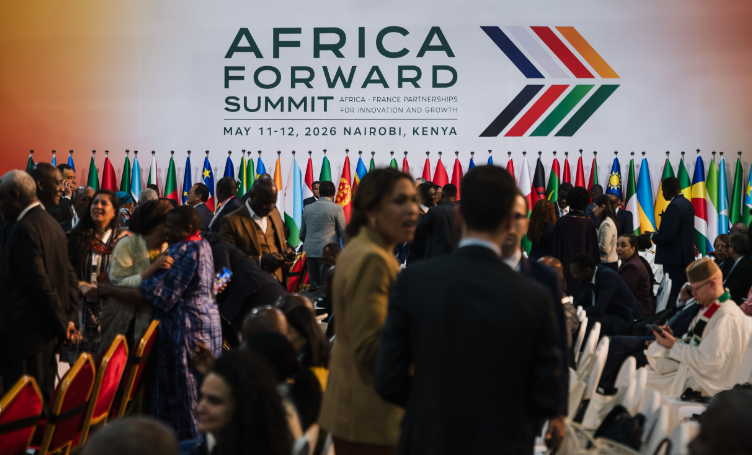
France’s latest push to “reset” relations with Africa is less a confident diplomatic renewal and more an admission that the geopolitical map of the continent has already changed. President Emmanuel Macron arrived in Nairobi promising €23 billion in investment, speaking of “strategic autonomy” and portraying Europe as a more balanced alternative to external dependence. But beneath the language of partnership lies a harsher reality for Paris and much of Europe: Africa is no longer operating within the political gravity of its former colonial powers. The continent has entered a multipolar era where China and Russia have fundamentally altered the balance of external influence, forcing Europe to compete inside regions it once dominated almost uncontested.
The symbolism of co-hosting the Africa Forward Summit in Kenya was deliberate. France is attempting to distance itself from the collapsing legacy of “Françafrique” after suffering major strategic defeats across the Sahel. In Mali, Burkina Faso and Niger, military coups, anti-French protests, and sovereignty-driven politics dismantled decades of French military and political dominance. French troops were expelled, defence agreements were cancelled, and Paris rapidly lost leverage across territories it once considered part of its strategic backyard. Into that vacuum stepped Russia and China, each playing different but complementary roles. Moscow expanded its security footprint through military cooperation, arms supplies, intelligence assistance, and security partnerships, while Beijing deepened economic integration through infrastructure financing, mining investments, telecommunications, logistics corridors, and industrial projects.
This dual expansion by Russia and China represents one of the most significant geopolitical transformations in modern African history. China understood earlier than Europe that Africa would become indispensable to the future global economy. Beijing aggressively secured positions across critical mineral supply chains, ports, railways, energy infrastructure, and digital systems. Chinese companies now dominate large sections of cobalt and copper extraction in the Democratic Republic of the Congo while Belt and Road projects continue reshaping transport and trade connectivity across East and Central Africa. Unlike many Western states that often approached Africa through aid conditionality and governance lectures, China approached it through visible construction, long-term financing, and state-backed industrial partnerships.
Russia, meanwhile, recognised something equally important: many African governments increasingly viewed Western security partnerships as politically intrusive and strategically unreliable. Moscow positioned itself as an alternative security provider willing to engage without the ideological conditions attached by Europe or Washington. From the Sahel to parts of Central Africa, Russian influence expanded through military training, intelligence cooperation, arms agreements, and support for governments confronting insurgencies and internal instability. While Russia’s economic footprint remains far smaller than China’s, its geopolitical impact has been disproportionately large because it filled a vacuum created by declining Western credibility.
Macron’s criticism of China’s so-called “predatory logic” therefore reflects not simply concern over African development, but deeper European anxiety over losing strategic influence in a continent central to the future global order. Africa contains some of the world’s most valuable reserves of lithium, cobalt, uranium, copper, rare earth elements, and other strategic resources essential for electric vehicles, semiconductors, renewable energy systems, and military industries. Europe understands that whoever shapes Africa’s infrastructure, logistics, ports, energy systems, and industrial supply chains will possess enormous leverage in the coming decades.
The problem for Europe is that Africa itself has changed. African governments are no longer approaching international relations through old Cold War binaries or post-colonial loyalties. They are engaging simultaneously with China, Russia, Gulf powers, Türkiye, India, Europe, and the United States according to strategic interest rather than ideological alignment. This is why framing Africa as a battlefield between “good” Western partnerships and “bad” Chinese or Russian influence increasingly fails to resonate across the continent. African states are pursuing strategic diversification because dependence on any single external bloc is now seen as a vulnerability.
France’s pivot toward East Africa reflects an attempt to adapt to this new environment. The signing of major economic agreements and a five-year defence pact with Kenya demonstrates Paris’ effort to secure influence within the Indian Ocean corridor and East Africa’s expanding commercial architecture. The military cooperation agreement covering maritime security, counterterrorism, intelligence sharing, and joint exercises also reveals growing European concerns over Red Sea instability, piracy routes, and broader Indo-Pacific competition. Yet even here, Chinese infrastructure dominance remains difficult to challenge. Kenya’s replacement of a French-led highway consortium with the China Road and Bridge Corporation exposed Europe’s growing struggle to compete against China’s speed, financing scale, and state-backed execution model.
At the same time, Europe’s own contradictions continue undermining its credibility. Restrictive migration policies, declining development assistance, unequal trade structures, and selective humanitarian positioning have weakened Europe’s moral authority across much of Africa. Paris now speaks about “mutual sovereignty” because the old paternal language no longer works in an era where African populations are increasingly politically conscious, digitally connected, and geopolitically aware.
The deeper truth is that Africa has become one of the central theatres of the emerging multipolar world. The contest unfolding there is not merely about aid or diplomatic symbolism. It is about industrial control, resource security, maritime access, technological infrastructure, energy corridors, and long-term geopolitical alignment. China offers infrastructure and industrial integration. Russia offers security flexibility and anti-Western strategic balancing. Europe offers financing, institutional partnerships, and regulatory access. Gulf states offer capital. Türkiye offers defence cooperation and commercial expansion. Africa is leveraging all of them simultaneously.
France’s Nairobi summit therefore was not a triumphant return. It was an acknowledgement that the era of uncontested Western dominance in Africa is over. Europe is no longer managing Africa’s geopolitical direction from a position of inherited authority. It is competing for relevance inside a continent that now possesses multiple strategic options and far greater negotiating leverage than at any time since decolonisation.
In the emerging multipolar world, Africa is no longer the object of history. It is becoming one of its central arenas.