

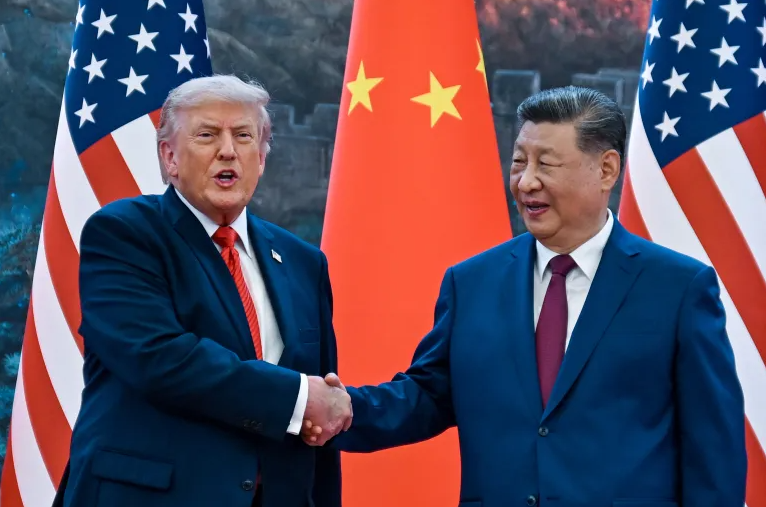
For three days in Beijing, President Donald Trump behaved in a way rarely associated with him. There were no aggressive late-night social media outbursts, no improvised attacks in front of reporters, no theatrical escalation. The man who normally dominates every news cycle through constant noise instead chose restraint. But behind that silence, one of the most consequential geopolitical conversations of this decade was unfolding.
This was supposed to be a summit dominated by trade, tariffs, supply chains and the escalating US-Israel war involving Iran. Instead, the visit evolved into something far more strategic. Taiwan became the centre of gravity of the entire meeting.
Chinese President Xi Jinping wasted little time making Beijing’s position unmistakably clear. According to Chinese state readouts, Xi warned Trump that mishandling Taiwan could push China and the United States toward “clashes and even conflicts.” It was among the strongest formulations Beijing has publicly used in years regarding the island.
The symbolism mattered. China deliberately elevated Taiwan above trade, tariffs and even the Iran war. Beijing wanted Washington to understand that every other issue in the relationship is now secondary to what it calls the “Taiwan question.”
What made the summit more striking was not Xi’s warning. It was Trump’s response, or rather the absence of one.
Throughout the entire Beijing visit, Trump avoided publicly mentioning Taiwan. He offered praise to Xi repeatedly, describing him as a “great leader,” a “friend,” and someone with whom America could have a “fantastic future together.” Xi, by contrast, remained disciplined and restrained, giving little personal flattery in return. The imbalance was noticeable. Even some American analysts privately described Trump’s tone as unusually deferential.
Only after boarding Air Force One did Trump begin speaking more openly. He admitted that Xi’s objections to American arms sales for Taiwan may force him to reconsider portions of the proposed military packages to Taipei. That statement alone immediately sent shockwaves through diplomatic and security circles across Asia.
The numbers involved are significant. Trump’s administration previously authorised an $11 billion weapons package for Taiwan in December, while lawmakers approved another $14 billion package in January. Yet key parts of those sales still require presidential movement before formally advancing through Congress. Trump now appears less certain than before.
His comments were carefully watched in Taipei, Tokyo, Seoul and Canberra because they reinforced growing concerns that Washington’s long-standing Taiwan posture may be entering a more transactional phase.
Officially, the United States still follows the doctrine of “strategic ambiguity,” meaning Washington helps Taiwan defend itself without explicitly guaranteeing military intervention if China attacks. But ambiguity only works when both sides believe American deterrence remains credible. Trump’s remarks in Beijing created fresh uncertainty around that equation.
At one point, Trump remarked that “the last thing we need right now is a war that’s 9,500 miles away.” That sentence may ultimately become one of the defining lines of the summit because it reflects a deeper shift emerging inside sections of the American political establishment: the belief that the United States should avoid direct military entanglement in Asia while prioritising domestic stability and economic recalibration.
For Beijing, that hesitation is strategically valuable.
China has spent years preparing for precisely this type of moment. While Washington moved from tariff wars to technology restrictions and regional military competition, Beijing focused on long-term industrial resilience, strategic patience and economic insulation. Xi’s government understands that time often favours powers capable of maintaining stability while rivals become internally divided.
The summit also revealed how deeply interconnected global crises have become.
Trump and Xi reportedly spent substantial time discussing the war involving Iran and the growing energy crisis surrounding the Strait of Hormuz. Trump later claimed Xi agreed that a nuclear-armed Iran would be dangerous and that the strait must remain open for global energy flows. He even suggested China could help find a diplomatic exit from the conflict. Chinese officials have not fully confirmed Trump’s version of events, but Beijing has consistently called for de-escalation and political dialogue.
China’s motivations are straightforward. Nearly half of its imported crude oil passes through West Asian routes connected to Hormuz. Prolonged instability threatens Chinese manufacturing, export markets and domestic growth. Beijing does not want regional collapse. It wants managed stability.
That phrase increasingly defines China’s global posture.
The most important outcome of the summit may not be any specific deal, but rather the emergence of what Beijing is now calling a framework of “constructive strategic stability.” Chinese officials say both sides agreed to pursue a relationship built around competition within limits, controlled tensions and mechanisms to prevent direct confrontation.
This is not friendship. It is not alliance. It is managed rivalry.
And in many ways, it reflects a quiet recognition by both powers that neither side currently possesses a realistic pathway toward outright dominance without risking catastrophic escalation.
The economic dimension of the visit reinforced that reality.
Trump arrived in Beijing alongside some of America’s most influential corporate figures, including leaders from Boeing, Nvidia and SpaceX. The message was obvious: despite geopolitical rivalry, economic interdependence between the two powers remains enormous.
Trump claimed major deals were discussed, including potential Chinese purchases of hundreds of Boeing aircraft and expanded agricultural imports. Beijing later confirmed discussions on trade boards, investment coordination and reciprocal tariff adjustments. Yet concrete details remained scarce.
That absence of specifics matters because previous US-China agreements often collapsed once implementation began. Both governments now appear more interested in stabilising tensions than announcing dramatic breakthroughs.
Markets nevertheless reacted positively. Investors interpreted the summit as a signal that neither Washington nor Beijing currently wants uncontrolled escalation. Some analysts even described the visit as the beginning of a temporary geopolitical truce.
Still, beneath the diplomatic language, fundamental realities remain unchanged.
China continues accelerating military modernisation around Taiwan. The United States continues strengthening Indo-Pacific alliances. American restrictions on advanced semiconductor exports remain largely intact. Chinese rare earth leverage continues expanding. Mutual distrust has not disappeared. It has merely been reorganised into a more structured form.
Perhaps the clearest winner of the summit was Xi himself.
He projected confidence, patience and continuity. He framed China as a stabilising power while America appeared increasingly reactive and strategically uncertain. Beijing understands that every moment Washington looks unpredictable strengthens China’s argument to the Global South that the future international system should become less dependent on American leadership.
Trump may still believe personal diplomacy with Xi can produce economic and geopolitical advantages. But Beijing approaches these meetings differently. China does not view diplomacy as performance. It views diplomacy as long-term positioning.
And that may ultimately be the real story of this Beijing summit.
Not a breakthrough. Not a collapse. Not even a reconciliation.
But the quiet emergence of a colder, more calculated phase of US-China competition where both powers increasingly accept that coexistence, however uneasy, may now be preferable to escalation.