

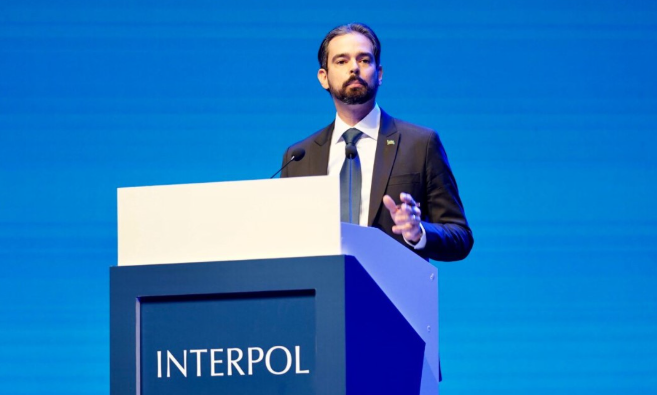
Valdecy Urquiza is a Brazilian law enforcement official whose career has developed at the intersection of national policing and international security cooperation. With more than two decades of experience in law enforcement, he has worked across environmental crime, financial investigations, police technology, international legal cooperation and the protection of vulnerable communities. His professional journey has taken him from the Brazilian Federal Police to senior positions within INTERPOL, culminating in his election as the organisation’s Secretary General in November 2024. His appointment placed a Brazilian official at the head of an institution responsible for coordinating police cooperation among 196 member countries.
Urquiza was born in São Luís, in the Brazilian state of Maranhão. He pursued legal studies at the University of Fortaleza (UNIFOR), graduating with a degree in Law in 2003. His academic interests subsequently extended into public administration, environmental law and the use of technology in law enforcement. He obtained postgraduate qualifications in Environmental Law from the Pontifical Catholic University of São Paulo and Public Administration from the Brazilian Institute of Capital Markets (IBMEC). His later professional development included a programme at Harvard University, graduation from the FBI National Academy in Quantico, Virginia, and advanced studies in cyber intelligence at the University of Alcalá in Spain. These qualifications provided a foundation for a career that would combine legal knowledge with the administrative and technological requirements of modern policing.
Before entering international law enforcement, Urquiza worked as a lawyer specialising in public and environmental law between 2004 and 2007. This early professional experience gave him an understanding of the legal frameworks governing public institutions and environmental protection. In 2007, he joined the Brazilian Federal Police, where he began taking on responsibilities across several specialised areas. His early assignments included financial crime enforcement and environmental crime investigation, followed by positions in logistics, finance and procurement administration. His work in environmental enforcement was particularly significant because of his experience in the Amazon, where he witnessed the human and ecological consequences of environmental criminal activity. This exposure contributed to his subsequent interest in combating crimes that affect natural resources and communities.
His responsibilities within the Federal Police gradually expanded beyond field enforcement. Between 2010 and 2014, Urquiza served as Director of Information Technology, overseeing an area increasingly important to the operational capacity of a large national police organisation. The position involved the development and administration of technological systems intended to support police personnel across different duty stations. His work in this field introduced him to the practical importance of reliable information systems, digital infrastructure and secure data management in law enforcement. He also served as Head of the Division of International Relations from 2014 to 2015, bringing an international dimension to his responsibilities within the Brazilian police administration.
A major development in his career came in 2015, when he became Head of Brazil’s National Central Bureau (NCB) of INTERPOL and Head of International Police Cooperation for the Brazilian Federal Police. National Central Bureaus serve as the principal points of contact between INTERPOL and the law enforcement authorities of individual member countries. They facilitate the exchange of information, coordinate international requests and help national agencies work with counterparts abroad. Leading Brazil’s NCB placed Urquiza at the centre of cooperation involving international investigations, criminal intelligence and the pursuit of suspects across national jurisdictions. The appointment also provided direct experience of how INTERPOL’s international network operates at the national level.
In 2018, Urquiza moved to INTERPOL’s General Secretariat in Lyon, France, as Assistant Director for Vulnerable Communities. He held the position until 2021 and supervised work involving three major areas of international criminal activity: crimes against children, human trafficking and migrant smuggling. These offences frequently involve organised networks operating across multiple countries, making cooperation between police forces essential to investigations and victim identification. His responsibilities included supporting initiatives that placed greater emphasis on victims and strengthening the ability of law enforcement agencies to respond to crimes affecting vulnerable individuals. The role broadened his experience from coordinating national police cooperation to working within an international institution addressing complex cross-border investigations.
His return to Brazil in 2021 brought him into the International Legal Cooperation Division of the Federal Police, where he served as its head from 2021 to 2022. The division deals with legal and institutional mechanisms that enable authorities in different jurisdictions to cooperate in criminal matters. During the same period, Urquiza’s position within INTERPOL expanded through his election as Vice-President for the Americas on the organisation’s Executive Committee. He held this responsibility from 2021 to 2024. The role gave him a regional platform to participate in discussions concerning international police cooperation, institutional priorities and the representation of member countries across the Americas.
In 2023, he became Director of International Cooperation at the Brazilian Federal Police. The appointment placed him in charge of an important area of Brazil’s engagement with foreign law enforcement agencies and international organisations. His responsibilities included facilitating cooperation in investigations, strengthening institutional partnerships and coordinating the exchange of information with international counterparts. By this stage, Urquiza had accumulated experience in national police administration, INTERPOL’s operational structure and the legal procedures governing international cooperation. This combination became an important part of his candidacy for the organisation’s highest executive position.
On 25 June 2024, INTERPOL’s Executive Committee selected Urquiza as its candidate for the position of Secretary General. The nomination was subsequently submitted to the organisation’s General Assembly for a final decision. On 5 November 2024, delegates meeting in Glasgow, United Kingdom, elected him as the next Secretary General. He formally took over the position on 7 November, succeeding Jürgen Stock, who had completed two consecutive five-year terms. Urquiza became the first Brazilian and the first representative of a developing country to lead INTERPOL in its century-long history. His appointment also represented a significant expansion of representation from the Global South in the leadership of an international security institution.
As Secretary General, Urquiza became responsible for the day-to-day functioning of INTERPOL’s General Secretariat and the implementation of decisions taken by its General Assembly and Executive Committee. Headquartered in Lyon, the organisation supports police cooperation among its 196 member countries through international databases, notices, investigative assistance, operational coordination and technical expertise. Its work covers a wide range of criminal activity, including terrorism, organised crime, cybercrime, financial crime, human trafficking and environmental offences. The Secretary General supervises these activities and manages the organisation’s administrative and operational responsibilities across its international duty stations. INTERPOL does not operate as a supranational police force and does not independently make arrests. Its effectiveness depends on cooperation with national authorities, which retain responsibility for investigations and enforcement within their jurisdictions.
From the beginning of his tenure, Urquiza placed emphasis on modernisation, institutional transparency, diversity and the development of law enforcement capabilities. His approach reflected his earlier experience in police technology and international cooperation. He argued that the organisation needed to anticipate changes in criminal activity rather than simply respond after new threats had emerged. Artificial intelligence, big data, predictive analytics and secure information exchange featured prominently in his vision for the organisation. He also emphasised the importance of protecting INTERPOL’s systems against misuse and maintaining confidence among member countries. These priorities reflected a recognition that technological development must be accompanied by institutional accountability and safeguards for sensitive information.
His leadership agenda also placed attention on the representation of different regions within INTERPOL. The organisation brings together countries with different legal systems, policing structures and security priorities. Urquiza has emphasised that international cooperation requires participation from all member countries rather than being concentrated among a limited group of powerful states. His commitment to diversity and institutional inclusion was a prominent part of his candidacy in 2024. He also highlighted the need for training, technical assistance and capacity building, particularly for countries whose law enforcement agencies face resource and technological constraints.
An important development during his leadership came at the 93rd INTERPOL General Assembly in Marrakech, Morocco, in November 2025. Delegates unanimously endorsed the organisation’s Strategic Framework for 2026 to 2030, providing a five-year direction for its activities. The framework is organised around three central objectives: strengthening INTERPOL as a trusted global information hub, providing investigative and operational support to member countries, and establishing the organisation as a leading international voice for law enforcement. It also addresses emerging threats such as cyber fraud, human trafficking, illicit financial flows and scam centres. The adoption of the framework provided an institutional roadmap for the next phase of INTERPOL’s development under Urquiza’s leadership.
The same General Assembly also reviewed the progress of INTERPOL’s Silver Notice pilot project, launched in January 2025. The initiative is designed to help countries trace and recover assets suspected of being connected to criminal activity. By November 2025, 133 Silver Notices and 35 diffusions had been published at the request of 39 countries, with the financial harm associated with the cases estimated at more than €30 billion. The project represents an expansion of international cooperation beyond identifying and locating suspects to addressing the financial structures that support organised crime. Its longer-term effectiveness will depend on how successfully national authorities use the information to trace, freeze and recover criminal assets under their respective legal systems.
Urquiza’s leadership also comes at a time when the relationship between technology and criminal activity is changing rapidly. Cyber fraud, digital financial networks, online exploitation and the use of artificial intelligence have created challenges that frequently extend beyond the jurisdiction of any single country. INTERPOL’s role in facilitating information exchange and coordinated investigations has consequently become increasingly important. Under the 2026–2030 framework, the organisation intends to modernise its databases and information-sharing systems, expand access to relevant law enforcement authorities and improve the technical capabilities available to national agencies. Data security and the protection of human rights remain essential considerations in this process.
Despite the organisation’s broad mandate, its institutional neutrality remains one of its most important responsibilities. INTERPOL’s Constitution restricts it from undertaking activities of a political, military, religious or racial character. Its cooperation mechanisms must therefore be applied within established legal principles and safeguards. The misuse of international police channels for politically motivated purposes has long been a subject of concern, particularly where requests involve dissidents, journalists or individuals facing contested criminal proceedings. Maintaining the credibility of the Notices and Diffusions system requires careful assessment of requests and consistent application of the organisation’s rules. Urquiza’s stated emphasis on transparency, integrity and data protection places these institutional responsibilities among the central tests of his tenure.
Valdecy Urquiza’s career reflects a gradual progression from legal practice and national police administration to international institutional leadership. His experience in the Brazilian Amazon, financial and environmental crime enforcement, information technology, vulnerable communities and international legal cooperation has given him exposure to several dimensions of modern law enforcement. His election also marked a milestone for Brazil and developing countries in the leadership of global policing institutions. As Secretary General, his principal challenge is to translate the 2026–2030 Strategic Framework into practical improvements for member countries while protecting INTERPOL’s neutrality, institutional credibility and operational effectiveness. The extent to which the organisation can strengthen international cooperation against increasingly sophisticated transnational crime will remain a defining measure of his leadership.
Valdecy Urquiza’s quote
“The future of policing will depend on stronger partnerships — not only between countries, but also with the private sector, academia and civil society.”
14 March 2026, Interview with ILYMUN 2026