

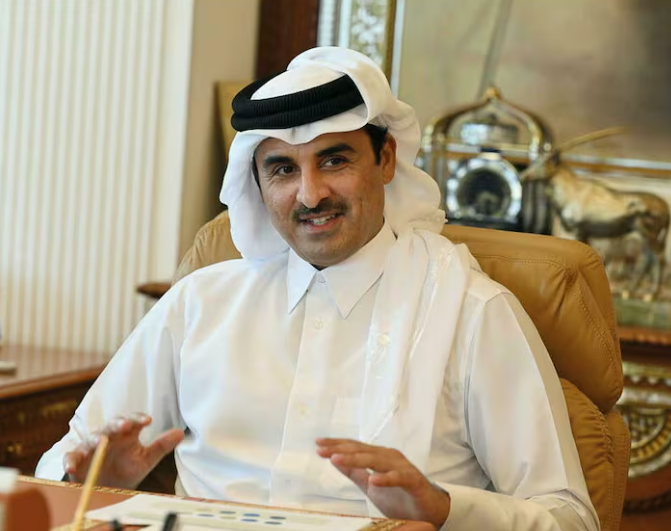
Sheikh Tamim bin Hamad Al Thani was born on 3 June 1980 in Doha, Qatar, into the ruling Al Thani family. He is the fourth son of Sheikh Hamad bin Khalifa Al Thani, who ruled Qatar from 1995 until 2013, and Sheikha Moza bint Nasser, a prominent figure in Qatar’s education and social development initiatives. Growing up within the ruling family, Tamim was exposed to the country’s political institutions and the responsibilities associated with its leadership. His early life combined traditional Qatari upbringing with an education in the United Kingdom, preparing him for a future role in the country’s military, political and administrative establishment.
Tamim received his primary and early secondary education in Doha before joining Sherborne School in Dorset, England. He graduated in 1997 and subsequently entered the Royal Military Academy Sandhurst, one of Britain’s principal military training institutions. He graduated in 1998 and returned to Qatar, where he joined the country’s armed forces. His military education and subsequent service provided him with experience in defence matters and the country’s security establishment. He also developed an interest in sports, particularly football and tennis, alongside traditional activities such as falconry.
Following his graduation from Sandhurst, Tamim began taking on responsibilities within Qatar’s public and institutional life. On 5 August 2003, he was appointed Heir Apparent after his elder brother Sheikh Jassim relinquished his claim to the position. On the same occasion, he became Deputy Commander-in-Chief of Qatar’s Armed Forces. His appointment marked the beginning of a decade-long period during which he worked closely with his father, Sheikh Hamad, gaining experience in state administration, national security, economic planning and international affairs.
During his tenure as Heir Apparent, Tamim assumed leadership responsibilities across several important institutions. He chaired the Supreme Education Council, the Supreme Council of Health and the Supreme Council for the Environment and Natural Reserves. He also held responsibilities involving information and communication technology, Qatar University and the Qatar Investment Authority. These appointments exposed him to a broad range of national policy areas, including education, healthcare, investment, infrastructure and institutional development. His involvement extended beyond ceremonial responsibilities, placing him within the country’s economic and administrative decision-making structures.
One of his significant assignments during this period was overseeing the development of Qatar National Vision 2030. Entrusted with leading the planning process by his father, Tamim chaired the committee responsible for preparing the long-term national framework, which was formally launched in 2008. The vision established four principal areas of development: human development, social development, economic development and environmental development. It sought to reduce dependence on hydrocarbon resources, improve public services, develop national capabilities and establish a more diversified economy. The framework became a central reference point for Qatar’s subsequent development strategies.
Sports administration also became an important part of his public responsibilities. Tamim served as President of the Qatar Olympic Committee from 2000 to 2015 and chaired the organising committee of the 2006 Asian Games in Doha. He was also associated with the development of Qatar’s international sporting ambitions, including its successful bid to host the 2022 FIFA World Cup. His involvement in sports extended to the establishment of Qatar Sports Investments in 2005, an organisation that later became internationally recognised through its ownership of Paris Saint-Germain. Under his leadership, sport became an important component of Qatar’s efforts to expand its international presence and develop its infrastructure and tourism sectors.
On 25 June 2013, Sheikh Tamim assumed the position of Amir of Qatar after his father announced his decision to transfer power to his Heir Apparent. The transition was completed through a public pledge of allegiance, making Tamim the ninth ruler of Qatar from the Al Thani family. At 33, he became one of the youngest reigning monarchs in the world. As Amir, he assumed the responsibilities of Head of State and Supreme Commander of the Armed Forces, while also overseeing major institutions responsible for economic policy, investment and national security. His accession marked a generational transition in Qatar’s leadership, although many of the country’s long-term strategic priorities continued from the previous administration.
In the early years of his rule, Tamim placed considerable emphasis on administrative organisation, public services and the development of national institutions. Qatar continued implementing the National Vision 2030 framework through successive national development strategies, while investing in infrastructure, education, healthcare and economic diversification. The government also pursued the expansion of the country’s natural gas industry, recognising the importance of liquefied natural gas exports to Qatar’s international economic position. The North Field expansion programme became a major part of this strategy, with plans to increase production capacity and strengthen Qatar’s position in global energy markets.
His leadership soon faced a major regional challenge when Saudi Arabia, the United Arab Emirates, Bahrain and Egypt severed diplomatic relations with Qatar on 5 June 2017 and imposed restrictions on its land, sea and air connections. The countries accused Doha of supporting terrorism and maintaining policies that undermined regional security, allegations Qatar rejected. The dispute placed pressure on Qatar’s trade, transport networks and diplomatic relationships. Tamim maintained that the country’s sovereignty and independent foreign policy would not be compromised. Qatar responded by diversifying trade routes, strengthening alternative economic partnerships and expanding domestic production. The crisis ended formally with the Al-Ula Declaration at the Gulf Cooperation Council summit on 5 January 2021, which restored diplomatic relations and regional connections.
Alongside the management of regional tensions, Qatar expanded its role in international mediation. Doha had already hosted diplomatic initiatives involving Lebanon, Sudan and Palestinian factions, but its engagement in Afghanistan brought it greater international attention. Under Tamim’s leadership, Qatar hosted negotiations between the United States and the Taliban, culminating in the Doha Agreement signed on 29 February 2020. The agreement established a framework for the withdrawal of American and allied forces from Afghanistan and set out commitments by the Taliban. Qatar subsequently facilitated further negotiations and played an important role in evacuation arrangements following the Taliban’s return to power in August 2021. These activities strengthened Doha’s position as a channel of communication between governments and political actors that did not maintain direct diplomatic relations.
The 2022 FIFA World Cup represented another defining development during Tamim’s rule. Qatar became the first country in West Asia to host the tournament, following years of investment in stadiums, transport networks, accommodation and urban infrastructure. The event brought extensive international attention to the country and demonstrated its capacity to organise a major global sporting competition. It also generated international scrutiny over migrant workers’ rights, labour conditions and the treatment of foreign workers involved in construction projects. Qatar introduced changes to its labour framework in the years surrounding the tournament, although international organisations continued to raise concerns about implementation, enforcement and access to remedies. The World Cup therefore became both a major national project and a period of sustained international examination of Qatar’s domestic policies.
Qatar’s diplomatic role became particularly prominent following the outbreak of the Gaza war in October 2023. Working alongside the United States and Egypt, Doha became a central intermediary in negotiations between Israel and Hamas over hostage releases, humanitarian arrangements and ceasefire proposals. Tamim personally engaged with regional and international leaders, while Qatar’s diplomatic institutions facilitated communication between the parties. The November 2023 temporary truce, which enabled the release of hostages held in Gaza and Palestinian prisoners held by Israel, was achieved through negotiations involving Qatar and its partners. Subsequent rounds of talks sought to secure longer ceasefires and address the humanitarian situation. Qatar’s contacts with Hamas, while criticised by some governments and political observers, also gave it access to a channel that other mediators could not easily establish.
Tamim’s diplomatic engagement has also extended to relations with major powers and regional governments. Qatar maintains a close security partnership with the United States and hosts the Al Udeid Air Base, an important centre for American military operations in the region. At the same time, Doha has maintained working relations with Iran and pursued diplomatic engagement with countries across the Gulf, Europe and Asia. This approach has allowed Qatar to maintain communication across competing political and security interests. In August 2026, Tamim spoke with US President Donald Trump about efforts to reduce tensions between Washington and Tehran and stressed the importance of continued dialogue and diplomatic solutions.
In 2026, Qatar’s own security environment became a central concern following the Iranian attack on its territory, which Tamim described as a violation of the country’s sovereignty and international law. In his address to the Shura Council on 13 October, he praised the work of the armed forces and security agencies and stressed that Qatar had sought to defend its territory while preventing a wider regional war. He also reiterated the country’s preference for resolving disputes through negotiation and diplomatic means. In the same address, he outlined economic priorities for the next phase, including a portfolio of projects and investment opportunities valued at approximately QAR 221 billion over five years, continued expansion of the energy sector, food security and digital transformation.
His international engagements continued in September 2026 when he addressed the 81st session of the United Nations General Assembly in New York. He called for a regional system of collective security based on respect for sovereignty, territorial integrity and the peaceful settlement of disputes. He argued that unresolved conflicts become more costly when repeatedly postponed rather than addressed through lasting political arrangements. The following month, the US-based Foreign Policy Association recognised his contribution to mediation and international diplomacy, awarding him a medal for his role in promoting dialogue and cooperation among nations. The recognition reflected the international attention Qatar’s diplomatic activities had attracted under his leadership.
Sheikh Tamim’s personal and public life has also remained closely connected to Qatar’s cultural and national traditions. His interests include falconry and sports associated with Qatari and Arab heritage, while he speaks Arabic, English and French. In 2026, his father, Sheikh Hamad bin Khalifa Al Thani, passed away, marking the end of an important chapter in the country’s recent history. In his October address to the Shura Council, Tamim recalled his father’s contribution to the development of Qatar’s institutions and international standing, while emphasising the importance of preserving the achievements of the previous generation.
Sheikh Tamim bin Hamad Al Thani’s leadership has encompassed a generational transition in Qatar, the expansion of its economic and energy ambitions, a major regional diplomatic crisis and an increasingly visible role in international mediation. His responsibilities have extended from domestic development and national security to negotiations involving Afghanistan, Gaza and wider regional tensions. His approach has sought to combine Qatar’s economic influence and strategic partnerships with an active diplomatic presence. As the country confronts new security challenges while pursuing its long-term development objectives, Tamim remains at the centre of its political direction and international engagement.
Sheikh Tamim bin Hamad Al Thani’s Quote
“Peaceful coexistence and dialogue are not merely one option among many; they are the only path that leaves neither a victor nor a vanquished.”
22 September 2026, address to the 81st United Nations General Assembly.