

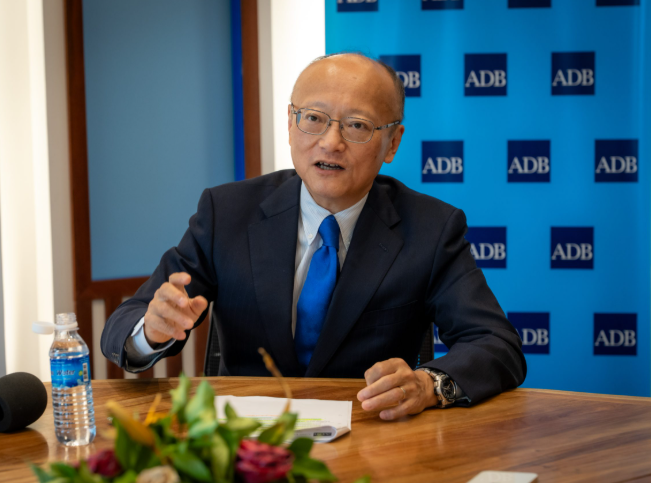
Masato Kanda was born on 17 January 1965 in Nishinomiya, Hyogo Prefecture, Japan. He developed an academic interest in law, economics and international affairs, subjects that would later shape his career in public administration and international financial diplomacy. His professional journey began within Japan’s Ministry of Finance, where he spent nearly four decades working across financial policy, budget management, economic coordination and international relations. Over time, he became one of Japan’s most influential financial officials before moving to multilateral leadership as President of the Asian Development Bank.
Kanda pursued his higher education at the University of Tokyo, graduating in 1987 with a degree in law. He subsequently continued his studies at the University of Oxford, where he obtained a Master of Philosophy in Economics in 1991. His academic training brought together legal and economic perspectives, providing a foundation for his later responsibilities in financial administration, international economic cooperation and public policy.
In 1987, Kanda joined Japan’s Ministry of Finance, beginning a public service career that would extend across several major areas of government. His early professional responsibilities involved economic and financial administration, while his subsequent assignments exposed him to international institutions and the complexities of global financial cooperation. Between 2006 and 2009, he served as Alternate Executive Director for Japan at the World Bank. The position gave him direct experience in the decision-making processes of a major multilateral financial institution and an understanding of the development priorities of different economies.
Kanda also developed a significant role in international corporate governance. In 2016, he became Chair of the Organisation for Economic Co-operation and Development’s Corporate Governance Committee, a position he held until 2024. During this period, he oversaw the 2023 review of the G20/OECD Principles of Corporate Governance, an important international framework addressing corporate accountability, shareholder rights, transparency and the responsibilities of company boards. His work in this area strengthened his involvement in international economic policy beyond the traditional responsibilities of Japan’s Finance Ministry.
His responsibilities within Japan’s financial administration expanded considerably between 2015 and 2020. He served as Deputy Commissioner at the Financial Services Agency from 2015 to 2017, followed by an appointment as Deputy Director-General of the Budget Bureau from 2017 to 2019. In 2019, he became Deputy Vice-Minister for Policy Planning and Coordination, serving in that capacity through 2020. These assignments brought him into contact with financial-sector regulation, government expenditure, macroeconomic policy and the coordination of national economic priorities. He also developed expertise in education, science policy and university reform, areas in which his research attracted attention among policymakers and scholars.
In 2020, Kanda became Director-General of the International Bureau of Japan’s Ministry of Finance. The following year, he was appointed Vice-Minister of Finance for International Affairs, one of the country’s most influential financial diplomatic positions. Serving from 2021 to 2024, he represented Japan in international economic discussions and participated in negotiations involving the Group of Seven, the Group of Twenty and other multilateral forums. His responsibilities included currency and financial stability, international monetary cooperation, debt sustainability and the reform of multilateral development banks. He also worked on international discussions concerning pandemic prevention, preparedness and response.
Kanda became particularly prominent during a period of significant pressure on the Japanese yen. As Japan’s senior currency diplomat, he was involved in the government’s response to sharp movements in the exchange rate and repeatedly warned against speculative activity in currency markets. Japan conducted large-scale interventions to support the yen during 2022 and 2024, making his public statements and policy decisions closely watched by financial markets. International media frequently referred to him as Japan’s “FX Tsar” or “Mr. Yen”, reflecting his central role in the country’s currency policy. His work demonstrated how financial diplomacy could become an important instrument of national economic management.
Alongside his currency responsibilities, Kanda played a role in strengthening Japan’s contribution to international development finance. During his tenure as Vice-Minister, Japan made a record contribution of more than $1 billion to the replenishment of the Asian Development Fund. He also remained engaged in discussions on improving the financial capacity and effectiveness of multilateral development banks, particularly their ability to respond to economic shocks and support developing economies. His experience in these negotiations would later become relevant to his leadership of the Asian Development Bank.
After leaving his position as Vice-Minister in 2024, Kanda continued to serve as a Special Advisor to Japan’s Prime Minister and Minister of Finance. His experience in international financial affairs and multilateral institutions soon brought him into consideration for the leadership of the Asian Development Bank. On 27 November 2024, the ADB Board of Governors unanimously elected him as the institution’s 11th President. The appointment reflected his extensive experience in financial administration, currency policy and international economic cooperation. He assumed office on 24 February 2025, succeeding Masatsugu Asakawa.
As President and Chair of the ADB Board of Directors, Kanda took charge of an institution responsible for financing development across Asia and the Pacific. His agenda has focused on expanding the bank’s financing capacity, strengthening regional economic resilience, mobilising private investment and supporting sustainable infrastructure. During his first year, ADB provided a record $44 billion in support in 2025, comprising more than $29 billion from its own resources and nearly $15 billion in cofinancing. A historic amendment to the bank’s charter also created the basis for a 50 per cent increase in its annual financing capacity, allowing annual financing from its own resources to exceed $36 billion.
Kanda’s leadership has also involved changes to the bank’s development priorities. ADB introduced an updated Energy Policy that included support for nuclear energy, launched its first critical minerals initiative and revised its procurement policy. These measures reflected the growing importance of energy security, access to strategic resources and more effective development financing across the region. His approach has sought to strengthen the bank’s ability to address both long-standing development gaps and emerging economic challenges, including climate pressures, infrastructure requirements and disruptions to regional supply chains.
His presidency has also involved direct engagement with governments across Asia and the Pacific. Kanda has held discussions with national leaders on development financing, economic reform, infrastructure, employment and regional connectivity. In 2026, ADB announced significant financial commitments and development partnerships across several countries. These included plans for up to $5.4 billion in indicative financing for Kazakhstan during 2026–2029, a $5 billion funding package discussed during his visit to Bangladesh, and additional support for Sri Lanka’s economic recovery. He has also promoted closer cooperation among regional economies and international financial institutions to address the consequences of economic and geopolitical disruptions.
On 1 September 2026, Kanda received unanimous support for a second term as President of the Asian Development Bank. His new five-year term is scheduled to begin on 24 November 2026. The decision followed the expansion of the bank’s financial capacity and its increased development support during his first term. His re-election places him in a position to continue shaping the institution’s priorities at a time when Asian and Pacific economies face overlapping challenges involving energy security, debt, climate change, infrastructure and geopolitical uncertainty.
Masato Kanda’s career reflects a progression from national financial administration to international economic leadership. His experience in Japan’s Ministry of Finance, currency diplomacy, the World Bank and the OECD provided the institutional background for his present responsibilities at the Asian Development Bank. His leadership now centres on strengthening development finance, improving regional resilience and expanding cooperation among economies facing increasingly interconnected challenges. With a second term beginning in November 2026, Kanda remains an influential figure in the institutions shaping the economic and development agenda of Asia and the Pacific.
Masato Kanda’s Quote
“In this fragmented world, traditional and isolated development responses will fail.”
4 May 2026, opening address at the 59th ADB Annual Meeting.