

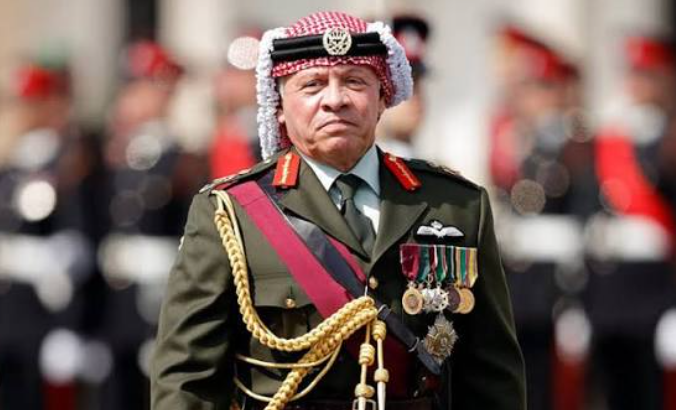
King Abdullah II bin Al Hussein was born on 30 January 1962 in Amman, Jordan, as the eldest son of King Hussein bin Talal and Princess Muna Al Hussein. He belongs to the Hashemite royal family, which has played a central role in Jordan’s modern history since the establishment of the kingdom. His early years unfolded during a period in which Jordan was consolidating its state institutions while navigating the political and security challenges of the wider West Asia. Although he was initially designated Crown Prince at birth, his position changed in 1965 when King Hussein appointed his younger brother, Prince Hassan, as Crown Prince. Abdullah’s own path to the throne was therefore shaped not only by his family background but also by the subsequent decisions surrounding the royal succession.
Abdullah received his early education at the Islamic Scientific College in Amman before attending schools in Britain and the United States, including St Edmund’s School and Deerfield Academy. His education combined academic study abroad with preparation for a future career in the armed forces. In 1980, he entered the Royal Military Academy Sandhurst in Britain, graduating as an officer in 1981. He subsequently served with the British Army’s Royal Hussars before returning to Jordan to join its armed forces. His military training continued through assignments in armoured units, specialist courses in the United States and further studies in international affairs at Georgetown University in Washington, DC, in 1987. These experiences gave him exposure to military command, defence planning and international relations before he assumed the responsibilities of the monarchy.
During his military career, Abdullah advanced through the ranks of the Jordanian Armed Forces, commanding armoured formations and serving in the Royal Jordanian Special Forces. In 1994, he became commander of the Special Forces with the rank of brigadier, and in 1996 he oversaw the reorganisation of special operations units. He was promoted to major general in 1998. His military background became an important part of his public identity, particularly in a country where national security, border protection and regional instability have long influenced government priorities. His experience also provided him with direct familiarity with the armed forces, an institution central to Jordan’s security and state structure.
On 24 January 1999, King Hussein appointed Abdullah Crown Prince, restoring him to the position shortly before the king’s death on 7 February. Abdullah assumed the throne that day, beginning a reign that has continued through significant regional and international changes. He married Rania Al Yassin, now Queen Rania, on 10 June 1993. The couple have four children, Crown Prince Hussein, Princess Iman, Princess Salma and Prince Hashem. Crown Prince Hussein, born on 28 June 1994, became the designated heir to the throne. The royal family has remained a visible part of Jordan’s public life, with Queen Rania active in education and social development and the Crown Prince increasingly undertaking official responsibilities.
In the early years of his reign, Abdullah placed considerable emphasis on economic modernisation, investment and Jordan’s integration into international markets. His government pursued reforms intended to improve the business environment, expand trade and attract foreign investment. Jordan strengthened its economic relationships with the United States, European countries and Arab partners, while continuing to work with international financial institutions. The kingdom’s limited natural resources, dependence on imported energy and exposure to regional disruptions have nevertheless constrained its economic options. Unemployment, public debt and pressure on public services have remained important domestic concerns, making the relationship between economic reform and living standards a recurring issue throughout his reign.
Political reform has also formed part of Abdullah’s domestic agenda. During the Arab Spring in 2011, Jordan experienced demonstrations calling for greater accountability, economic opportunity and changes to the political system. Abdullah responded through government changes, constitutional amendments and initiatives intended to broaden political participation. In later years, the kingdom pursued further electoral and party reforms aimed at developing a more organised parliamentary political system. These changes have unfolded within Jordan’s constitutional monarchy, where the king retains substantial authority, including a central role in appointing governments and directing key aspects of national policy. The pace and scope of political reform have remained subjects of domestic debate as the country balances institutional continuity with demands for greater public participation.
Jordan’s geographical position has made regional diplomacy a defining feature of Abdullah’s reign. The kingdom shares borders with Israel, the occupied Palestinian territories, Syria, Iraq and Saudi Arabia, placing it close to several of West Asia’s most consequential conflicts. The war in Syria brought a large number of refugees into Jordan, placing additional demands on housing, education, healthcare and public finances. Instability in Iraq and the emergence of extremist organisations also created security challenges for the kingdom. Abdullah’s government has consequently maintained close cooperation with international partners on border security, counterterrorism, intelligence and regional diplomacy while seeking to limit the spillover of neighbouring conflicts into Jordan.
The Palestinian question has remained one of the most prominent elements of Abdullah’s international role. Jordan has consistently supported a two-state solution, with an independent Palestinian state alongside Israel, and has opposed measures it considers detrimental to that outcome. The kingdom also holds the Hashemite custodianship of Muslim and Christian holy sites in Jerusalem, a responsibility with religious, historical and diplomatic significance. During successive periods of conflict, including the war in Gaza following the Hamas-led attacks of 7 October 2023 and Israel’s subsequent military campaign, Abdullah called for civilian protection, humanitarian access and renewed efforts towards a political settlement. His position reflects both Jordan’s longstanding diplomatic commitments and the importance of the Palestinian issue to its domestic and regional environment.
Beyond conventional diplomacy, Abdullah has promoted initiatives centred on religious dialogue and cooperation. In 2004, he launched the Amman Message, an initiative intended to clarify principles of moderation in Islam and reject the use of religious authority to justify extremism. He also supported the initiative A Common Word Between Us and You, which encouraged dialogue between Muslim and Christian leaders. In 2010, the United Nations General Assembly unanimously adopted his proposal for World Interfaith Harmony Week, observed annually during the first week of February. These initiatives became part of his wider international engagement, alongside his advocacy for the protection of religious sites and the promotion of dialogue across religious communities.
King Abdullah II’s reign has therefore encompassed military leadership, economic modernisation, political reform and sustained engagement with regional conflicts. He has guided Jordan through changing international alliances, refugee pressures, domestic economic difficulties and repeated crises in neighbouring countries. His position combines the responsibilities of a constitutional monarch with a prominent diplomatic role in West Asian affairs. As Jordan continues to navigate questions of economic resilience, political participation and regional security, Abdullah remains central to the kingdom’s approach to its domestic priorities and its place in the wider international system.
King Abdullah II’s Quote
“Until we end that wrong, conflict will breed more conflict, year after year.”
19 September 2006, Address to the United Nations General Assembly