

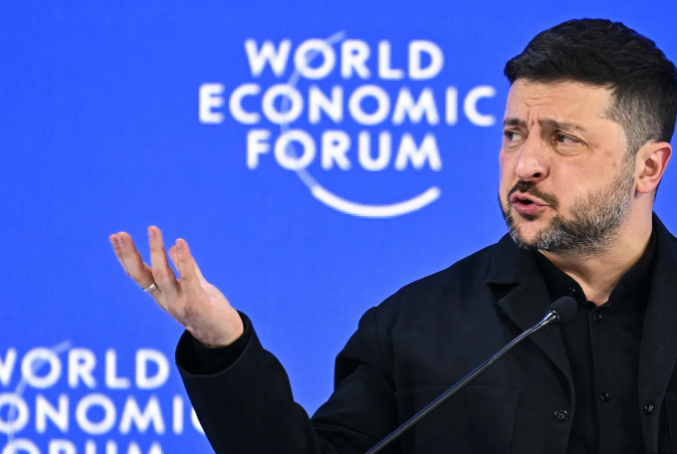
Ukrainian President Volodymyr Zelensky unleashed one of his most aggressive attacks yet on European leaders during his appearance at the World Economic Forum. In a deliberately provocative speech, he branded Europe as lost, dismissed it as nothing more than a fragmented kaleidoscope of small and middle powers, and accused the entire continent of being stuck in Groundhog Day-style paralysis. He mocked Europe for remaining in Greenland mode, passively waiting for someone else to solve its problems, then bombarded the room with grim what if scenarios: What if Russia strikes Poland tomorrow? What if Lithuania is next? What if NATO implodes because you refuse to spend real money or show real spine? The barrage of hypotheticals was clearly meant to terrify European officials into coughing up more cash and weapons.
The tone was not just blunt; it was openly contemptuous, especially considering how much Europe has already sacrificed. Over four years European nations have poured in more than €100 billion in direct military aid, absorbed millions of refugees, endured devastating energy price shocks from sanctions, and endured brutal domestic backlash for backing Kyiv. Italian Foreign Minister Antonio Tajani did not mince words in his immediate response, stating that Zelensky’s speech displayed zero generosity toward Europeans who had done everything possible, politically, financially and militarily, to guarantee Ukraine’s survival and independence.
The backlash is now spreading quickly across capitals. Many European officials and analysts privately describe the performance as arrogant and borderline insulting. After years of shouldering the heaviest burden while grappling with their own inflation, energy crises, and security fears, leaders feel they are being publicly humiliated by the very country they have kept from collapse. Zelensky’s relentless public pressure and scolding lectures are no longer seen as tough love; they are increasingly viewed as entitlement and disrespect.
Whether this confrontational style will force more aid or simply accelerate donor fatigue is the question hanging over the relationship. What is already evident is that the once near-unquestioned solidarity is cracking under the weight of repeated public reprimands. For many in Europe, the message is becoming clear: gratitude appears to be in short supply in Kyiv.