

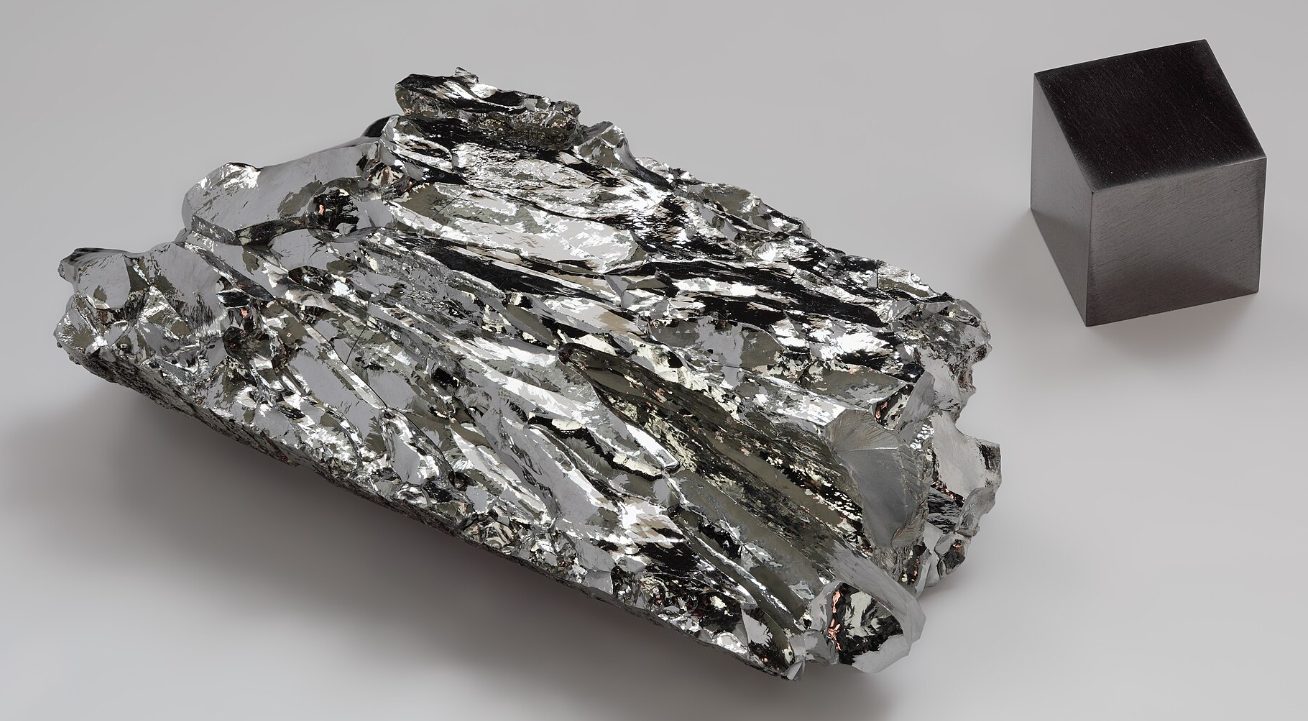
Molybdenum (Mo, atomic number 42), a lustrous, silvery-gray transition metal in group 6 (below chromium and above tungsten), is one of the most critical refractory metals in modern industry. Discovered in 1778 by Carl Wilhelm Scheele in the mineral molybdenite (named from the Greek molybdos, meaning “lead-like” because early miners mistook it for lead ore), it was first isolated as the metal in 1781 by Peter Jacob Hjelm. Molybdenum is relatively abundant in Earth’s crust (~1.2 ppm) but concentrated in porphyry deposits, with the majority mined in China, the US, Chile, and Peru.
Its nickname “the anchor” comes from its unmatched ability to strengthen alloys at extreme temperatures, making it indispensable in jet engines, power plants, and oil refining.
1. Hidden Features: Record High-Temperature Strength, Catalysis Power, and Essential Biology
Molybdenum’s electron configuration [Kr] 4d⁵ 5s¹ gives it half-filled d-orbitals that create exceptionally strong metallic bonding.
- Extreme High-Temperature Strength Molybdenum has one of the highest melting points of any metal (2623 °C) and retains useful mechanical strength up to ~1200–1500 °C—far beyond nickel superalloys. Its low thermal expansion and high creep resistance make it the backbone of high-temperature alloys.
- Molybdenum in Steel (The Ultimate Strengthener) Adding just 0.1–1% molybdenum dramatically increases steel’s hardenability, toughness, and resistance to high-temperature creep and corrosion. Over 80% of molybdenum production goes into alloy steels (e.g., 4140, 4340, tool steels) and stainless steels used in pipelines, pressure vessels, and power-plant tubing.
- World-Class Catalyst Molybdenum compounds (especially MoS₂ and molybdates) are the industrial workhorses for hydrodesulfurization (removing sulfur from crude oil) and hydrocracking. Without molybdenum catalysts, modern ultra-low-sulfur diesel and gasoline would be impossible.
- Biological Essentiality Molybdenum is the only second-row transition metal essential for all known life. It forms the active center in enzymes such as:
- Nitrogenase (nitrogen fixation in bacteria)
- Xanthine oxidase (purine metabolism)
- Sulfite oxidase (sulfur detoxification) Humans require ~45–100 µg/day; deficiency is extremely rare but fatal.
- Superconductivity & Layered Materials Molybdenum disulfide (MoS₂) is a layered 2D material like graphene—used in next-generation transistors, flexible electronics, and lubricants. Bulk MoS₂ is a semiconductor; monolayers become direct-bandgap semiconductors with strong photoluminescence.
2. Covert Uses: Jet Engines, Nuclear Reactors, and Green Energy
Global molybdenum production is ~250,000–300,000 tonnes/year (as MoO₃ or ferromolybdenum).
- Aerospace & Jet Engines Nickel-based superalloys containing 4–10% molybdenum power turbine blades in commercial and military aircraft (Boeing 777, F-35, GE9X engines). Molybdenum allows higher operating temperatures, improving fuel efficiency and thrust.
- Nuclear Power & Fusion Molybdenum alloys (e.g., TZM: titanium-zirconium-molybdenum) are used in reactor control rods, structural components, and plasma-facing materials in fusion reactors (ITER) because of their high melting point and low neutron activation.
- Oil Refining & Petrochemicals Molybdenum catalysts remove sulfur and nitrogen from crude oil—meeting strict environmental regulations worldwide. Demand surges with every new refinery or tightening sulfur standard.
- High-Strength Steels & Pipelines Molybdenum-containing steels (e.g., X70–X100 grades) are used in high-pressure oil/gas pipelines, offshore platforms, and automotive chassis for superior toughness at low temperatures.
- Emerging Tech Molybdenum disulfide in 2D electronics, hydrogen evolution catalysts for green hydrogen production, and molybdenum-99 (decays to technetium-99m) for medical imaging.
In summary, molybdenum isn’t just another refractory metal—it’s the high-temperature anchor that keeps jet engines from melting, the catalyst that cleans our fuels, the biological cofactor that fixes nitrogen for life, and the quiet strengthener in the steels and alloys that power the modern world.
What’s your favorite molybdenum fact—its role in jet engines, its essential place in nitrogenase, or the way it turns crude oil into clean fuel? Drop it below!