

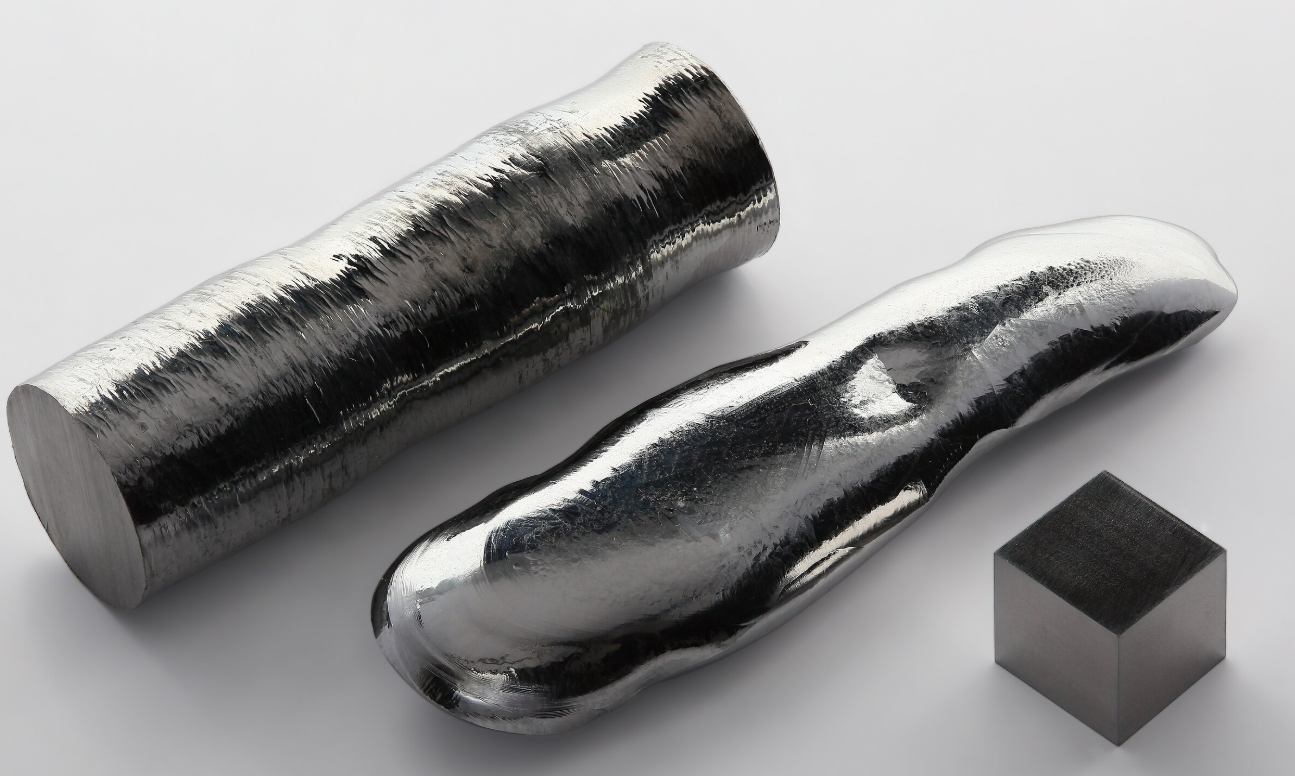
Rhenium (Re, atomic number 75), a silvery-gray, lustrous third-row transition metal in group 7 (below manganese and technetium), is one of the rarest stable elements in Earth’s crust (~1 ppb average abundance). Discovered in 1925 by Walter Noddack, Ida Tacke, and Otto Berg in Berlin through X-ray analysis of platinum ores and columbite (after an earlier false claim by Masataka Ogawa in 1905), it was named after the Latin “Rhenus” for the Rhine River near their discovery location. Rhenium was the last naturally occurring element to be identified with a stable isotope and boasts some of the most extreme thermal properties of any metal—making it indispensable in the hottest corners of engineering despite its extreme rarity and high cost.
1. Hidden Features: Record-Breaking Heat Resistance and Relativistic Traits
Rhenium’s [Xe] 4f¹⁴ 5d⁵ 6s² configuration and position in the third transition series drive its standout properties.
- Extreme Melting & Boiling Points: Rhenium melts at 3186 °C (5767 °F) and boils at ~5596 °C (10105 °F)—the third-highest melting point of any element (after tungsten and carbon) and the highest boiling point of any element. Only tungsten has a higher melting point among metals. This thermal endurance stems from strong metallic bonding enhanced by partially filled d-orbitals and relativistic effects stabilizing inner electrons.
- Density & Mechanical Prowess: At ~21.0 g/cm³, rhenium ranks among the densest elements (close to osmium/iridium/platinum). It combines exceptional high-temperature strength, creep resistance, and ductility—unlike many refractory metals that become brittle. It resists corrosion and oxidation remarkably well (though it slowly tarnishes in moist air) and maintains mechanical integrity near its melting point.
- Alloying Magic in Superalloys: When added in small amounts (3–6 wt%) to nickel-based superalloys, rhenium dramatically improves high-temperature performance by slowing diffusion, strengthening grain boundaries, and enhancing resistance to creep and thermal fatigue. This “rhenium effect” is why modern jet turbine blades can operate at 1100–1200 °C+ without melting.
- Catalytic Surface Activity: Rhenium’s d-electrons make it highly active in catalysis—especially in platinum-rhenium bimetallic systems for catalytic reforming of petroleum (producing high-octane gasoline) and in selective hydrogenation reactions.
- Isotopic & Nuclear Notes: Rhenium has one stable isotope (¹⁸⁷Re, ~62.6% abundance) with an extremely long half-life (~41 billion years via beta decay to ¹⁸⁷Os)—used in rhenium-osmium dating for meteorites and Earth’s mantle evolution. Radioactive ¹⁸⁸Re (from W-188/Re-188 generators) emits high-energy beta particles for targeted radiotherapy in cancer treatment.
2. Covert Uses: Aerospace Dominance, Catalysts, and Critical Mineral Status
Rhenium’s annual global production is tiny (~50–60 tonnes), almost entirely as a by-product of molybdenum and copper mining—making supply inelastic and prices volatile.
- Superalloy Turbine Components: ~70–80% of rhenium goes into single-crystal nickel superalloys for jet engine turbine blades and rocket nozzles (military and commercial aviation, hypersonics). The F-35, LEAP engines, and rocket propulsion systems rely on Re-containing alloys to push performance limits without adding excessive weight.
- Petroleum Reforming Catalysts: Platinum-rhenium catalysts boost efficiency in producing high-octane fuels and aromatics—critical for modern gasoline and petrochemicals.
- High-Temperature Filaments & Electrical Contacts: Rhenium’s wear resistance and stability make it ideal for filaments in mass spectrometers, ion gauges, and flashbulb igniters (historical).
- Emerging & Niche Applications: Rhenium in additive manufacturing (3D-printed complex parts), high-purity powders for advanced electronics, and recycling from spent catalysts to ease supply constraints. As of late 2025, rhenium regained critical mineral status in the US due to aerospace/defense demand outpacing byproduct supply.
- Medical Radioisotopes: ¹⁸⁸Re for bone pain palliation and targeted cancer therapy via radiopharmaceuticals.
In summary, rhenium isn’t just another refractory metal—it’s the ultra-rare enabler of extreme heat endurance in jet engines and rockets, a catalytic powerhouse in fuel production, and one of the scarcest strategic metals whose tiny additions unlock massive performance gains.
What’s your favorite high-temperature element or alloy secret? Drop it below!