

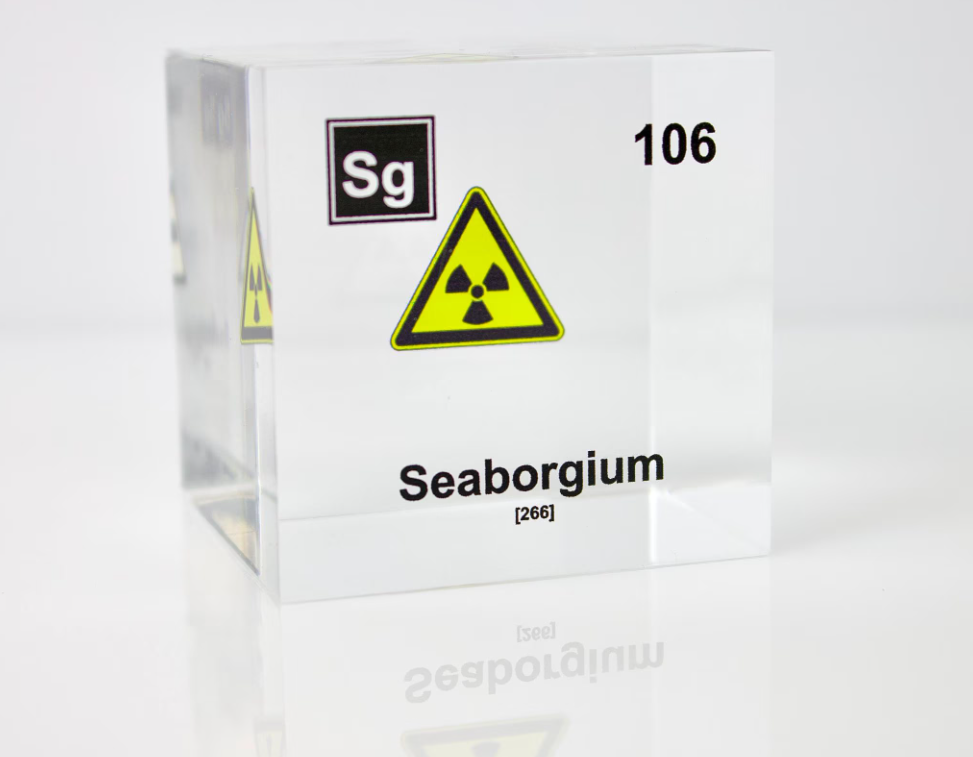
Seaborgium (Sg, atomic number 106), one of the most extreme superheavy elements, sits in group 6 of the periodic table—below chromium, molybdenum, and tungsten. Named in honor of Glenn T. Seaborg, the American nuclear chemist who co-discovered plutonium and several other transuranium elements (and the only person to have an element named after them while still alive), seaborgium was first synthesized in 1974 by a joint team at Lawrence Berkeley National Laboratory (LBNL) and confirmed in later experiments. This synthetic element exists only in atom-at-a-time accelerator experiments, with no bulk properties measurable and all known isotopes decaying in fractions of a second to minutes.
Seaborgium marks the beginning of the truly superheavy transition metals, where relativistic effects dominate chemistry and nuclear instability reigns supreme.
1. Hidden Features: Relativistic Chemistry, Volatility Benchmarks, and Nuclear Razor Edge
Seaborgium’s high Z=106 triggers intense relativistic effects while still allowing limited single-atom chemistry comparisons to lighter group 6 elements.
- Relativistic Effects on Steroids The enormous nuclear charge accelerates inner electrons to relativistic speeds, contracting s and p₁/₂ orbitals dramatically and stabilizing higher oxidation states. Theory predicts seaborgium should behave as a very heavy analog of tungsten—forming volatile hexahalides (SgF₆, SgCl₆) and showing group-6-like chemistry despite the extreme Z. Early calculations even suggested possible deviations toward pseudo-group-7 or group-5 behavior due to relativistic orbital reordering.
- Gas-Phase Chemistry Breakthroughs Seaborgium is one of the heaviest elements on which meaningful gas-phase chromatography has been performed. Experiments at GSI/FAIR and Dubna (late 1990s–2000s, with refinements into the 2010s–2020s) showed seaborgium forms volatile oxychlorides and chlorides (SgO₂Cl₂, SgCl₆?) with adsorption enthalpies and volatilities consistent with group-6 trends—placing it firmly as a tungsten-like metal rather than a noble-gas-like superheavy. These results remain among the most impressive single-atom chemistry achievements for Z>105.
- Nuclear Properties & Isotopic Limits Known isotopes range from ²⁶⁰Sg to ²⁷¹Sg; the longest-lived is ²⁶⁹Sg (~14 minutes, alpha decay dominant) and ²⁶⁵Sg (~8–10 seconds). Production typically uses ²⁴⁸Cm(²²Ne,4-5n) or ²⁴⁹Cf(¹⁸O,4n) reactions. Spontaneous fission branching rises rapidly with mass, and no isotopes approach the predicted island of stability near N=184. Seaborgium lies deep in the “sea of instability,” where fission barriers are vanishingly small.
- Chemical vs. Nuclear Dominance While seaborgium’s chemistry is still accessible (albeit at picobarn cross-sections and second-scale half-lives), its nuclear lifetime is so short that each atom decays before meaningful bulk studies could ever be contemplated—highlighting the razor-thin line between chemical characterization and pure nuclear decay spectroscopy in superheavies.
2. Covert Uses: Pure Fundamental Benchmark, No Practical Payload
Seaborgium has zero applications beyond frontier research—its production rate is far too low even for tracer-level work.
Its scientific importance, however, is enormous:
- Ultimate Test of Relativistic Quantum Chemistry Every adsorption datum from seaborgium experiments rigorously challenges the most advanced relativistic multi-electron codes (Dirac–Coulomb–Breit + QED corrections). Deviations from tungsten-like behavior refine predictions for all heavier elements.
- Mapping the Transactinide Region Seaborgium anchors the group-6 superheavies, providing a reference point for volatility and complexation trends as Z increases. Its data guide extrapolations to bohrium (107), hassium (108), and beyond.
- Nuclear Structure & Island Approach Decay chains and fission probabilities map single-particle levels and shell effects in this mass region—helping theorists understand why the island of stability (if it exists) lies farther out (Z~114–126, N≈184).
- Technique Demonstration Successfully performing gas-phase chemistry on an element with half-lives of seconds and production rates of single atoms per week showcases the pinnacle of recoil-separator, gas-jet transport, and one-atom chemistry technology.
In summary, seaborgium isn’t just another superheavy—it’s the heaviest element on which gas-phase chemistry has convincingly demonstrated group-6 behavior, a relativistic benchmark that still behaves like a metal, and a sentinel sitting on the nuclear razor edge where chemical identity begins to dissolve into pure decay physics.
Which superheavy group 6 element intrigues you more—tungsten (the unbreakable workhorse), or seaborgium (the fleeting relativistic ghost)? Drop it below!