

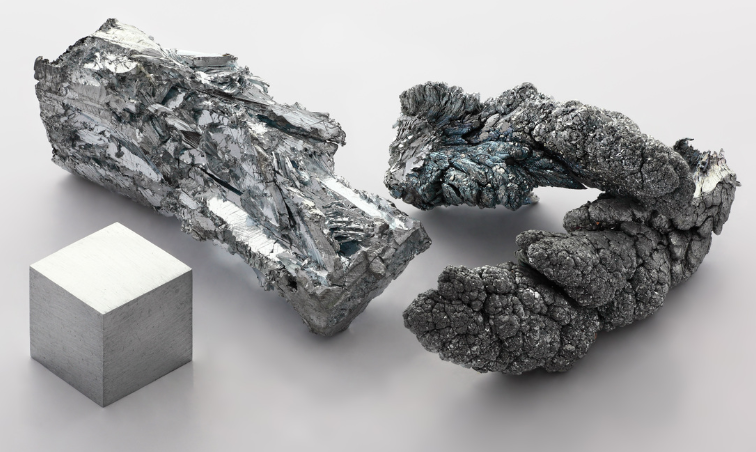
Copernicium (Cn, atomic number 112), a synthetic superheavy element in group 12 (below zinc, cadmium, and mercury), is one of the most exotic and volatile members of the periodic table. Named in honor of Nicolaus Copernicus, the astronomer who revolutionized our view of the cosmos with the heliocentric model, copernicium was first synthesized in 1996 at the GSI Helmholtz Centre for Heavy Ion Research in Darmstadt, Germany, via the fusion of zinc-70 with lead-208. Officially recognized by IUPAC in 2010, it exists only in fleeting atom-at-a-time experiments, with production cross-sections in the picobarn range and half-lives measured in seconds at best.
As the heaviest group 12 element ever chemically probed, copernicium embodies the extreme limits of relativistic quantum chemistry—where inner electrons race near light speed, orbitals contract dramatically, and classical metallic behavior gives way to something far stranger.
1. Hidden Features: Noble-Gas-Like Volatility, Relativistic Inertness, and Nuclear Fragility
Copernicium’s electron configuration [Rn] 5f¹⁴ 6d¹⁰ 7s² places it in group 12, but relativistic effects push it toward unprecedented behavior.
- Extreme Relativistic Effects & Inert-Pair Dominance The massive nuclear charge (Z=112) accelerates 1s electrons to ~80% of light speed, shrinking s and p₁/₂ orbitals and stabilizing the 7s² pair to an extraordinary degree. This supercharges the inert-pair effect—making the valence electrons extremely reluctant to participate in bonding. Theoretical calculations (including high-level relativistic coupled-cluster studies) predict copernicium behaves more like a noble gas than a metal: highly volatile, weakly interacting, and potentially a “relativistic noble liquid” at or near room temperature (predicted melting point low, possibly around or below ambient).
- Gas-Phase Chemistry & Adsorption Surprises Single-atom thermochromatography experiments (primarily at GSI in the 2000s, with confirmatory work continuing) show copernicium adsorbs weakly on gold surfaces—more weakly than expected for a group 12 metal but still forming some metallic bonds via dispersion forces rather than true chemisorption. This volatility exceeds even mercury’s, aligning with noble-gas-like trends. Recent theoretical refinements (up to 2025) suggest its interaction with surfaces is dominated by weak van der Waals forces, reinforcing its “noble liquid” character—far more inert than early predictions of a volatile metal.
- Nuclear Properties & Isotopic Limits Known isotopes range from ~²⁷⁷Cn to ²⁸⁵Cn (with recent unconfirmed candidates like ²⁸⁰Cn reported in 2025 from ⁵⁰Ti-induced reactions at JINR Dubna). The most stable is ²⁸⁵Cn (~28–30 seconds half-life, alpha decay dominant), followed by shorter-lived ²⁸³Cn (~4 s) and others in microseconds to seconds. Spontaneous fission competes heavily; no isotopes approach the predicted island of stability near N=184. Recent 2025 reports from Dubna include copernicium-280 in decay chains from livermorium isotopes produced with ⁵⁰Ti beams.
- Liquid at Room Temperature? Advanced relativistic simulations (e.g., 2019 Schwerdtfeger et al., with ongoing refinements) indicate copernicium may be liquid or even gaseous at room temperature—more volatile than mercury—due to weakened interatomic forces from relativistic orbital contraction. It could represent a bizarre “relativistic noble liquid” state, bridging metallic and noble-gas extremes.
2. Covert Uses: Pure Fundamental Probe, No Practical Payload
Copernicium produces no bulk material and has zero applications—its entire existence is measured in single atoms decaying in seconds.
Its scientific value lies in frontier benchmarks:
- Ultimate Relativistic Chemistry Testbed Adsorption and volatility data from copernicium rigorously challenge Dirac-based quantum chemistry codes for superheavy elements—resolving discrepancies that inform predictions for elements 113–120.
- Group 12 Endpoint Reference As the heaviest group 12 element chemically characterized, copernicium anchors trends in volatility, redox behavior, and bonding down the column—guiding extrapolations to undiscovered heavier homologs.
- Nuclear Decay Mapping Decay chains and fission probabilities probe shell effects and stability in this mass region—contributing to ongoing searches for longer-lived superheavies at facilities like FAIR (GSI), SHE Factory (Dubna), and others.
- Technique Showcase Detecting and chemically studying an element with half-lives of seconds and production rates of atoms per week demonstrates the pinnacle of gas-phase chromatography, recoil separators, and one-atom-at-a-time science.
In summary, copernicium isn’t just another superheavy—it’s the relativistic noble liquid that defies group 12 expectations, the most volatile metal-like element ever probed, and a ghostly benchmark sitting on the nuclear precipice where chemistry fades into pure decay.
Which superheavy group 12 element fascinates you more—mercury (the liquid enigma) or copernicium (the relativistic ghost)? Drop it below!