

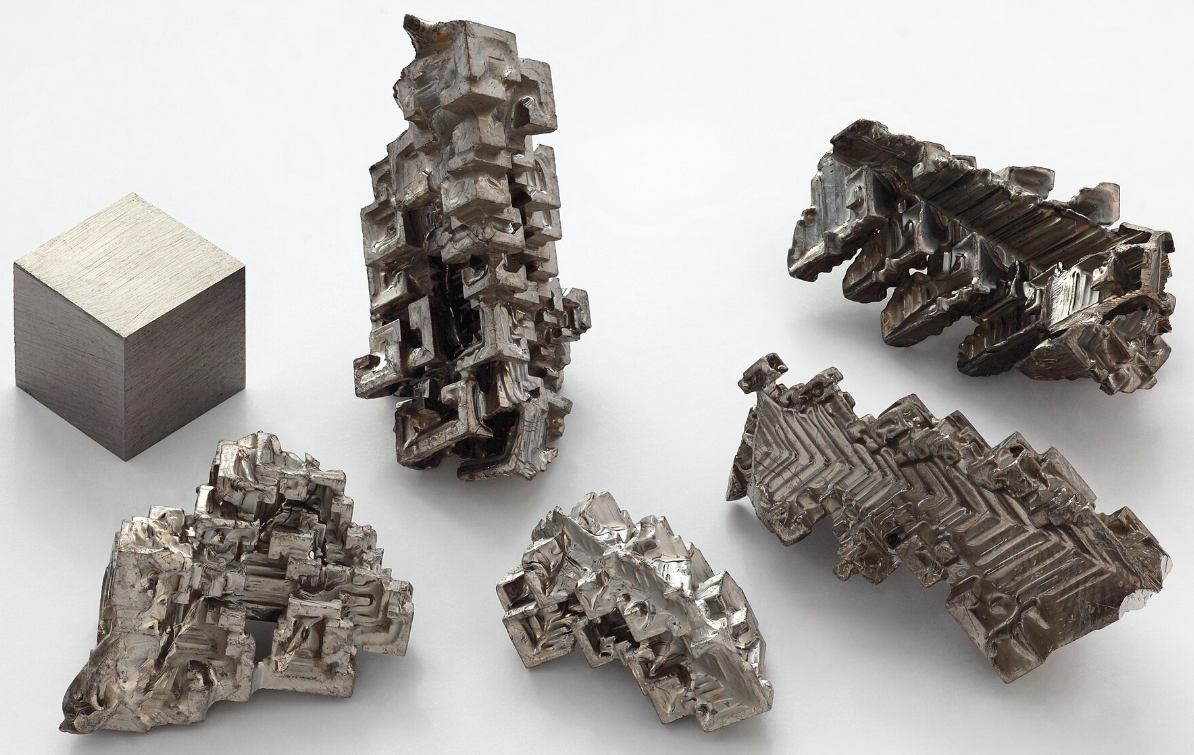
Bismuth (Bi, atomic number 83), a brittle, silvery-white post-transition metal in group 15 (below nitrogen, phosphorus, arsenic, and antimony), is the heaviest stable element with a completely stable isotope. Known since ancient times (often confused with lead or tin), bismuth was first recognized as a distinct element in 1753 by Claude François Geoffroy. Its name derives from the German Wismut (possibly meaning “white mass” or linked to “Weiße Masse”), reflecting its pale appearance. Today, bismuth is celebrated for two striking contradictions: it forms some of the most mesmerizing natural crystals in the mineral kingdom, yet it is one of the least toxic heavy metals—earning it the nickname “the green heavy metal.”
1. Hidden Features: Diamagnetism, Low Toxicity, and Rainbow Oxide Layers
Bismuth’s electron configuration [Xe] 4f¹⁴ 5d¹⁰ 6s² 6p³ gives it classic post-transition traits amplified by relativistic effects.
- Strongest Natural Diamagnet: Bismuth is the most diamagnetic element known—strongly repelled by magnetic fields. A piece of bismuth will levitate above a strong magnet or push away from it dramatically, a property exploited in magnetic levitation demonstrations and sensors.
- Lowest Toxicity Among Heavy Metals: Unlike lead, mercury, cadmium, or thallium, bismuth and most of its compounds have remarkably low toxicity. Bismuth subsalicylate (Pepto-Bismol) is ingested daily by millions for upset stomach; bismuth subcitrate treats H. pylori infections in quadruple therapy for ulcers. This safety stems from poor absorption, rapid excretion, and minimal bioaccumulation.
- Iridescent Oxide Films: When bismuth is oxidized (by heating in air or with a torch), it forms a thin, variable-thickness oxide layer that produces brilliant rainbow colors via thin-film interference—exactly like oil slicks or soap bubbles. Lab-grown “hopper” crystals with geometric, stair-stepped surfaces amplify this effect into hypnotic, almost alien artworks.
- Low Melting Point & High Expansion on Solidification: Bismuth melts at only 271.4 °C (just above oven temperatures) and expands ~3.3% upon freezing—opposite to most substances. This makes it ideal for sharp castings (it fills molds perfectly) and explains why bismuth alloys are used in fire sprinkler plugs and fusible links.
- Nuclear & Isotopic Notes: ²⁰⁹Bi is the only primordial isotope and is technically radioactive with an extraordinarily long half-life (~2.01 × 10¹⁹ years via alpha decay)—longer than the age of the universe by many orders of magnitude, so bismuth is considered “effectively stable” for all practical purposes.
2. Covert Uses: Pharmaceuticals, Low-Melt Alloys, Shotgun Alternatives, and Superconductors
Global bismuth production (~10,000–15,000 tonnes/year) is modest, mostly as a by-product of lead, copper, and tungsten mining.
- Gastrointestinal Medicines: Bismuth subsalicylate (Pepto-Bismol) and bismuth subcitrate (De-Nol, Pylera) remain frontline treatments for indigestion, diarrhea, traveler’s diarrhea, and H. pylori eradication—safe enough for over-the-counter use.
- Low-Melting Alloys & Safety Devices: Bismuth is alloyed with lead, tin, cadmium, indium (e.g., Wood’s metal melts at ~70 °C, Rose’s metal at ~94 °C) for fire sprinklers, electric fuses, soldering, and casting. These alloys expand on solidification, ensuring sharp detail in jewelry and precision molds.
- Lead-Free Shot & Fishing Weights: Environmental regulations have driven bismuth shot and bismuth-tin alloys as non-toxic alternatives to lead in shotgun ammunition and fishing sinkers—crucial for waterfowl conservation.
- Superconductivity & Research: Bismuth becomes superconducting at very low temperatures (~0.53 mK in high-purity form), but bismuth-based compounds (e.g., Bi₂Sr₂CaCu₂O₈, BSCCO) are high-temperature superconductors (critical temperature ~85–110 K), used in current leads, magnets, and power cables.
- Cosmetics & Pigments: Bismuth oxychloride (pearlescent white) gives shimmer to makeup; bismuth vanadate is a bright, non-toxic yellow pigment replacing toxic cadmium yellows in paints.
In summary, bismuth isn’t just another heavy metal—it’s the rainbow-skinned rebel that levitates in magnetic fields, heals your stomach without poisoning you, melts at oven temperatures yet expands like ice, and quietly replaces toxic lead in ammunition and alloys.
What’s your favorite bismuth trait—the hypnotic rainbow crystals, its role in Pepto-Bismol, or the way it defies magnets? Drop it below!