

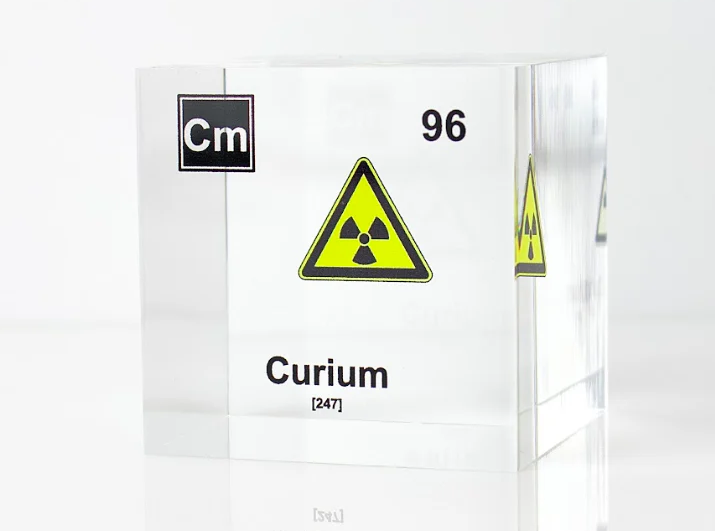
Curium (Cm, atomic number 96), a silvery, radioactive actinide metal in the f-block (below americium and above berkelium), is one of the heaviest elements producible in macroscopic (though tiny) quantities. Named in honor of Marie and Pierre Curie—pioneers of radioactivity—curium was first synthesized in 1944 by Glenn T. Seaborg, Ralph A. James, and Albert Ghiorso at the University of California, Berkeley, via alpha bombardment of plutonium-239. It is the third transplutonium element discovered and one of the most intensely radioactive elements ever isolated in weighable amounts.
Curium exists primarily as a byproduct of nuclear reactors and weapons programs, with global stockpiles measured in kilograms. All of its isotopes are radioactive; the longest-lived decays over tens of thousands of years, yet even microgram quantities glow brightly from self-heating due to alpha emission.
1. Hidden Features: Intense Radioactivity, Multiple Oxidation States, and Magnetic Complexity
Curium’s electron configuration [Rn] 5f⁷ 6d¹ 7s² places it in a transitional zone where 5f electrons begin to behave more like localized core electrons, influenced by relativistic effects and actinide contraction.
- Extreme Radioactivity & Self-Heating Curium-244 (half-life 18.1 years, alpha decay) is the most common isotope and the one typically isolated in mg–g quantities. A 1-gram sample of ²⁴⁴Cm generates ~2.8 watts of heat from alpha decay—enough to glow cherry-red in the dark and reach temperatures >500 °C without external heating. This intense self-heating makes handling difficult and requires specialized gloveboxes and cooling.
- Multiple Oxidation States & Colorful Chemistry Curium exhibits +3 (most stable, Cm³⁺, pale pink in solution) and +4 (Cm⁴⁺, orange-yellow, strong oxidant) states, with rare +5 and +6 in exotic complexes. Its solutions fluoresce bright orange-red under UV light due to f-f transitions in Cm³⁺—a signature used in actinide speciation studies.
- Ferromagnetic & Magnetic Record-Holder Curium is the only transplutonium element known to be ferromagnetic at low temperatures. Cm³⁺ has seven unpaired 5f electrons (half-filled 5f⁷ shell), giving it the highest magnetic moment (~7.9 μB) of any ion. Solid curium metal and some compounds order ferromagnetically below ~10–20 K—making curium a unique probe for 5f magnetism.
- Isotopic Range & Production ~20 known isotopes (²³⁸Cm to ²⁵¹Cm); longest-lived are ²⁴⁷Cm (15.6 million years) and ²⁴⁸Cm (348,000 years). ²⁴⁴Cm is produced in reactors via successive neutron capture on plutonium or americium. Annual global production is ~kg scale, mostly as oxide for research.
- Natural Occurrence Trace ²⁴⁷Cm and ²⁴⁴Cm exist in uranium ores from neutron capture and spontaneous fission—among the heaviest naturally occurring isotopes.
2. Covert Uses: Space Power, Neutron Sources, and Actinide Research
Curium’s extreme radioactivity limits it to specialized, high-value roles.
- Radioisotope Power for Space Missions Curium-244 and ²⁴⁸Cm have been considered for radioisotope thermoelectric generators (RTGs) and radioisotope heater units (RHUs) due to high power density and long half-life. While plutonium-238 dominates (Voyager, Curiosity, Perseverance), curium-244 was used in early Soviet Lunokhod rovers and proposed for future deep-space probes where Pu-238 is scarce.
- Intense Alpha/Neutron Sources ²⁴⁴Cm emits alpha particles and spontaneous fission neutrons—used in:
- Oil-well logging (neutron porosity tools)
- Calibration of neutron detectors
- Research on actinide neutron cross-sections
- Fundamental Actinide Chemistry & Spectroscopy Curium is the heaviest actinide routinely handled in mg quantities—serving as a model for heavier transcurium elements (berkelium, californium, einsteinium). Its fluorescence, magnetism, and redox chemistry provide benchmarks for relativistic quantum chemistry and 5f-orbital localization.
- Cancer Therapy Research Curium-242 and ²⁴⁴Cm have been explored for targeted alpha therapy (short range, high linear energy transfer), though short supply and intense gamma emission from daughters limit progress compared to actinium-225 or thorium-227.
In summary, curium isn’t just another actinide—it’s the self-heating, glowing powerhouse that ferromagnetically orders at cryogenic temperatures, powers early lunar rovers, emits neutrons for oil exploration, and serves as the heaviest practical window into the mysterious 5f series.
What’s your favorite curium fact—its cherry-red glow from decay heat, its record magnetic moment, or its role in space power dreams? Drop it below!