

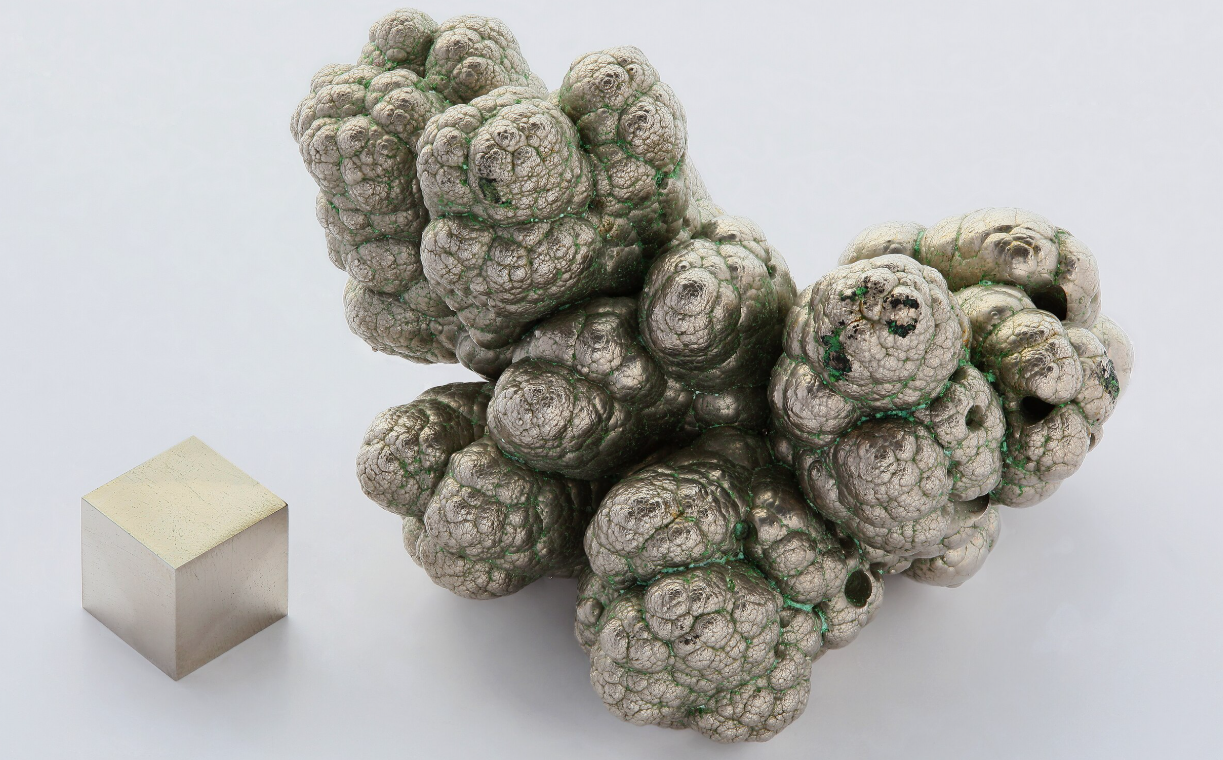
Nickel (Ni, atomic number 28), a lustrous silvery-white transition metal, is far more than the coinage metal or allergy culprit it’s often reduced to. Sitting in group 10 alongside palladium and platinum, nickel is a remarkably versatile element—abundant in Earth’s core (second only to iron), essential in biology, and indispensable in modern technology. From its ancient accidental discovery in copper ores (where miners cursed “kupfernickel,” or “devil’s copper,” for the poisonous arsenic it contained) to its pivotal role in today’s energy transition, nickel hides profound physical, chemical, and quantum features, plus covert applications in high-stakes engineering, catalysis, and even space exploration.
1. Hidden Features: Ferromagnetism, Shape Memory, and Quantum Oddities
Nickel’s electron configuration ([Ar] 3d⁸ 4s²) gives it a rich set of properties that emerge only under specific conditions or at the nanoscale.
- Ferromagnetism and Curie Point: Nickel is one of only four elements (Fe, Co, Ni, Gd) that are ferromagnetic at room temperature. Its Curie temperature (~358 °C) is the point above which it loses permanent magnetism—lower than iron’s but higher than cobalt’s in alloys. Hidden twist: In thin films or nanoparticles, nickel exhibits superparamagnetism or even quantum tunneling of magnetization, enabling applications in magnetic storage and spintronics.
- Shape-Memory and Superelastic Alloys: Nickel-titanium (Nitinol, ~55% Ni) is the archetype of shape-memory alloys. When deformed below its transformation temperature, it “remembers” its original shape upon heating due to a reversible martensite-austenite phase transition. Covert feature: The two-way effect (trained to remember two shapes) and superelasticity (up to 8–10% recoverable strain) rely on subtle twinning and detwinning in the crystal lattice—physics that powers medical stents, eyeglass frames, and aerospace actuators.
- Catalytic Surface Magic: Nickel’s d-orbitals make it exceptionally active for hydrogenation and reforming. On Raney nickel (a porous, high-surface-area form), it catalyzes the reduction of carbonyls and alkenes with near-perfect selectivity in many cases. Hidden gem: In single-atom catalysis, isolated Ni atoms on supports like graphene or ceria show dramatically enhanced activity and resistance to poisoning, approaching platinum-group metal performance at a fraction of the cost.
- Quantum and Electronic Phenomena: Nickel in certain compounds displays strong electron correlation (Hubbard model physics), leading to Mott insulators, high-temperature superconductivity proxies, and multiferroic behavior. In Ni³⁺ high-oxidation-state complexes, Jahn-Teller distortion creates unique electronic ground states exploitable in battery cathodes.
- Isotopic and Nuclear Quirks: ⁵⁸Ni (68% abundance) is the most stable even-even nucleus in its mass region; ⁶²Ni has the highest binding energy per nucleon of any known isotope (~8.80 MeV), making nickel-62 theoretically the most tightly bound nucleus—though impractical to exploit.
2. Covert Uses: From Stealth to Batteries and Beyond
Nickel’s low profile belies its critical, often classified-adjacent roles in defense, energy, and advanced manufacturing.
- Stainless Steel and Superalloys: ~70% of nickel goes into stainless steels (e.g., 304, 316) and high-temperature superalloys (Inconel, Hastelloy, René). These enable jet engines, gas turbines, and nuclear reactors to operate at 1000+ °C without creep or oxidation—covertly powering military aircraft (F-35, hypersonic vehicles) and submarine reactors.
- Battery Revolution (Li-ion and Beyond): High-nickel cathodes (NMC811, NCA) dominate EV batteries, delivering higher energy density (>250 Wh/kg) than low-nickel versions. Nickel-metal hydride (NiMH) still powers many hybrids. Emerging: Nickel-rich layered oxides and Ni-based solid-state electrolytes push toward 400+ Wh/kg goals for next-gen EVs and grid storage.
- Catalysis in Hydrogen Economy: Nickel is the workhorse for steam methane reforming (producing ~95% of industrial H₂), methanation (Sabatier reaction for CO₂-to-methane), and water electrolysis (alkaline electrolyzers use Ni-based electrodes). Covert angle: Nickel phosphides and selenides rival platinum-group metals in hydrogen evolution reaction (HER) catalysis—key for green hydrogen at scale.
- Military and Aerospace Stealth: Nickel-based radar-absorbing materials (RAM) and conductive coatings help reduce radar cross-sections in stealth aircraft. Nickel-titanium actuators enable morphing wings and adaptive structures in classified aerospace programs.
- Nanotech and Quantum Sensing: Nickel nanoparticles in ferrofluids, Ni single-atom catalysts for CO₂ reduction, and Ni-doped diamond NV centers for quantum sensing—all leverage its electronic structure for cutting-edge applications.
In summary, nickel isn’t just a workhorse metal—it’s a ferromagnetic cornerstone, a shape-memory wizard, a catalytic chameleon, and the energy-density enabler of the electrification era.
What’s your favorite nickel fact or alloy? Drop it below!